Status indicators: signal towers, indicator lights and audible alarms
Machine status indicators — signal towers (stack lights), panel indicator lights and audible alarms · IEC 60204-1 colour meanings, tiers, voltage, current per tier, sound level in dB at 1 m, IP rating, mounting
Status indicators show an operator what state a machine is in: signal towers (stack lights) of stacked coloured LED tiers, panel-mounted indicator lights, and buzzers or audible alarms driven by the machine's control outputs. Ask three things first: which colours and meanings your machine must show; the voltage and current your control outputs can drive; and how loud and how well sealed the device must be for its location.
Signal towers and stack lights, panel indicator (pilot) lights, buzzers and panel-mounted audible alarms used as machine status and warning devices, including tower buzzer modules and accessories. Rotating beacons for vehicles, fire-alarm sounders, emergency-stop devices and HMI display panels are outside this page except where compared.
CNFX editorial research · Sources checked October 11, 2026 · 4 sources
Assign colours and meanings, then choose the tiers
IDEC's LD6A signal tower datasheet reproduces the colour table of IEC 60204-1 (fifth edition, clause 10.3.2) for indicator lights: RED means emergency — a hazardous condition requiring immediate action; YELLOW means abnormal — an abnormal or impending critical condition calling for monitoring or intervention; BLUE means mandatory — a condition that requires action by the operator; GREEN means normal, with operator action optional; WHITE is neutral, for other conditions or wherever doubt exists about applying red, yellow, green or blue. The same datasheet states that indicating towers on machines should show the colours from the top down in the order red, yellow, blue, green, white. [1]
The LD6A stacks up to 5 LED units in red, yellow, blue, green and pure white on a ø40 × 60 mm oval body, with frame, wall, direct and pole mounting; approximate weight runs from 180 g for 1 tier to 340 g for 5 tiers. [1] Patlite's LR6 is a φ60 mm tower offered from 1 to 5 tiers in red, amber, green, blue and white, steady or flashing at 60 ±2 flashes per minute, with a 7-colour multi-colour LED module (LR6-E-MZ) and a twist-and-lock modular design. [2]
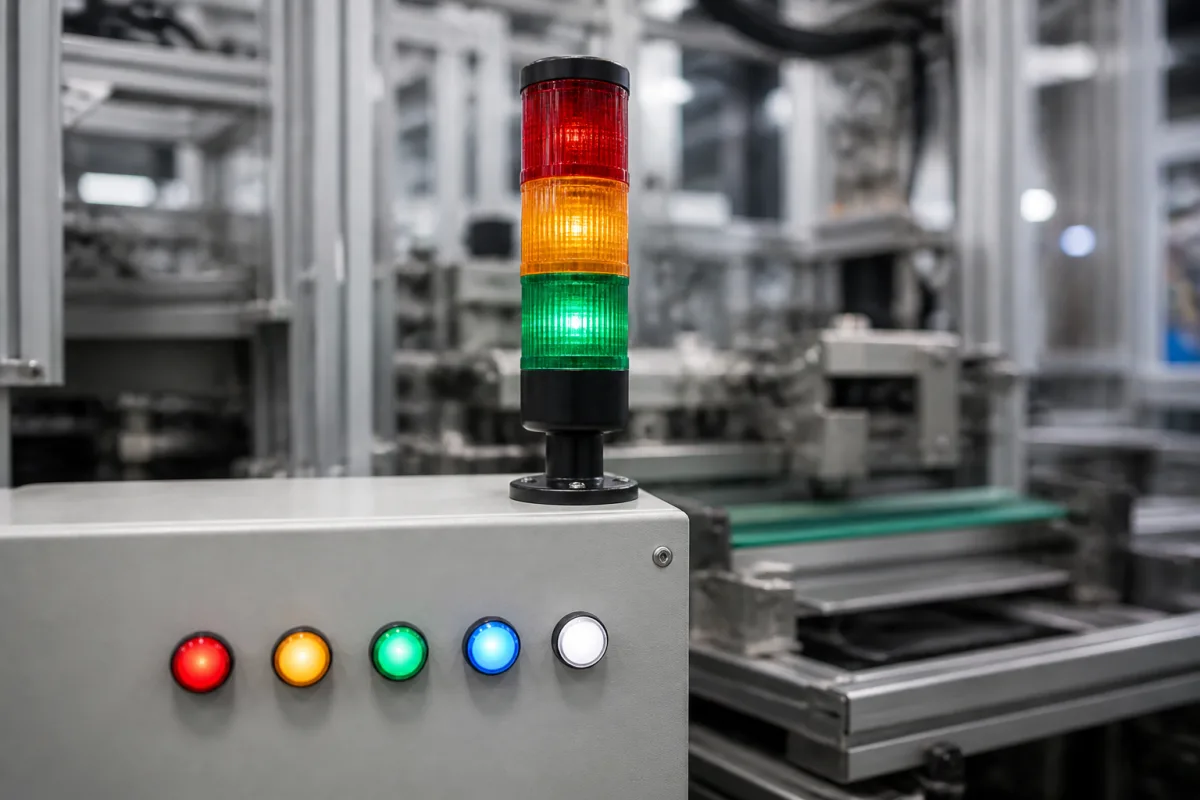
Editorial note: the image on this page shows a three-tier red, amber and green tower; confirm with your machine's safety documentation which conditions each tier signals before fixing the colour order.
Give the supplier the colour order from the top, the condition each tier signals, steady or flashing per tier, whether a buzzer is needed and its sound pattern, the supply voltage (AC or DC) and control output type (NPN, PNP, relay), body diameter, mounting method (direct, pole, bracket, panel cutout), location (indoor, outdoor, washdown), IP rating, connector or cable, approvals and quantities.
02
Check voltage, current, sound level and protection
The LD6A runs on 24 V AC/DC ±10% with a rated current per tier of 25 mA (red, yellow), 30 mA (blue, green) and 20 mA (white), and power per tier of 0.6 W, 0.75 W and 0.5 W; it is rated IP65 (IEC 60529), −25 to +55 °C and 45 to 85% RH without condensation, with an LED life of approx. 30,000 hours to 50% of initial brightness. [1] Patlite's LR6 is offered for 24 V DC or 100–240 V AC (off-white only); each LED unit draws typ. 40 mA / 1 W and max. 45 mA / 1.3 W, and the buzzer unit max. 250 mA / 1.3 W; it is rated IP65 (IEC 60529) and NEMA Type 4X, 13 (LJ type IP54), for indoor use, −20 to +50 °C. [2]
Sound level is quoted at 1 m. The LR6 buzzer gives typ. 88 dB measured from all directions at 1 m with sound No. 4, with approx. −10 dB reduction set by DIP switch and 4 patterns: rapid intermittent beep and continuous beep at 3378 Hz, rapid hi-lo at 2016 Hz and 3012 Hz, and a 1000–4032 Hz sweep; Patlite lists 85 dB for LR4 and LR5 and 90 dB for LR7 towers. [2] For panel mounting, Patlite's BD audible alarm gives up to 98 dB (typ.) in a 54.0 mm-deep body, is rated IP65 for the product itself — panel sealing depends on installation — holds 32 built-in sounds selected by DIP switch and bit input, and comes in 12–24 V DC (NPN or PNP) and 100–240 V AC (NPN) models. [3]
Editorial calculation: a 5-tier LD6A in red, yellow, blue, green and white draws 25 + 25 + 30 + 30 + 20 = 130 mA and 0.6 + 0.6 + 0.75 + 0.75 + 0.5 = 3.2 W with all tiers lit; a 5-tier LR6 with buzzer can draw up to 5 × 45 + 250 = 475 mA across its signal wires, so check each control output's rating per tier. [1][2]
Editorial calculation: the BD's 98 dB is 10 dB above the LR6 buzzer's 88 dB, and the LR6's −10 dB setting brings it to about 78 dB; compare only figures stated at the same distance. [3][2]
03
Specify a panel pilot light by hole size, enclosure type and shock
Rockwell Automation's product page for the Allen-Bradley 800FD-P4N3 describes a 22 mm pilot light in monolithic plastic with a red, round, diffuse cap, an integrated LED illumination module for 24V AC/DC, a latch-mounted illumination module and screw terminals. It lists a hole diameter of 22.5 mm, enclosure compatibility of IP66, Type 3/3R/4/4X/12/13, shock of 100 G, vibration of 10 G maximum, and humidity of ≤95% RH from 25 to 60 °C (77 to 140 °F). [4]
These figures cover the panel indicator light that the signal-tower datasheets above leave open. The page gives no current draw or LED life for this catalogue number, so ask the supplier for the mA per lamp at 24 V and the life-test basis before comparing it with the LD6A's approx. 30,000 hours to 50% brightness. [4][1]
Editorial note: specify the colour per lamp from the IEC 60204-1 table above, and check that the enclosure type listed for the operator matches the rating of the panel it is fitted to.
04
Signal tower, tower buzzer, panel alarm and pilot light examples
ONPOW lists plastic signal lamps and Tayee lists AD17 indicator lamps; the table sets one published example per device type against what to ask a supplier.
When requesting quotations, ask each supplier for the colour and tier options, voltage and current per tier, sound level at 1 m, IP rating, mounting drawings and samples.
Device
Published example
Ask the supplier for
Signal tower (stack light)
1–5 tiers, φ60 mm, 24 V DC or 100–240 V AC, IP65. [2]
Colour per tier, voltage, mA per tier, dB at 1 m, IP code and cutout for an indicator order
Current per tier differs by maker, 20–30 mA on IDEC's LD6A and up to 45 mA on Patlite's LR6, so size the control outputs for the device actually ordered. [1][2]
Field
What it means and published values
Ask the supplier for
Colour meanings
IEC 60204-1: red emergency, yellow abnormal, blue mandatory, green normal, white neutral. [1]
2 companies list this product among what they make. Company figures are quoted from each
company's own website; every card states where the relationship came from.
Explore company information and manufacturing capabilities, then discuss the scope of your project with a relevant supplier.
Share this page
Compiled and source-reviewed by the CNFX editorial team.
Each manufacturer above links to the page on that company's own website where the product is listed, with the date we checked it. How we source and review
· Page last updated 13 October 2026
Buyer questions
What do signal tower colours mean?
IDEC's datasheet quotes IEC 60204-1: red emergency, yellow abnormal, blue mandatory, green normal and white neutral, stacked in that order from the top. [1]
How loud is a signal tower buzzer?
Patlite lists typ. 88 dB at 1 m for its LR6 tower buzzer, with a setting about 10 dB quieter. [2]
Can an audible alarm be mounted in a control panel?
Patlite's BD panel-mount alarm gives up to 98 dB (typ.) in a 54.0 mm-deep IP65 body; panel sealing depends on installation. [3]
What hole size does a 22 mm panel pilot light need?
Rockwell Automation lists a 22.5 mm hole diameter for its Allen-Bradley 800FD-P4N3 24V AC/DC LED pilot light, with IP66 and Type 3/3R/4/4X/12/13 enclosure compatibility. [4]
Sources and what still needs a direct check
Sources checked 2026-10-11. All four sources are maker documents: an IDEC signal tower datasheet hosted by a distributor, two Patlite product pages and a Rockwell Automation product page for an Allen-Bradley pilot light.