Editorial Technical Reference

Industrial Washing Machine Drum Forming Press

This page explains how Industrial Washing Machine Drum Forming Press is classified within Manufacture of Domestic Appliances. Technical values and manufacturer relationships are research references; confirm the current specification and supplier evidence for each order.

Technical Definition & Core Assembly

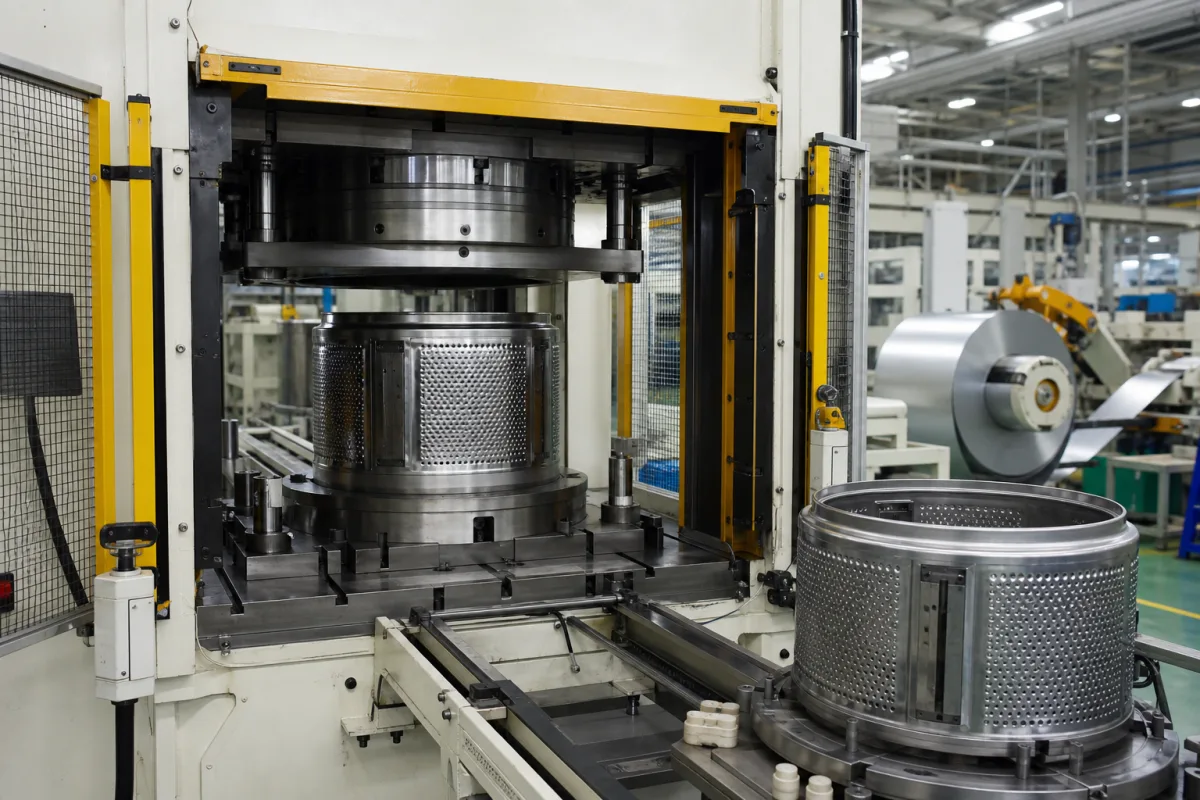
This industrial hydraulic press is engineered for high-volume production of washing machine drums.

Industrial Washing Machine Drum Forming Press in a manufacturing environment
Representative product image. Confirm appearance and specifications with the manufacturer.

Product Specifications

Technical details and manufacturing context for Industrial Washing Machine Drum Forming Press

Definition
This industrial hydraulic press is engineered for high-volume production of washing machine drums. It transforms flat sheet metal blanks into cylindrical drum shapes required for domestic washing appliances. Operating within appliance manufacturing assembly lines, it ensures consistent dimensional accuracy and structural integrity for critical laundry appliance components. The equipment is essential for B2B suppliers serving major appliance OEMs with reliable, high-throughput drum production capabilities. The press uses a hydraulic ram to apply controlled, high pressure to a sheet metal blank positioned between precision-matched male and female dies, permanently deforming the metal into the desired drum shape. Key parameters include a maximum forming force of 2000–5000 kN, work table size of 1200×1200–2000×2000 mm, daylight opening of 600–1200 mm, ram stroke length of 400–800 mm, motor power of 15–45 kW, forming speed of 50–150 mm/s, positioning accuracy of ±0.05 mm, electrical supply of 380/50–480/60 V/Hz (IEC 60038), operating temperature of 5–40 °C, noise level ≤80 dB(A) (ISO 3746), machine weight of 15–30 t, and overall dimensions of 3000×2500×3500–5000×4000×5000 mm. Materials on file include high-strength steel alloy and hardened tool steel. These values are reference ranges and must be verified with the legal manufacturer or supplier for specific models and applications. The press is designed for integration into automated production lines, with interfaces for control systems and safety devices. Selection inputs include required drum dimensions, material thickness, production volume, and available floor space. Verification questions should address actual forming force, die compatibility, and compliance with relevant standards. Maintenance signals include hydraulic fluid contamination, pressure drops, and unusual noise. Failure boundaries include exceeding maximum force or stroke limits, which can damage dies or the press structure.
Working Principle
A hydraulic ram applies controlled, high pressure to a sheet metal blank positioned between precision-matched male and female dies, permanently deforming the metal into the desired drum shape. The press cycle involves clamping the blank, advancing the ram at a controlled speed, and releasing after forming. The hydraulic system provides consistent force and speed, ensuring repeatable part quality. The dies are made from hardened tool steel to withstand repeated use. The press is designed for high-volume production, with automated material handling and control systems to optimize cycle times.
Common Materials
High-Strength Steel Alloy, Hardened Tool Steel
Technical Parameters
ParameterTypical rangeNotes & selection driver
Maximum Forming ForceRequired2000–5000 kNPeak hydraulic ram force output
Work Table SizeRequired1200×1200–2000×2000 mmDimensions of the die mounting surface
Daylight OpeningRequired600–1200 mmMaximum vertical clearance between platens
Ram Stroke LengthRequired400–800 mmTotal vertical travel distance of the press ram
Motor PowerRequired15–45 kWRated power of the main hydraulic pump motor
Forming Speed50–150 mm/sAffects cycle time and material flow.
Positioning Accuracy±0.05 mmEnsures consistent drum dimensions.
Electrical Supply380/50–480/60 V/HzThree-phase; voltage and frequency options.IEC 60038
Operating Temperature5–40 °CHydraulic oil viscosity range.
Noise Level≤80 dB(A)Compliance with workplace safety regulations.ISO 3746
Machine Weight15–30 tAffects foundation and installation requirements.
Overall Dimensions (L×W×H)3000×2500×3500–5000×4000×5000 mmCheck workshop space and transport constraints.

Ranges are indicative industry figures for RFQ preparation, not a supplier commitment. Confirm every value and standard with the legal manufacturer before ordering.

Components / BOM
  • Main Hydraulic Cylinder
    Generates the primary pressing force via hydraulic pressure
    Material: Hardened Steel with Chrome-Plated Rod
  • Upper and Lower Platens Part
    Provide mounting surfaces for the forming dies and distribute force
    Material: Stress-Relieved Cast Steel
  • Hydraulic Power Unit
    Generates and regulates hydraulic fluid pressure for the system
    Material: Steel Housing with Internal Components
  • Programmable Logic Controller
    Controls press cycle sequencing, safety interlocks, and operator interface
    Material: Electronic Components in Enclosure

Industry Taxonomies & Aliases

Commonly used trade names and technical identifiers for Industrial Washing Machine Drum Forming Press.

Industrial Ecosystem & Supply Chain Structure

Complementary Systems
Downstream Applications
Specialized Tooling

Application Fit & Sizing Matrix

Operational Limits
pressure: Up to 500 bar hydraulic system pressure
other spec: Sheet metal thickness: 0.5-3.0 mm, Cycle time: 30-120 seconds, Maximum forming force: 2000-5000 kN
temperature: Ambient to 150°C (for heated forming processes)
Media Compatibility
✓ Stainless steel sheets (304/316 grade) ✓ Galvanized steel sheets ✓ Aluminum alloy sheets
Unsuitable: Corrosive chemical environments (e.g., acid baths, chlorine-rich atmospheres)
Sizing Data Required
  • Required annual production volume (units/year)
  • Maximum drum diameter and depth dimensions (mm)
  • Sheet metal material grade and thickness (mm)

Reliability & Engineering Risk Analysis

Failure Mode & Root Cause
Hydraulic cylinder seal failure
Cause: Contamination of hydraulic fluid with particulate matter leading to abrasive wear, compounded by high-pressure cycling causing seal extrusion and fatigue
Ram guideway misalignment
Cause: Uneven loading during forming operations causing asymmetric wear on linear bearings, exacerbated by inadequate lubrication and thermal expansion differentials
Maintenance Indicators
  • Audible knocking or grinding during ram descent indicating bearing wear or misalignment
  • Visible hydraulic fluid leakage around cylinder seals or fittings, especially during pressure cycles
Engineering Tips
  • Implement condition-based monitoring with vibration analysis on ram guides and pressure transducers on hydraulic circuits to detect early degradation
  • Establish strict contamination control protocols for hydraulic fluid including scheduled filtration and particle count analysis, coupled with precision alignment checks after major maintenance events

Indicative industry ranges for design and RFQ preparation. Confirm the exact figures and applicable standard with the manufacturer before specifying.

Compliance & Manufacturing Standards

Applicable Standards
ISO 12100:2010 - Safety of machinery ANSI B11.0-2020 - Safety of machinery CE Marking - Machinery Directive 2006/42/EC

Quoted from the published standard.

Manufacturing Precision
  • Drum bore diameter: +/-0.05mm
  • Press plate parallelism: 0.08mm across full surface
Quality Inspection
  • Dimensional verification with CMM (Coordinate Measuring Machine)
  • Ultrasonic testing for material integrity and weld quality

Manufacturers of Industrial Washing Machine Drum Forming Press

Manufacturer profiles associated with Industrial Washing Machine Drum Forming Press.

Sourcing Industrial Washing Machine Drum Forming Press from China?
Tell us your specification and target quantity — we will match it against manufacturer records and come back with the factories that fit.
Request manufacturers We manufacture this

Manufacturer listings support early research and capability understanding. They are not certification, ranking, or transaction guarantees.

Share this page
Technical documentation
Request current drawings, revision history, and a signed specification sheet.
Manufacturing capability
Verify equipment lists, process limits, capacity, and representative production evidence.
Inspection readiness
Confirm test methods, calibrated equipment, sampling plans, and traceable reports.
Supplier transparency
Check the legal entity, factory address, ownership, certifications, and direct contacts.

CNFX does not score or rank suppliers. Buyers must verify all claims and documents with the legal manufacturer before ordering.

Frequently Asked Questions

What is the maximum forming force of this press?

The maximum forming force is in the range of 2000–5000 kN, as listed in the directory. However, the exact value depends on the specific model and configuration. You must verify the actual force rating with the legal manufacturer or supplier for your intended application.

What materials can be formed with this press?

The press is designed to form sheet metal blanks, typically made of high-strength steel alloy. The dies are made of hardened tool steel. The specific material grade and thickness must be confirmed with the manufacturer to ensure compatibility with the press's capacity and die design.

What are the electrical supply requirements?

The electrical supply is three-phase, with voltage and frequency options of 380/50 to 480/60 V/Hz, according to IEC 60038. However, the actual electrical requirements may vary by model and installation location. Always check the nameplate and consult the manufacturer for precise specifications.

How is the press's noise level controlled?

The noise level is specified as ≤80 dB(A) according to ISO 3746. This is a reference value that should be verified for the specific model. The press may include noise reduction features, but actual noise levels depend on installation and operating conditions. Ensure compliance with local workplace safety regulations.

Data Basis

Editorial classification, named public sources where available, and source-reviewed manufacturer records.

Preliminary Technical Classification
This page supports structured research, RFQ preparation, and supplier evaluation. It does not replace buyer-led supplier qualification, standards review, or technical approval.
Buyer enquiry

Request manufacturing insight for Industrial Washing Machine Drum Forming Press

Ask for use case, specification boundaries, supplier type, and RFQ preparation information for this product.

Where it goes
Straight to the CNFX editorial desk, and to the manufacturer if this product is linked to a claimed profile. Nothing is broadcast to a supplier list.
Your details stay here
We do not sell or rent enquiry data, and we do not add you to a mailing list. Used only to answer this request.
No commission, no middleman
CNFX is a directory. We take no cut of any order and never negotiate on a supplier's behalf.
What we don't claim
A listing is not an endorsement. Qualify every supplier and verify every figure yourself before ordering.

Your business information is used only to process this request.

Thank you! Your message has been sent. We'll respond within 1–3 business days.
Sorry, we couldn't send your message. Please try again, or email us at [email protected].

Need to Manufacture Industrial Washing Machine Drum Forming Press?

Compare manufacturer profiles with relevant product and process capability.

Previous Product
Refrigerator Evaporator Fan Motor
Last Product
Get QuotesChat