Medium-voltage switching · Insulation levels and altitude, arc control and contact erosion, vacuum integrity testing
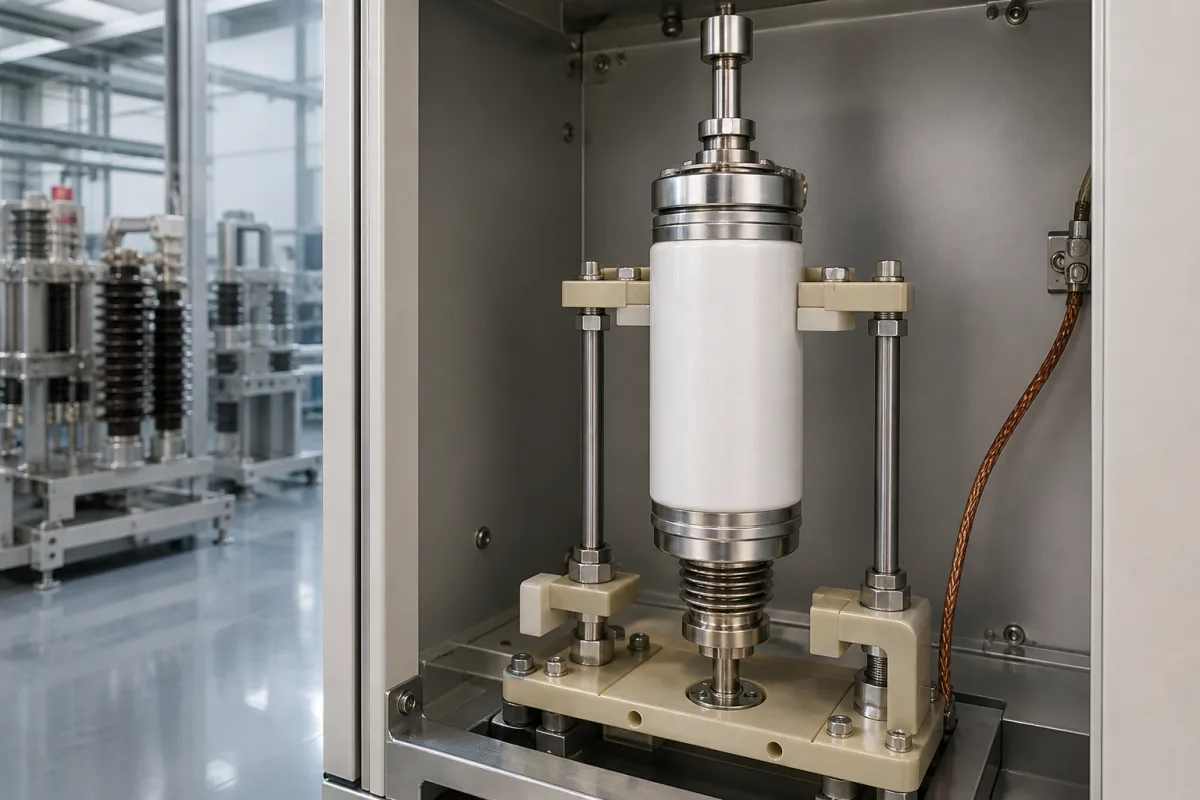
A medium-voltage vacuum interrupter is the sealed ceramic switching chamber inside a vacuum circuit-breaker, contactor or recloser: contacts open inside a high vacuum, and a metal bellows lets the moving contact travel without breaking the seal. Ask three things first: the rated voltage, insulation levels and breaking current it is type-tested for in your breaker, how contact erosion and wear are tracked over its life, and how its vacuum integrity can be tested in service.
Vacuum interrupters (vacuum bottles) for medium-voltage circuit-breakers, contactors, load-break switches and reclosers. Complete circuit-breakers and switchgear, vacuum interrupter test sets and low-voltage contactors are outside this page.
CNFX editorial research · Sources checked October 12, 2026 · 4 sources
Match the insulation levels and correct for altitude
ABB's VD4 technical catalogue lists 12 kV circuit-breakers to IEC 62271-100 with 28 kV power-frequency (1 min) and 75 kV lightning-impulse withstand, 63 kA breaking current, opening time ≤45 ms, arcing time ≤15 ms and an operating range of −5 to +40 °C; its 36 kV ratings are 95 kV and 185 kV. [1]
ABB notes that air insulation weakens with altitude, so external insulation of apparatus installed above 1000 m needs a correction, while the interrupter's internal insulation is unaffected because it relies on vacuum. The catalogue applies an altitude correction factor Ka: at 2000 m with 12 kV service voltage, Ka = 1.13 raises the required test values to 28 × 1.13 = 31.6 kV rms and 75 × 1.13 = 84.7 kV peak at sea level, so ABB concludes a 17.5 kV-rated breaker with 38 kV and 95 kV insulation levels is needed. [1]
Editorial note: the interrupter is type-tested together with its pole and mechanism, so ask for type-test reports that cover the interrupter in the breaker or contactor you will build, not the bottle alone.
Give the supplier the rated voltage, insulation levels, rated current, short-circuit breaking current, the application (breaker, contactor, recloser, load-break switch), switching duty such as capacitor or motor switching, mechanical and electrical life required, installation altitude and ambient, and the mounting and terminal dimensions.
02
Understand arc control and contact erosion
ABB explains that the vacuum arc consists only of melted and vaporised contact material. At rated current the arc is diffuse and erosion very limited; above the rated value it writes that “Starting at the anode, the arc contracts”, so spiral contacts create a magnetic field that rotates the arc over a wider surface, limiting thermal stress and erosion. The interrupter restores dielectric strength within microseconds of current zero. [1]
ABB's interrupter drawing shows the stem, twist protection, bellows, housing, shields, ceramic insulator and contacts. In the operating mechanism, closing springs apply contact force, and the available overtravel is higher than the maximum contact erosion over the interrupter's life. [1] Editorial note: ask the supplier for the erosion limit and how wear is indicated or measured, because overtravel and contact force fall as contacts erode.
Ghorit's data sheet for its TD-12/1250-25 interrupter (12 kV, 1,250 A, 25 kA) shows the mechanical values a breaker designer must match: 9 ± 1 mm clearance between open contacts, average opening speed 1.1 ± 0.2 m/s and closing speed 0.7 ± 0.2 m/s, rated contact pressure 2,000 ± 200 N, a self-closing force from bellows and atmosphere of 110 ± 30 N, and 190 ± 30 N counterforce at full stroke. It gives a contact limit erosion of 3 mm, circuit resistance below 25 µΩ at minimum rated contact force, mechanical endurance of 10,000 operations, 30 short-circuit making operations and a 20-year storage life. [3]
Editorial calculation: with 9 mm of open gap at an average 1.1 m/s, the contacts take about 8 ms to travel fully open (9 ÷ 1.1); the 3 mm erosion limit is a third of that gap, so ask how the mechanism or wear indicator shows remaining contact wear. [3]
03
Check vacuum integrity in service
Megger's VIDAR datasheet explains that interrupter vacuum does not last forever: leakage can begin after years or decades, and Megger writes that "in most cases, the leakage process is rapid once it has started", leaving a breaker that cannot interrupt reliably. Its test applies a DC voltage across the open contacts and checks for flashover, because flashover voltage falls as internal pressure rises; normal internal pressure is below 10⁻² mbar. [2]
Megger states that the breaker maker should specify an AC test voltage, otherwise standards give it; the equivalent DC test voltage equals the peak of the AC voltage, the DC method is described in IEEE C37.20.3, and IEC 62271-1 and IEEE C37.06 give guidance on test voltage. The tester offers 10, 14, 25, 40 and 60 kV DC and flags a defect above 0.3 mA. [2]
Editorial calculation: a 28 kV rms power-frequency test corresponds to a DC test of 28 × √2 ≈ 39.6 kV. [2][1]
A Lublin University of Technology group working on built-in pressure monitoring for medium-voltage vacuum chambers states that vacuum keeps its insulating properties up to about 1 Pa, that above this the breakdown voltage of the gap drops sharply, and that a rise above 1 Pa may result in sustained arcing after contact separation. Their concept sensor targets 1 × 10⁻⁴ Pa to 1 × 10⁵ Pa, with calibration focused on 10⁻⁴ to 1 Pa; an optimised 316 L stainless-steel membrane of 25.4 mm outer diameter and 50.8 µm thickness kept FEM von Mises stress at 1.96 × 10⁸ Pa, below its 2.8 × 10⁸ Pa yield strength, and allowed pressure monitoring below 10⁻¹ Pa. Their bench results deviated from the membrane maker's catalogue deflections, which they attribute to uneven bonding and lack of coaxiality. [4]
Editorial calculation: 1 mbar = 100 Pa, so Megger's normal-pressure figure of below 10⁻² mbar equals below 1 Pa, the same threshold at which the Lublin group says insulation strength falls away; an off-line VIDAR test and an on-line membrane sensor are two ways of watching the same limit. [2][4]
04
Interrupters for breakers, contactors and load-break switches, some sold with complete breakers
Listings include interrupters for circuit-breakers, contactors and load-break switches, some alongside complete vacuum circuit-breakers.
05
Ceramic housing, contacts, shields, bellows, stem and terminals
The bellows and stem are the moving seal: they let the contact travel the 9 ± 1 mm open gap of a 12 kV bottle such as Ghorit's TD-12 without breaking the vacuum; Ghorit rates that bottle for 10,000 mechanical operations. [1][3]
Insulation level, breaking current, contact gap and force, erosion limit and vacuum level for an interrupter order
Two rows fix the interrupter to its mechanism rather than to the network: Ghorit's TD-12 needs 2,000 ± 200 N contact force and allows 3 mm of contact erosion, so the breaker's springs and overtravel have to match. [3]
5 companies list this product among what they make. Company figures are quoted from each
company's own website; every card states where the relationship came from.
Explore company information and manufacturing capabilities, then discuss the scope of your project with a relevant supplier.
Share this page
Compiled and source-reviewed by the CNFX editorial team.
Each manufacturer above links to the page on that company's own website where the product is listed, with the date we checked it. How we source and review
· Page last updated 13 October 2026
Buyer questions
What insulation levels does a 12 kV vacuum interrupter need?
ABB's 12 kV VD4 breakers are rated 28 kV power-frequency and 75 kV impulse withstand; above 1000 m external insulation needs an altitude correction. [1]
How is vacuum integrity tested?
By applying a high voltage across the open contacts; Megger's VIDAR uses DC equal to the peak of the specified AC test voltage and flags flashover. [2]
Do vacuum interrupter contacts wear?
Yes, slowly; ABB rotates the arc with spiral contacts to limit erosion and keeps mechanism overtravel above lifetime erosion. [1]
What contact pressure does a 12 kV vacuum interrupter need?
Ghorit's TD-12/1250-25 data sheet gives a rated contact pressure of 2,000 ± 200 N, with 9 ± 1 mm open contact clearance. [3]
At what pressure does a vacuum interrupter lose its insulation?
A Lublin University of Technology study states that vacuum keeps its insulating properties up to about 1 Pa and that above this the breakdown voltage of the gap drops sharply, with a risk of sustained arcing after contact separation. [4]
Sources and what still needs a direct check
Sources checked 2026-10-12. ABB's catalogue describes its own VD4 breakers and interrupters; Megger is a test-equipment maker describing its own tester; Ghorit publishes data for one interrupter; the Lublin University of Technology paper reports research on in-service pressure monitoring. Ratings for another interrupter must come from its type tests.