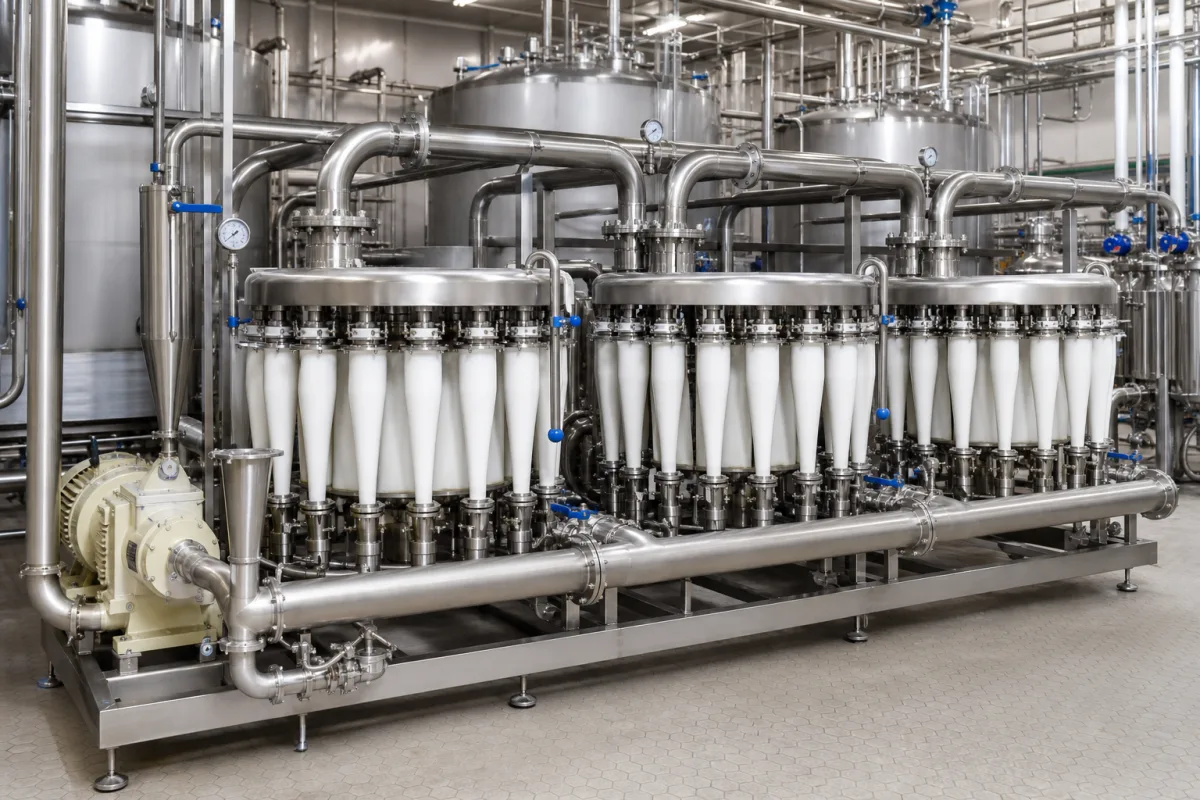
Starch washing hydrocyclones · 10 mm cyclonettes in multi-stage countercurrent nets, feed and outlet Baumé, protein left in the starch, inlet pressure and its effect on separation, wash-water use, cyclonette wear parts and CIP
A continuous starch hydrocyclone separator is a bank of small cyclones (cyclonettes), fed by a pump, that spins starch slurry so the denser starch granules leave through the underflow while protein, fibre fragments and dissolved matter go out with the overflow; banks in series with wash water flowing countercurrent make up a starch washing station. Ask three things first: what feed and product concentration and protein level the starch must reach, how many stages, cyclone size and inlet pressure achieve that, and how much fresh water, pumping and cleaning the station needs.
Multi-cyclone (cyclonette) units and multi-stage hydrocyclone stations for starch washing, refining, concentration and recovery in corn, wheat, potato and similar starch plants. Primary starch-gluten separating centrifuges, fibre screens, germ cyclones, vacuum filters and dryers are outside this page except where compared.
CNFX editorial research · Sources checked October 12, 2026 · 5 sources
Set the washing duty: concentration, protein and stages
US patent 12,686,011 B2 (Lee Tech, published July 2026) describes corn wet-mill starch washing in which an approximately 20–22 °Baumé starch slurry from the primary centrifuge underflow is fed to a "multi- (normally 12) stage 10 mm starch washing cyclone net"; the starch moves forward from stage 1 to stage 12 while clean water enters at stage 12 and flows back stage by stage, and the last-stage underflow leaves as a 23 °Baumé slurry with less than 0.35% protein on a dry basis. Elsewhere it states that the 12-stage countercurrent washing reduces protein from 4% to less than 0.4%. [1]
The same patent describes a cyclone concentrator ahead of the primary centrifuge that takes 10–13 °Baumé starch slurry and splits it into a 23 °Baumé underflow and a 5–7 °Baumé overflow, reducing the centrifuge capacity needed. [1]
SiccaDania's multi-hydrocyclone data sheet explains starch washing as repeated concentration and re-dilution with cleaner water in a counter-current, multi-stage process to keep fresh water use low, lists concentration, peeler starch recovery and refining and washing of suspensions as applications, and claims outlet concentration above 23 °Bé, cleaning-in-place and full stainless steel construction. [3]
Editorial note: these values come from one patent's process description and one maker's data sheet; ask each supplier for the stage count, cyclone size and expected protein and Baumé for your own starch, feed and water, backed by reference plants or trials.
Give the supplier the starch source (corn, wheat, potato, other), duty (washing, concentration, recovery), dry starch throughput, feed Baumé and protein, target product Baumé and protein, fresh water quality and limit, number of stages wanted, cyclonette size and material, pump and seal type, CIP needs, layout space, materials of construction and spare parts.
02
Set inlet pressure and wash-water use
Singh and Eckhoff (University of Illinois, Cereal Chemistry 72(4), 1995) built a laboratory starch-protein separation system from a Dorr-Oliver Doxie 5 unit (six 10 mm hydrocyclones in parallel, five of them plugged) fed by a positive displacement pump, with inlet pressure held at 8.96–9.65 bar (130–140 psi) by recirculating part of the pump flow. Preliminary runs showed that pressure above 9.65 bar threw larger protein particles into the starch underflow and pressure below 8.96 bar threw smaller starch particles into the protein overflow. The mill starch was diluted to 1–2 °Bé (specific gravity 1.0069–1.0140) and the underflow was re-washed with water for five passes. [2]
With five passes the hydrocyclone starch held 0.64% (dent) and 0.65% (waxy) protein against 0.33% and 0.45% from starch tabling, while tabling gave 3–4% (dent) and 2–3% (waxy) higher starch yields; a single Doxie Type A cyclone raised starch yield but protein in starch rose to 1.29% and 0.97%. The authors note that industrial plants refine starch-protein through continuous centrifuges and hydrocyclone systems using 2.1–2.5 L of water per kg of dry starch, and that a pilot wet-milling plant used four 10 mm hydrocyclones. [2]
Editorial calculation: a plant producing 200 t of dry starch per day at the cited 2.1–2.5 L of water per kg would use about 420–500 m³ of water per day in starch-protein refining; ask the supplier for the fresh water the proposed station needs at your throughput and how much recycled process water it can accept. [2]
Editorial note: the 8.96–9.65 bar band applied to one laboratory set-up; ask for the design inlet pressure, pressure drop per stage and pump duty of the proposed station, and for pressure gauges at each stage.
03
Count cyclonettes per housing and check the inspection design
G. Larsson Starch Technology's product sheets list how many cyclonettes each LARSSON™ multi-cyclone housing holds. The high-capacity sheet gives housings 520/8 and 520/10 with up to 520 cyclones of Ø8 or Ø10, 330/15 with 330 cyclones of Ø15, and two-stage 2x234/8 and 2x234/10 housings with 234 + 234 cyclones, for capacities "up to 140m3/h". Its lid carries a hydraulic plate that spreads "35 000 kg force" over the sealing areas between cyclones and vortexes, and with two stages per housing "a 6 stage cyclone unit can be built with only 3 housings". [4]
Larsson states that all components in contact with the product are made of FDA-approved materials, with stainless steel housings and synthetic cyclones and vortexes, and piping in AISI 316 (EN 1.4401) or AISI 304 (EN 1.4301). Its housings open without tools for inspection, which it says takes "a minimum of 3 minutes" on the 520/10 housing. [4][5] SiccaDania's HCC data sheet also offers CIP [3]; ask each supplier how long a stage is out of service for inspection and how the cyclonettes are sealed.
The patent this page cites describes a "normally 12" stage net of 10 mm cyclones for corn starch washing [1]. With two stages per 2x234 housing, a 12-stage line needs six housings on Larsson's figures [4]. Ask the supplier for the number of housings and cyclonettes per stage, and the spare cyclonettes recommended.
Editorial calculation: a 12-stage net of 2x234/10 housings uses 6 housings and 12 × 234 = 2,808 cyclonettes; at the stated maximum of 140 m³/h a single 520/10 housing passes about 0.27 m³/h (270 L/h) per cyclone if all 520 positions are fitted. [4][1]
LARSSON housing
Max number of cyclones
Cyclone size
520/8 · 520/10
520
Ø8 · Ø10
330/15
330
Ø15
2x234/8 · 2x234/10 (two stages)
234 + 234
Ø8 · Ø10
120/8 · 200/8
120 · 200
Ø8
120/10 · 200/10
120 · 200
Ø10
72/15 · 120/15
72 · 120
Ø15
Values are from LARSSON hydrocyclone product sheets DO0041001-A4.0 and DO0055001-A1 (text extracted from the PDFs) and its hydrocyclone page; the 140 m³/h capacity is the maker's figure for its high-capacity housings.
04
Starch hydrocyclone maker listed for this page
Myande has a product page for starch hydrocyclones; ask for its cyclonette size, number of cyclonettes per housing and the stage count it proposes for your protein target.
05
Cyclonettes, housings, blinds, stage pumps and countercurrent piping
Unused cyclonette positions are closed with blinds to match flow, as Singh and Eckhoff did by plugging five of the six 10 mm cyclones in their laboratory unit. [2][3]
Part
Role
Fix in the order
Cyclonettes (10 mm in the sources)
Split starch to underflow, protein to overflow. [1][2]
Baumé in and out, protein, stage count, inlet pressure and water use
The patent's 12-stage example sets the duty: about 20–22 °Bé in, 23 °Bé out and under 0.35% protein on a dry basis. The laboratory study held inlet pressure at 8.96–9.65 bar. [1][2]
Field
What it means and published values
Ask the supplier for
Feed concentration (°Bé)
About 20–22 °Bé from primary centrifuge in one patent. [1]
Design feed range.
Product concentration (°Bé)
23 °Bé in the patent; >23 °Bé claimed in a data sheet. [1][3]
Guaranteed value.
Protein in washed starch
<0.35% dry basis after 12 stages in the patent. [1]
1 company lists this product among what they make. Company figures are quoted from each
company's own website; every card states where the relationship came from.
Myande Group Co., Ltd.
Manufacturing site to be confirmed for the order
Its website has a product page for starch hydrocyclones.
Explore company information and manufacturing capabilities, then discuss the scope of your project with a relevant supplier.
Share this page
Compiled and source-reviewed by the CNFX editorial team.
Each manufacturer above links to the page on that company's own website where the product is listed, with the date we checked it. How we source and review
· Page last updated 13 October 2026
Buyer questions
How many stages does a starch washing hydrocyclone station use?
One corn wet-milling patent describes a "multi- (normally 12) stage" countercurrent net of 10 mm cyclones producing 23 °Baumé starch with under 0.35% protein. [1]
Why does hydrocyclone inlet pressure matter?
In one laboratory study, pressure above 9.65 bar sent larger protein particles into the starch and below 8.96 bar sent smaller starch particles into the protein stream. [2]
How much water does starch washing use?
A Cereal Chemistry paper cites 2.1–2.5 L of water per kg of dry starch in industrial starch-protein refining. [2]
How many cyclonettes fit in one starch hydrocyclone housing?
LARSSON lists housings from 72 to 520 cyclones of Ø8, Ø10 or Ø15, including two-stage 2x234 housings, with high-capacity housings rated up to 140 m³/h. [4][5]
Sources and what still needs a direct check
Sources checked 2026-10-12. The patent describes one inventor's process, the data sheet one maker's equipment, and the Cereal Chemistry paper a laboratory method; none is a design standard. Performance for your plant must come from the supplier's guarantees and trials.