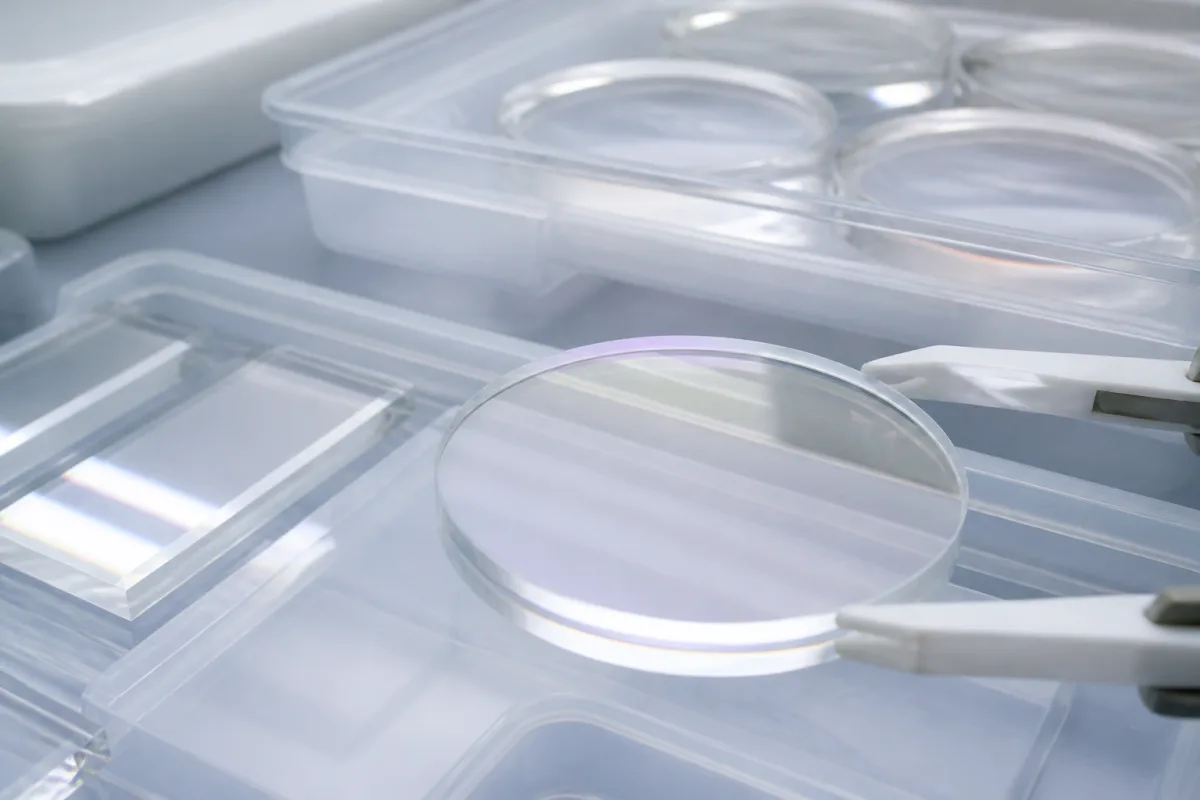
High-purity quartz crystal blank (cultured quartz for resonators)
Quartz crystal blanks and the cultured quartz they are cut from · Material grade (infrared alpha and Q), inclusions, etch channel density, handedness and sweeping, orientation and cut, dimensions and surface
A quartz crystal blank is a precisely oriented slice of single-crystal quartz that, once lapped, electroded and mounted, becomes the resonator in a crystal unit or oscillator. Settle three things before ordering blanks: the grade of cultured quartz they come from, the cut and orientation for the frequency-temperature behaviour you need, and the dimensions, flatness and surface the resonator process expects.
Cultured (synthetic) single-crystal quartz for piezoelectric resonators — as-grown and lumbered bars, swept quartz and the oriented blanks and wafers cut from them. Packaged crystal units and oscillators, fused silica and quartz glass, and natural quartz for optics are outside this page; crystal oscillators have their own page.
CNFX editorial research · Sources checked October 11, 2026 · 4 sources
Sawyer's general material specification covers single-crystal cultured quartz bars for piezoelectric elements in timing, frequency control and frequency selection. It grades material Q through infrared alpha (α₃₅₀₀ = (1/t) log(T₃₈₀₀/T₃₅₀₀), measured by FTIR on a Y-cut slice from the largest bar of each autoclave run) with the correlation 10⁶/Q = 0.114 + 7.47α − 0.45α²: IEC grade C (electronic) at α 0.060 for Q 1.8 × 10⁶, grade B (premium Q) at 0.045 for 2.2 × 10⁶ and grade A (special premium Q) at 0.033 for 3.0 × 10⁶. [1]
It grades inclusions into IEC grades Ib, I and II by their count and size in a sampled volume, and dislocations by etch channel density on an etched AT-cut slice (IEC grade 1 ≤ 10, 2 ≤ 30, 3 ≤ 100, 4 ≤ 300 per cm²), requires freedom from electrical and optical twinning, cracks and gross imperfections in the useful volume, and supplies right-handed quartz unless otherwise specified; it notes that swept quartz needs ultra-low inclusion density so sweeping does not start cracks. [1] Sawyer lists high-Q quartz (minimum Q ≥ 3.0 million), low etch channel quartz (≤ 10/cm² before sweeping) and swept quartz for radiation hardness and etch processing. [3]
Editorial calculation: for grade B, 0.114 + 7.47 × 0.045 − 0.45 × 0.045² ≈ 0.450, so Q ≈ 10⁶ ÷ 0.450 ≈ 2.2 × 10⁶, matching the table. [1]
Give the supplier the quartz grade (IEC alpha/Q, inclusion and etch channel grades), handedness, swept or unswept, the cut and angle with tolerance, blank shape and dimensions (diameter or rectangle, thickness or target frequency), flatness, parallelism and surface finish, edge treatment, inspection and sampling plan, packaging and quantity.
02
Fix orientation, cut and dimensions
For lumbered bars, Sawyer's specification sets X and Z dimension tolerances of ±0.13 mm, seed centring within a 3.0 mm band, orientation verified by X-ray diffraction before and after lumbering, and a maximum deviation of ±15′ on the minus-X reference surface (and on the Z surfaces for seed-free bars, ±1° for seed-centred bars), with the reference surface flat within 0.1 mm so that all but the principal wafer-cutting angle is set by that surface; properties are verified by sampling to MIL-STD-1055D and it cites IEC 758. [1]
Sawyer's hydrothermal growth note describes quartz grown on seed crystals in steel autoclaves from a nutrient of natural quartz in an alkali hydroxide or carbonate solution, at operating conditions between 300 and 400 °C, with the temperature difference between dissolving and growing chambers as the chief control of growth rate, and lithium added at 0.01–0.10 mol/L. [2] It also lists lumbered bar stock for doubly rotated cuts and seed-free bars with Z = 10–28 mm and X = 100 mm. [3]
Editorial note: the blank's cut angle, thickness and diameter follow from the resonator design — frequency, overtone and temperature behaviour — so give the supplier the resonator target as well as the blank drawing. [1]
03
Work out blank thickness and contour from frequency
US patent 4,124,809 A, filed in 1972 by the Swiss watch group SSIH, summarises how a thickness-shear blank is cut and sized. Rotating the cut about the X-axis by +35° (AT-cut) or −49° (BT-cut) reduces, and at certain temperatures nullifies, the thermal coefficients of frequency. For the AT-cut the frequency constant K is about 1,670 kHz per mm and the fundamental-mode range is about 1–20 MHz; blank thickness is K divided by the desired frequency. The BT-cut constant is about 2,550 kHz per mm. For circular blanks of a set diameter, the patent gives a bi-convex contour for 1–3 MHz, plano-convex for 3–10 MHz and plane-parallel above 10 MHz, and notes that low-frequency units perform poorly unless a minimum diameter-to-thickness ratio is kept; central electrodes trap the vibration energy so it decays towards the edge. [4]
Editorial calculation from K ≈ 1,670 kHz·mm: an AT-cut fundamental blank is about 1.67 mm thick at 1 MHz, 0.167 mm at 10 MHz and 0.0835 mm at 20 MHz; a BT-cut blank at 10 MHz is about 0.255 mm, about 1.5 times the AT-cut thickness. Final thickness is set by the resonator maker's frequency adjustment, so give the blank supplier the target frequency, overtone and tolerance rather than a thickness alone. [4]
Editorial note: confirm the cut angle tolerance, contour (bevel or convex radius) and diameter on the blank drawing, and that the bar orientation report from the quartz supplier covers the angle you need. [4][1]
The companies in the manufacturer list below show this product on their own websites. Confirm the legal seller, factory and scope for your order.
Ask each supplier for the material certificate with infrared alpha, inclusion and etch channel grades for the autoclave run, the X-ray orientation report and the dimensional inspection for the blanks you order. [1]
05
Trace what each property controls
This is a functional reference built from the sources cited; it is not one maker's specification.
Fill the specification fields with values for your resonator
A quartz blank quotation needs values for your resonator. The table explains each field, gives published values where a reviewed source states them, and says what to obtain from the supplier.
Explore company information and manufacturing capabilities, then discuss the scope of your project with a relevant supplier.
Share this page
Compiled and source-reviewed by the CNFX editorial team.
Published product pages show what a company offers, not tested performance. Confirm the legal seller, factory and scope for your order. How we source and review
· Page last updated 13 October 2026
Buyer questions
How is cultured quartz graded for resonators?
By infrared alpha, which correlates with material Q: Sawyer lists IEC grades C, B and A at Q 1.8, 2.2 and 3.0 million. [1]
What is etch channel density?
A count of dislocation channels after etching an AT-cut slice; IEC grades run from ≤10 to ≤300 per cm². [1]
How accurately are quartz bars oriented?
Sawyer holds the reference surface within ±15′, verified by X-ray diffraction, and dimensions to ±0.13 mm. [1]
How is cultured quartz grown?
Hydrothermally on seed crystals in steel autoclaves at 300–400 °C from an alkaline solution of natural quartz. [2]
How thick is an AT-cut quartz blank?
Thickness is the frequency constant divided by frequency; US patent 4,124,809 A gives about 1,670 kHz per mm for the AT-cut, so a 10 MHz fundamental blank is about 0.167 mm thick (Editorial calculation). [4]
Sources and what still needs a direct check
Sources checked 2026-10-11. Sawyer Technical Materials' cultured quartz specification, hydrothermal growth note and electronic quartz product page are used to show what a quartz blank material specification covers; US patent 4,124,809 A gives the AT- and BT-cut frequency constants. Values for your order must come from the supplier's certificate and drawing.