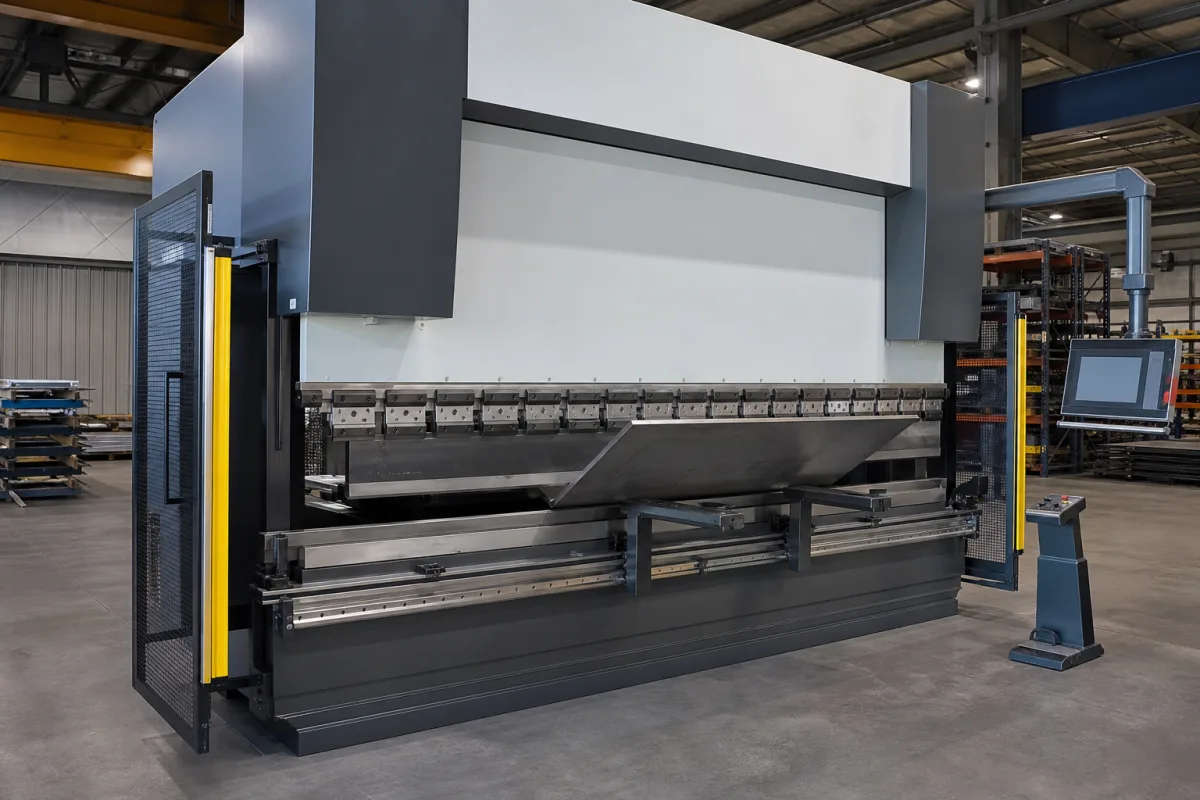
Heavy plate bending press for thick high-strength and wear-resistant steel
Heavy plate bending · Force per metre for high-strength and wear plate, springback and overbend, variable dies, 400–5000+ t machines
A heavy plate bending press is a large press brake for forming thick plate in high-strength structural and wear-resistant steels, for parts such as crane arms, poles, pipes and heavy-equipment, shipbuilding and offshore components. In SSAB's calculations, wear plate needs more than twice the bending force per metre of a 355 MPa structural grade at the same thickness; the press must deliver that force, overbend far enough to cancel large springback, and change wide dies quickly. Ask three things first: the force per metre your hardest plate needs at the die width you will use, how much overbend the tooling allows, and the bend length, stroke and tool space the frame must give.
Large press brakes and bending presses for thick plate in high-strength structural and wear-resistant steels, including their variable-die tooling and crowning. General CNC hydraulic and electro-hydraulic press brakes for sheet and plate, including tandem and robotic cells, are covered on the Hydraulic press brake page. Plate rolls, profile benders, panel benders and deep-drawing presses are outside this page.
CNFX editorial research · Sources checked October 12, 2026 · 4 sources
Size the press force per metre for your hardest grade
SSAB's press-brake guidance lists calculated forces to bend its grades to 90° along the rolling direction, as press force per metre of bend length: at 10 mm, 630 kN/m for SSAB Domex 355MC, 1,170 kN/m for Strenx 700MC, 1,340 kN/m for Strenx 1100E, 1,380 kN/m for Hardox 450 and 1,570 kN/m for Hardox 500 Tuf; at 15 mm, 950, 2,010, 2,070 and 2,370 kN/m for Domex 355MC, Strenx 1100E, Hardox 450 and Hardox 500 Tuf. [1]
SSAB states that the estimate depends on bend length, plate thickness, die width, tensile strength and the changing moment arm, with the peak load at a bend opening angle of 120° under normal friction without lubrication; a wider die reduces the force, as does a smaller punch radius, and trial tests are always recommended. [1]
Editorial calculation: a 3 m bend in 10 mm Hardox 450 needs 1,380 × 3 = 4,140 kN, about 422 t (÷ 9.807), while the same bend in Domex 355MC needs 630 × 3 = 1,890 kN, about 193 t: 2.2 times the force for the same plate thickness. A 6 m bend in 15 mm Hardox 500 Tuf needs 2,370 × 6 = 14,220 kN, about 1,450 t. Add margin and use the supplier's tonnage chart for your die.
Give the supplier the hardest grade and thickest plate, longest bend, die widths and punch radii you plan, part weight and size, required angle accuracy, part handling (sheet supports, front gauges, manipulators), and the floor space and foundation available.
02
Plan the overbend for springback
SSAB explains that springback increases with steel strength and with the ratio of die width to plate thickness (W/t), and that high-strength steel cannot be bent to 90° in a die with a 90° opening; the die must allow overbending beyond the final angle. [2]
Values are SSAB's BendCalc results for bending to 90° to its recommendations, longitudinal to the rolling direction. [2] Editorial calculation: to finish 10 mm Hardox 500 Tuf at 90°, the tooling must let the part close to about 90 − 19 = 71° under load, so the die and punch angles must clear that, while Domex 355MC needs only about 4°.
Grade (90° bend)
5 mm: force, springback
10 mm: force, springback
15 mm: force, springback
SSAB Domex 355MC
310 kN/m, 3.9°
630 kN/m, 3.9°
950 kN/m, 3.9°
Strenx 700MC
570 kN/m, 6.7°
1,170 kN/m, 6.9°
—
Strenx 1100E
820 kN/m, 14.2°
1,340 kN/m, 16.3°
2,010 kN/m, 16.2°
Hardox 450
860 kN/m, 14.8°
1,380 kN/m, 16.6°
2,070 kN/m, 16.5°
Hardox 500 Tuf
910 kN/m, 16.0°
1,570 kN/m, 19.0°
2,370 kN/m, 18.9°
03
Check the frame, stroke and tooling windows
Ursviken's Optima, a custom-engineered press brake for plate fabrication, large poles, pipes, crane arms and thick high-strength plate, is specified at 400 to over 5,000 t press force, 4,100–20,200 mm maximum bend length, 3,100–16,200 mm between side frames, 485–4,000 mm tool space and 300–1,500 mm stroke. [3]
Ursviken's options for such presses include segmented Flexicrown crowning for local corrections, angle control with automatic compensation, tool magazines and CNC lift-swing handling, and an EcoPump that it says cuts energy use by up to 95% by setting motor frequency per bending cycle. [3]
Its Variable Die Tool changes die opening under CNC instead of swapping heavy dies, with an opening range of 28 mm to 915+ mm and sizes of 28–124, 32–200, 40–260 and 50–370 mm; Ursviken states that it withstands much higher loads than single V-dies and can make non-symmetrical bends for offsets. [4] Editorial calculation, assuming a die opening ten times plate thickness: 30 mm plate needs a 300 mm opening, inside the 50–370 mm size. SSAB notes that a wider die lowers the force [1] but raises springback [2], so fix the die width with the supplier for each grade.
04
Frame, hydraulic drive, crowning and tooling of a heavy plate bending press
Explore company information and manufacturing capabilities, then discuss the scope of your project with a relevant supplier.
Share this page
Compiled and source-reviewed by the CNFX editorial team.
Each manufacturer above links to the page on that company's own website where the product is listed, with the date we checked it. How we source and review
· Page last updated 13 October 2026
Buyer questions
How much more force does wear plate need?
In SSAB's calculations, 10 mm Hardox 450 needs 1,380 kN/m to bend to 90°, against 630 kN/m for Domex 355MC. [1]
How much springback should the tooling allow?
SSAB lists 3.9° for Domex 355MC and up to 19.0° for 10 mm Hardox 500 Tuf; the die must allow overbending. [2]
How large are heavy plate press brakes?
Ursviken lists its Optima from 400 to over 5,000 t and 4,100–20,200 mm bend length. [3]
Sources and what still needs a direct check
Sources checked 2026-10-12. SSAB is a steelmaker publishing bending guidance for its own grades; Ursviken Technology is a press brake builder describing its own machines and tooling.