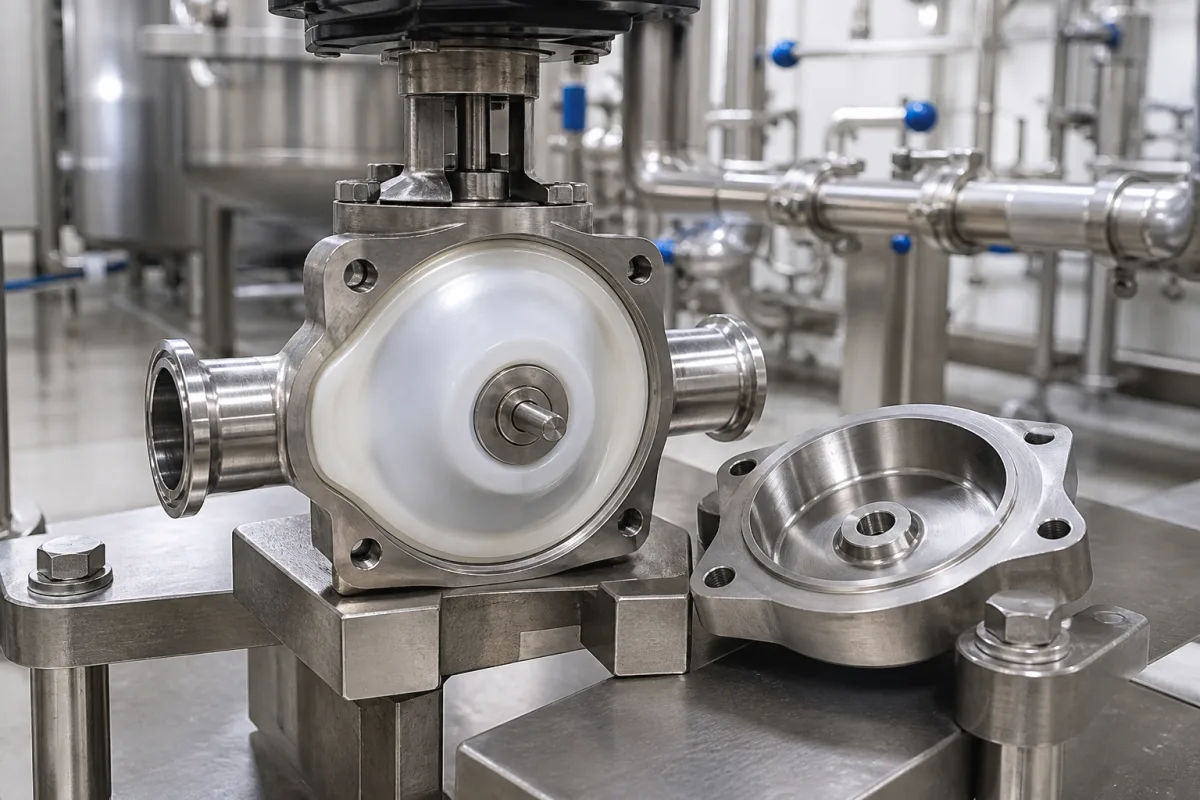
Sanitary diaphragm valve core: the replaceable PTFE/EPDM diaphragm and its steam-in-place life
The replaceable diaphragm inside a hygienic diaphragm valve · two-piece PTFE face on an EPDM backing, its steam-in-place limits, blistering after quench cooling, and when to change it
In a hygienic weir-type diaphragm valve the only part that touches the product and moves is the diaphragm: a PTFE face that seals against the weir, backed by an elastomer cushion and fixed to the compressor by a pin. It is a wear part, bought and stocked separately from the valve, and in food, dairy and pharmaceutical plants its life is set less by opening and closing than by steam-in-place sterilisation, especially when the steam is hot and the cool-down fast.
Replacement shut-off diaphragms for hygienic diaphragm valves: two-piece PTFE/EPDM and one-piece elastomer designs, their attachment, temperature and steam limits, failure modes and inspection and replacement intervals. Complete sanitary diaphragm valves, their bodies, drainability and lined variants are covered on the Sanitary diaphragm valve for dairy processing page; the pneumatic heads that drive them on the Pneumatic actuator for sanitary diaphragm valves page; and angle-seat control valves on the Sanitary flow control valve page.
CNFX editorial research · Sources checked October 12, 2026 · 3 sources
A PTFE face on a peroxide-cured EPDM backing, fixed by a sintered bayonet pin
GEMÜ's DD00_T1 datasheet shows what a current two-piece hygienic shut-off diaphragm consists of and what it is rated for. [1]
GEMÜ adds that each application must be analysed before choosing the diaphragm material, and that different locations in one plant can need different materials. [1]
Feature
GEMÜ DD00_T1 (PTFE/EPDM)
Layers
PTFE shield (face) and peroxide-cured EPDM backing, both compounded for GEMÜ. [1]
FDA 21 CFR 177.1550, Regulation (EC) 1935/2004 and (EU) 10/2011, USP Class VI, BSE/TSE (EMA/410/01 rev. 3); listed as free of latex, PVC, BPA and the phthalates named. [1]
02
Steam-in-place: 150 °C for 180 minutes per cycle, and blisters that appear after fast cooling
Sterilisation, not switching, is what ages a PTFE face. A valve maker's rating and a seal maker's steam test show two sides of that.
GEMÜ rates the PTFE/EPDM DD00_T1 for sterilisation at up to 150 °C for a maximum of 180 minutes per cycle, valid for saturated steam or superheated water up to 6 bar. It notes that using the PTFE diaphragm as a moisture barrier shortens its life, that the connecting screws between actuator and body cannot be retightened in that case or with high temperature fluctuations, and that maintenance cycles must be adapted; for steam-to-process interfaces it suggests a globe valve to shut off the steam line and a diaphragm valve as the interface to the process pipe. [1]
Garlock Sealing Technologies engineers, writing in Pharmaceutical Manufacturing in 2011, put conventional SIP at 120–135 °C, cite ASME-BPE 2009 Appendix J at a minimum of 130 °C for one hour for simulated SIP cycles, overkill cycles at a minimum of 140 °C for two to four hours, and high-temperature short-time systems at 140–160 °C with fast air or water cooling. [2]
Case reported by Garlock
Conditions
What was found
Field case 1
DIN 20 weir-type PTFE diaphragm, SIP at 150 °C. [2]
DIN 50 (2 in) weir valve; 145 °C / 45 psi steam for 20 min after every 100 actuations, fast water quench; 40,000 actuations and 400 SIP cycles; a 152 °C / 60 psi spike for two minutes. [2]
Small blisters at the first inspection after 100 cycles, growing at 200 and 300; blisters on front and back after 400; EPDM backing softened and split. [2]
Record the SIP temperature, hold time and cooling method each diaphragm sees, and compare them with the diaphragm maker's per-cycle limit before setting the inspection interval.
03
When to change it: application-based intervals, an 8-year ceiling and food-contact extraction limits
Neither source gives a fixed replacement count; both tie the interval to how the diaphragm is used.
GEMÜ calls diaphragms wearing parts that must be inspected and replaced regularly, with intervals set from the maintenance history and the stresses of frequent sterilisation or cycling, and gives a maximum recommended service life of 8 years counted as storage life plus operating life, with storage at −10 to 40 °C. [1]
Garlock recommends inspection and replacement schedules based on SIP parameters and system design, more frequent replacement for diaphragms exposed to severe SIP with fast cooling and high flex-cycle counts, earlier replacement for diaphragms near steam injection than for those near the cold spot, and avoiding superheated steam by not reducing steam pressure by more than 2:1 of absolute supply pressure. [2] Editorial calculation: the laboratory test ran 100 actuations per SIP cycle, so the first blisters appeared after about 10,000 actuations and 100 cycles.
For the PTFE face, 21 CFR 177.1550 on perfluorocarbon resins requires molded articles of 6.45 dm² (100 in²) or more and at least 1.27 mm thick to be extracted at reflux for 2 hours in distilled water, 50% ethanol, n-heptane and ethyl acetate, and sets extractability limits for coatings of total extractives not over 3.1 mg/dm² and fluoride, as fluorine, not over 0.46 mg/dm². [3]
Order replacement diaphragms by valve make, diaphragm size and attachment type, and ask for the material declarations and the production date so storage time counts toward the service life.
04
What to give for replacement diaphragms
Paste it into your enquiry below or into an email to a maker, then replace every bracket.
Valve: [make; type; diaphragm size; attachment pin type]
Material: [PTFE/EPDM two-piece; EPDM; other]
Process: [media; temperature; pressure; vacuum]
Cleaning: [CIP chemicals; SIP temperature, hold and cooling]
Duty: [actuations per day; SIP cycles per day]
Documents: [FDA 21 CFR 177.1550; EC 1935/2004; USP Class VI; batch and date]
Quantity: [installed base; spares]
Explore company information and manufacturing capabilities, then discuss the scope of your project with a relevant supplier.
Share this page
Compiled and source-reviewed by the CNFX editorial team.
Each manufacturer above links to the page on that company's own website where the product is listed, with the date we checked it. How we source and review
· Page last updated 13 October 2026
Buyer questions
How hot can a PTFE/EPDM sanitary valve diaphragm be steam-sterilised?
GEMÜ rates its DD00_T1 to 150 °C for a maximum of 180 minutes per cycle in saturated steam or superheated water up to 6 bar. [1]
Why do PTFE valve diaphragms blister?
Garlock engineers found blisters after SIP at 140–150 °C with fast cooling; in their test, blisters appeared after 100 cycles at 145 °C with water quench and grew by 400 cycles. [2]
How long can a sanitary valve diaphragm be kept in service?
GEMÜ gives a maximum recommended service life of 8 years including storage, with the actual interval set by the application. [1]
Sources and what still needs a direct check
Sources checked 2026-10-12. GEMÜ is a diaphragm valve maker describing its own diaphragm; the steam test is by engineers of Garlock Sealing Technologies published in Pharmaceutical Manufacturing; the extraction rules are the US FDA's.