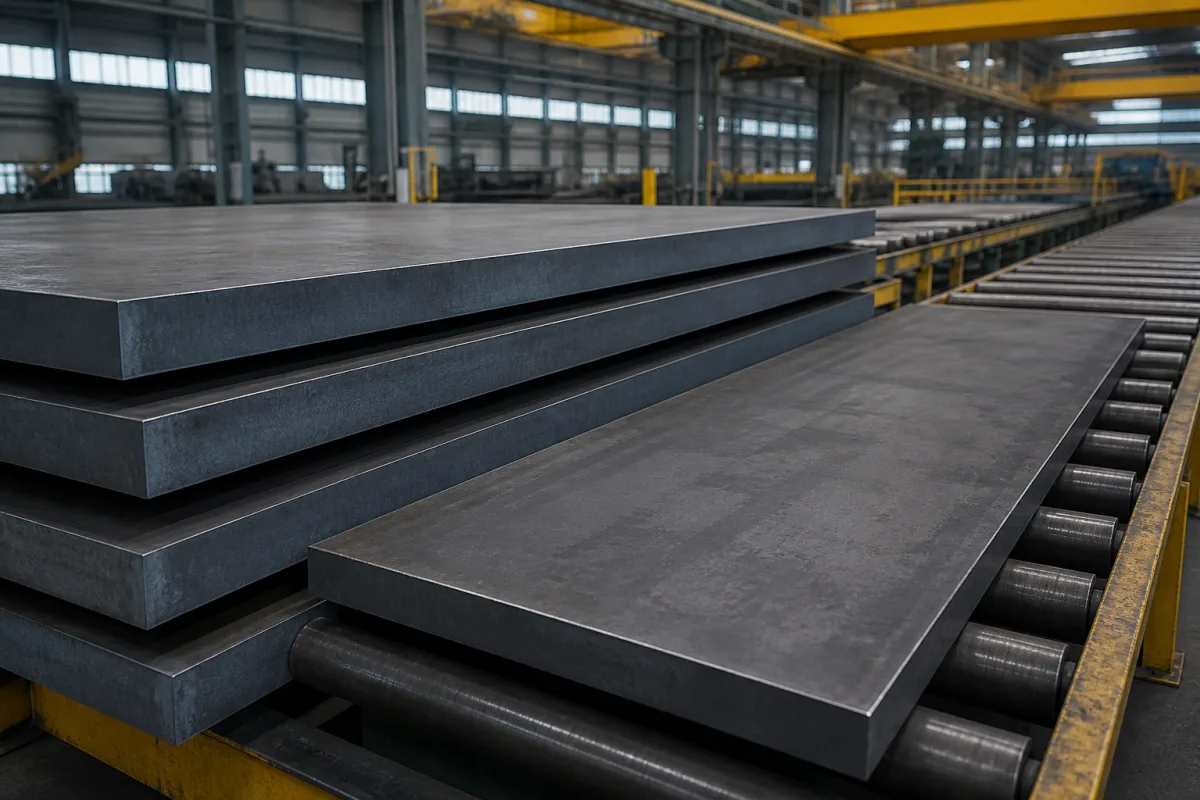
Structural steel plate · Yield strength by thickness band, impact grade, carbon equivalent, and when to step up from S355
High-strength structural steel plate is hot-rolled carbon-manganese or micro-alloyed steel plate made to a structural standard such as EN 10025, used for welded, bolted and riveted frames, bridges, cranes and machinery. Ask three things first: what minimum yield strength the grade guarantees at your actual plate thickness, which impact toughness grade and test temperature apply, and what carbon equivalent limit governs weldability.
Hot-rolled structural steel plate to EN 10025 and similar standards, from S355-class normalised steel to quenched-and-tempered grades around 700 MPa yield. Wear-resistant plate, pressure-vessel plate, shipbuilding plate, coil and sections are outside this page.
CNFX editorial research · Sources checked October 12, 2026 · 4 sources
Parker Steel's declaration of performance for S355J2 plate to EN 10025-2 lists transverse minimum yield strength falling with thickness: 355 MPa up to 16 mm, 345 MPa over 16 to 40 mm, 325 MPa over 40 to 80 mm, 315 MPa to 100 mm and 295 MPa to 150 mm; tensile strength 470–630 MPa up to 100 mm and 450–600 MPa beyond; and elongation from 20% down to 18%. Thickness and flatness tolerances are to EN 10029. [1]
SSAB's S355J2+N Zero, offered from 6 to 60 mm, lists 355 MPa minimum yield to 16 mm, 345 MPa to 40 mm and 335 MPa to 60 mm, with 470–630 MPa tensile strength and 20–21% elongation. [2] SSAB compares its Strenx 700 structural steel, at 700 MPa minimum yield depending on product and thickness, with 355 MPa for S355, claiming up to 80% higher load-bearing capacity for the same cross-section and average weight savings of 20%, up to 40%. [3]
Editorial calculation: a 50 mm S355J2 plate carries a minimum yield of 325 MPa in Parker's declaration but 335 MPa in SSAB's product, 8.5% and 5.6% below the 355 MPa nominal grade name; design and order to the band for your actual thickness. 700 MPa is about 1.97 times 355 MPa. [1][2][3]
Give the supplier the standard and grade (e.g. EN 10025-2 S355J2+N), thickness, width and length, quantity, delivery condition, impact grade and test temperature, CEV limit, thickness and flatness tolerance class, inspection certificate type (e.g. EN 10204 3.1), surface condition and any through-thickness or ultrasonic testing.
02
Fix impact grade and carbon equivalent
Parker's declaration gives longitudinal Charpy impact energy of 27 J for each subgrade — JR at +20 °C, J0 at 0 °C and J2, which SSAB's S355J2+N Zero states as 27 J at –20 °C on longitudinal 10 × 10 mm Charpy V specimens. [1][2]
For weldability, Parker lists maximum CEV of 0.45% up to 30 mm and 0.47% from 30 to 150 mm, with ladle limits including C 0.20% (0.22% over 30 mm), Si 0.55%, Mn 1.60% and P and S 0.025%. SSAB's S355J2+N Zero holds CEV to 0.45% maximum, with C 0.18%, Mn 1.60%, P 0.020% and S 0.010% maximum. [1][2] SSAB also offers its 700 MPa grades with impact toughness guaranteed down to –60 °C in the F variant. [3]
Editorial note: a mill product that is tighter than the standard (lower CEV, cleaner sulphur) still carries the standard's name; ask for the actual heat analysis and impact results on the 3.1 certificate rather than relying on the grade designation.
03
Compare a thermomechanically rolled S460 plate's CEV and processing limits
Dillinger's material data sheet for DI-MC 460 (June 2023) describes a thermomechanically rolled fine-grained structural steel meeting EN 10025-4, supplied from 8 to 160 mm thick as basic quality B (S460M, impact-tested at −20 °C) or low-temperature quality T (S460ML, at −50 °C), CE-marked up to 150 mm. Ladle limits include 0.13% carbon, 1.70% manganese, 0.020% phosphorus and 0.003% sulphur. Its maximum CEV is 0.40% up to 40 mm and 0.39% from 40 to 80 mm, against 0.45–0.48% allowed by EN 10025-4 for the same bands. Minimum yield strength is 460 MPa in the thinnest band, falling to 410 MPa at 63–80 mm, 400 MPa at 80–100 mm and 385 MPa at 100–160 mm. Longitudinal Charpy minimums are 40 J at −20 °C for B and 27 J at −50 °C for T. Dillinger states the plate can be flame cut without preheat, needs filler adding no more than 5 ml hydrogen per 100 g of weld metal, may be stress relieved at 530–580 °C for no more than 4 hours, and must not be hot formed above 580 °C; tests are per heat and per 60 t, documented on an EN 10204 3.1 certificate. [4]
Editorial calculation: at 50 mm, DI-MC 460's maximum CEV of 0.39% is 0.08 points below the 0.47% EN 10025-4 limit and below the 0.47% Parker gives for S355J2 over 30 mm, despite about 30% higher yield strength; Dillinger states that with suitable welding parameters preheating can be omitted even above 50 mm. Because hot forming above 580 °C destroys the rolled-in properties, tell the supplier if any part will be hot bent or heat treated. [4][1]
EN, ASTM and GB plate grades on the linked listings
Listings cover EN 10025 S235/S275/S355, ASTM A36/A572 and GB Q235/Q345 grades alongside other carbon steel plate; ask each for the producing mill and certificate.
05
Which plate property governs strength, fracture, welding and fit-up
Yield band, CEV and flatness class on a plate enquiry
For plate, a yield figure only means something with its thickness band attached, so the S355J2 entries below are given by band from Parker's declaration; width, length and density have no published value in these sources.
Explore company information and manufacturing capabilities, then discuss the scope of your project with a relevant supplier.
Share this page
Compiled and source-reviewed by the CNFX editorial team.
Each manufacturer above links to the page on that company's own website where the product is listed, with the date we checked it. How we source and review
· Page last updated 13 October 2026
Buyer questions
Does S355 plate always have 355 MPa yield?
No; Parker's EN 10025-2 declaration drops to 345 MPa over 16 mm and 325 MPa over 40 mm. [1]
What does J2 mean on S355J2?
A 27 J Charpy impact requirement; SSAB states it as 27 J at –20 °C. [2][1]
What CEV limit applies to S355J2 plate?
Parker lists 0.45% up to 30 mm and 0.47% above; SSAB's product holds 0.45% maximum. [1][2]
How much stronger is 700 MPa structural plate?
SSAB compares 700 MPa minimum yield for Strenx 700 with 355 MPa for S355. [3]
Can thermomechanically rolled structural plate be hot formed?
One mill's S460M/ML plate data sheet states hot forming above 580 °C is not permitted, and stress relief must stay at 530–580 °C for no more than 4 hours. [4]
Sources and what still needs a direct check
Sources checked 2026-10-12. Parker Steel is a UK stockist publishing its declaration of performance to EN 10025-2; SSAB is a steelmaker publishing its own product data. The standard itself governs requirements.