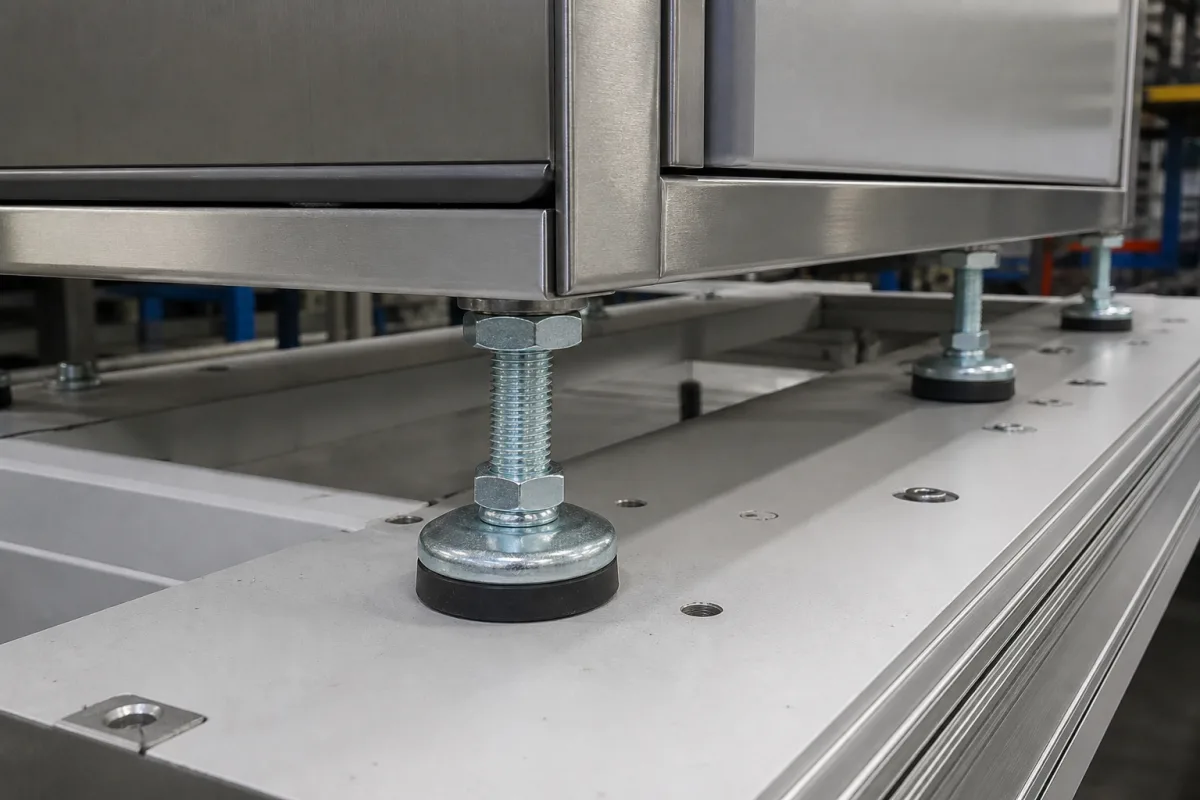
Furniture and equipment levelling feet · Static load by base diameter, safety factor and side loads, stud and base materials, anti-slip pads
An adjustable leveling foot is a threaded stud or socket fitted to a base, with or without a rubber pad, that screws into the leg or frame of furniture, cabinets or machines so they can be levelled and stand firmly on an uneven floor. Ask three things first: what static load the foot is rated for and how that rating was tested, how side loads, tilt and uneven floors reduce it, and which stud, base and pad materials suit your environment.
Threaded levelling feet (stud or socket type) with plastic, steel or stainless bases, rigid or articulated, with or without anti-slip pads, for furniture, cabinets and light machinery. Castors, anti-vibration mounts as a separate product, glides without adjustment and heavy machine-foundation wedges are outside this page.
CNFX editorial research · Sources checked October 11, 2026 · 4 sources
Check the static load rating and how it was tested
Ganter's GN 343.3/343.4 data sheet (published by JW Winco, a Ganter company) rates plastic-base levelling feet by base diameter: 25 mm bases (M6–M10) at 5 kN, 32 mm (M8–M12) at 7 kN, 40 mm and 50 mm (M8–M16) at 10 kN, and 60 mm with M12 at 14 kN. It explains that the values come from tests in which a limited number of feet carried a vertical static load for a limited time, that exceeding them can damage the plastic base, and that a safety factor must be applied so the permissible load is below the table value. [1]
Ganter's product page adds that side or angular loading is not uncommon in normal operation and considerably reduces load capacity, which must be taken into account. [2] Movet's MASSIV steel levelling foot (80 mm base, M16 × 75 mm stud) is designed for static loads up to 20,000 N, with an articulated screw that allows 5° of adjustment and an NBR anti-slip surface. [3]
Editorial calculation, with assumed figures: a 400 kg cabinet on four feet puts about 400 × 9.81 / 4 ≈ 0.98 kN on each; if an uneven floor leaves it on three feet, about 1.3 kN each. With an assumed safety factor of 3, the 3.9 kN needed is within the 5 kN rating of a 25 mm GN 343.4 foot; choose the safety factor for your own load case and dynamic effects. [1]
Give the supplier the total load and number of feet, possible uneven or dynamic loading (vibration, moving parts, loading and unloading), floor type, required height adjustment, thread size and length, mounting (into tapped leg, nut, plate with holes), environment (wet, wash-down, chemicals, temperature), pad requirement and any ESD or hygienic design need.
02
Choose stud, base and pad materials
In Ganter's GN 343.3/343.4, the base is glass-fibre-reinforced polyamide technopolymer, temperature resistant to 100 °C; the threaded stud is property class 5.8 steel, zinc plated and blue passivated; the hexagon nut is to ISO 4032; and the optional rubber pad is Perbunan (NBR) of 70 Shore A. Feet are supplied assembled but can be dismantled, and an ESD version in conductive plastic is available on request. [1]
Ganter lists related families in all-steel, stainless steel, plastic base with stainless stud, and vibration-damping versions. [1] Movet's steel foot uses a solid steel base and spindle for heavy loads. [3] Editorial note: for wash-down areas or corrosive environments ask for stainless studs and bases, and check the pad material against oils, cleaners and floor coatings.
03
Levelling feet sold alongside castors and floor locks
The supplier reviewed lists levelling feet with castors and floor locks; ask for the load rating and test method for each size, stud property class, base material and pad hardness.
04
Read limit static loads by base and ball-joint size
Elesa's LV.F data sheet (inch sizes) covers levelling elements with a glass-fibre reinforced polyamide (PA) technopolymer base, an articulated threaded zinc-plated steel stem, and an optional NBR no-slip disk of 70 Shore A; the sheet is marked -22 °F and +212 °F. It lists a maximum limit static load for each model and defines it as the value above which the applied load may cause some plastic material breakage in particular conditions of use, adding that a factor for the importance and safety level of the application must be applied to it. [4]
On the same base, the larger articulation diameter (0.94 in against 0.55 in) raises the listed limit: from 3,584 to 4,032 lbf on the 3.15 in base and from 4,032 to 5,600 lbf on the 3.94 in base; the 4.92 in base with the 0.94 in articulation is listed at 6,272 lbf. Elesa supplies base and stem unassembled, in separate packing. [4]
Editorial calculation: with 1 lbf = 4.448 N, 3,584 lbf ≈ 15.9 kN and 6,272 lbf ≈ 27.9 kN; 3.15 in ≈ 80 mm. These are breakage limits, not working loads: apply your own safety factor before comparing them with the GN 343.4 values above, which come from short vertical static tests. [4][1]
Thread, base diameter and rated load for each foot size
Read the load row with its test basis beside it: Ganter's ratings come from short vertical static tests and Elesa's are breakage limits, so neither is a working load until your own safety factor is applied.
Explore company information and manufacturing capabilities, then discuss the scope of your project with a relevant supplier.
Share this page
Compiled and source-reviewed by the CNFX editorial team.
Each manufacturer above links to the page on that company's own website where the product is listed, with the date we checked it. How we source and review
· Page last updated 13 October 2026
Buyer questions
How much load can a leveling foot carry?
It depends on size and design; Ganter's GN 343.4 ranges from 5 kN (25 mm base) to 14 kN (60 mm), from short vertical static tests, with a safety factor to be applied. [1]
Do side loads reduce leveling foot capacity?
Yes; Ganter says side or angular loading considerably reduces load capacity. [2]
What are levelling foot pads made of?
Ganter uses NBR (Perbunan) at 70 Shore A; Movet's steel foot also has an NBR anti-slip surface. [1][3]
What does a levelling foot's limit static load mean?
Elesa defines it as the load above which the element may cause plastic material breakage and says a safety factor must be applied; its LV.F limits run from 3,584 to 6,272 lbf. [4]
Sources and what still needs a direct check
Sources checked 2026-10-11. Ganter (through JW Winco) and Movet describe their own levelling feet and how their ratings were obtained; ratings for another foot must come from its own tests.