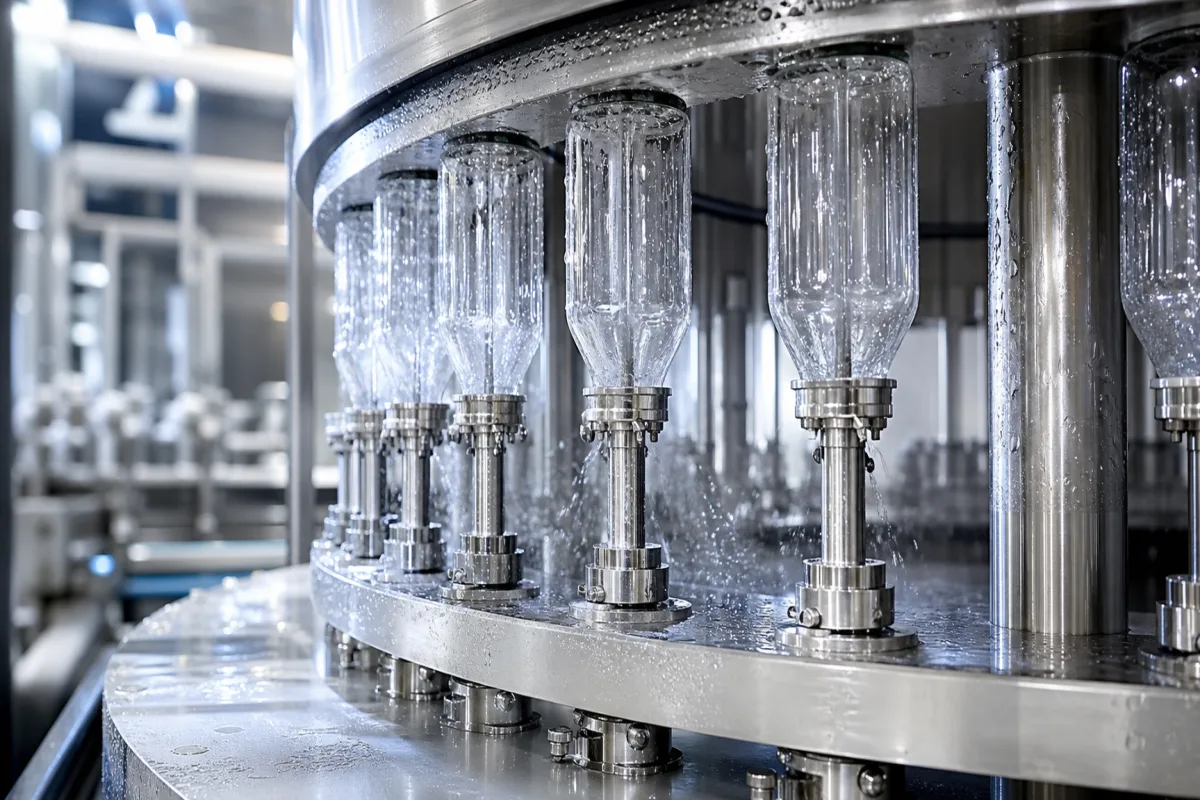
Beverage bottle rinsing nozzle for inverted-bottle carousel rinsers
Bottle rinsers · nozzles that spray into inverted containers, 2 to 3 bar, 8 to 30 s treatment, water or ionized air
A beverage bottle rinsing nozzle is the injector on a rinser that sprays water, disinfectant or ionized air into each empty bottle while it is held neck-down, so that loose particles and rinse liquid drain out before the filler. Settle three things before asking for prices: whether the nozzle enters the bottle or sprays from below the neck, the pressure, time and medium of each injection, and which hygiene rule the final rinse must satisfy.
Injection nozzles fitted to carousel and in-line rinsers that treat empty beverage bottles held upside down before filling, including penetrating and non-penetrating designs and small rotating bottle-cleaning heads. General hydraulic and air-atomizing spray nozzles for cooling, cleaning, coating and dust suppression are covered on the Spray nozzle page; tank-cleaning heads for process vessels are outside this page.
CNFX editorial research · Sources checked October 12, 2026 · 3 sources
Set the injection pressure and treatment time on a carousel rinser
Pierre Millet's Techniques de l'Ingénieur article on rinsing primary packaging describes the carousel rinser: the container arrives by screw and starwheel, is gripped at the neck and turned through 180° so the neck points down, and a nozzle or injector is then positioned, either penetrating the container or not, before the injections are made. [1]
The same article gives a treatment of 8 to 30 s, longer when more than one injection type is used, injection pressures of 2 to 3 bar, and notes that nozzles or injectors can be carried by the grippers themselves; drainage time depends on how much residual liquid the package can tolerate. [1]
It puts the water consumption of a rinser, even with pulsed injections, at 90 to 130 mL per bottle depending on volume. [1] Editorial calculation: at those figures, 1,000 bottles take 90 to 130 L of rinse water, so a run of 10,000 bottles uses 0.9 to 1.3 m³.
For new non-refillable PET containers, the article describes an ionized air rinse developed by makers such as KHS, which neutralises the electrostatic charge on the inner walls so particles can be blown out without water, using sterile air filtered at 0.2 µm and 5 to 8 L of air per container. [1]
Give the supplier the bottle material, volume, neck bore and height, rinse medium for each injection, pressure, treatment and drainage time, line speed and whether the nozzle may enter the bottle.
02
Meet the sanitizing and final-rinse rules for bottled water
For bottled drinking water sold in the US, 21 CFR 129.80 requires multiservice containers to be washed, rinsed and sanitized by mechanical washers or another method giving adequate sanitary results, and requires chemical sanitizers applied as a spray or fog to have at least 100 parts per million of available chlorine at 57 °F, or equivalent bactericidal action. [2]
Where a sanitizer other than those provided for in 21 CFR 178.1010 is used, the regulation requires it to be removed by rinsing, and the final rinse before filling must use disinfected water free of pathogenic bacteria or an equivalent additional sanitizing step. [2]
The same section says that at least once every 3 months a bacteriological swab or rinse count should be made from at least four containers and closures taken just before filling; no more than one of the four may exceed one bacterium per millilitre of capacity or one colony per square centimetre, and all must be free of coliform organisms. [2] Editorial note: these limits apply to the container and process, not to the nozzle itself; ask the rinser supplier how nozzle coverage and drainage are validated against them.
03
Compare nozzle arrangements
The arrangements below are those described in the cited sources.
Supplier cards below show what each company lists; confirm the nozzle fits your rinser's gripper or manifold before ordering.
Arrangement
What the source states
Source
Penetrating nozzle
Injector enters the inverted container before injection.
This company lists a rotating bottle cleaning nozzle.
CYCO Nozzles
Manufacturing site to be confirmed for the order
Lists the M-50 rotating bottle cleaning nozzle with POM, PTFE and 316 stainless parts and 360° coverage, for food, pharmaceutical and beverage cleaning.
Explore company information and manufacturing capabilities, then discuss the scope of your project with a relevant supplier.
Share this page
Compiled and source-reviewed by the CNFX editorial team.
Each manufacturer above links to the page on that company's own website where the product is listed, with the date we checked it. How we source and review
· Page last updated 13 October 2026
Buyer questions
What pressure does a bottle rinsing nozzle use?
Techniques de l'Ingénieur gives injection pressures of 2 to 3 bar on carousel rinsers, with a treatment of 8 to 30 s. [1]
How much water does rinsing use per bottle?
The same source puts it at 90 to 130 mL per bottle depending on volume, even with pulsed injections. [1]
What does US bottled-water regulation require of a spray sanitizer?
21 CFR 129.80 requires at least 100 ppm available chlorine at 57 °F or equivalent, and a disinfected final rinse when other sanitizers are used. [2]
Sources and what still needs a direct check
Sources checked 2026-10-12. Techniques de l'Ingénieur is a French engineering reference; 21 CFR 129.80 is the US FDA regulation for bottled drinking water processing; CYCO is a nozzle maker describing its own product.