PAC coagulant · Al2O3 strength and basicity grades, impurity limits for drinking water, dosing in g Al/m³ against alum
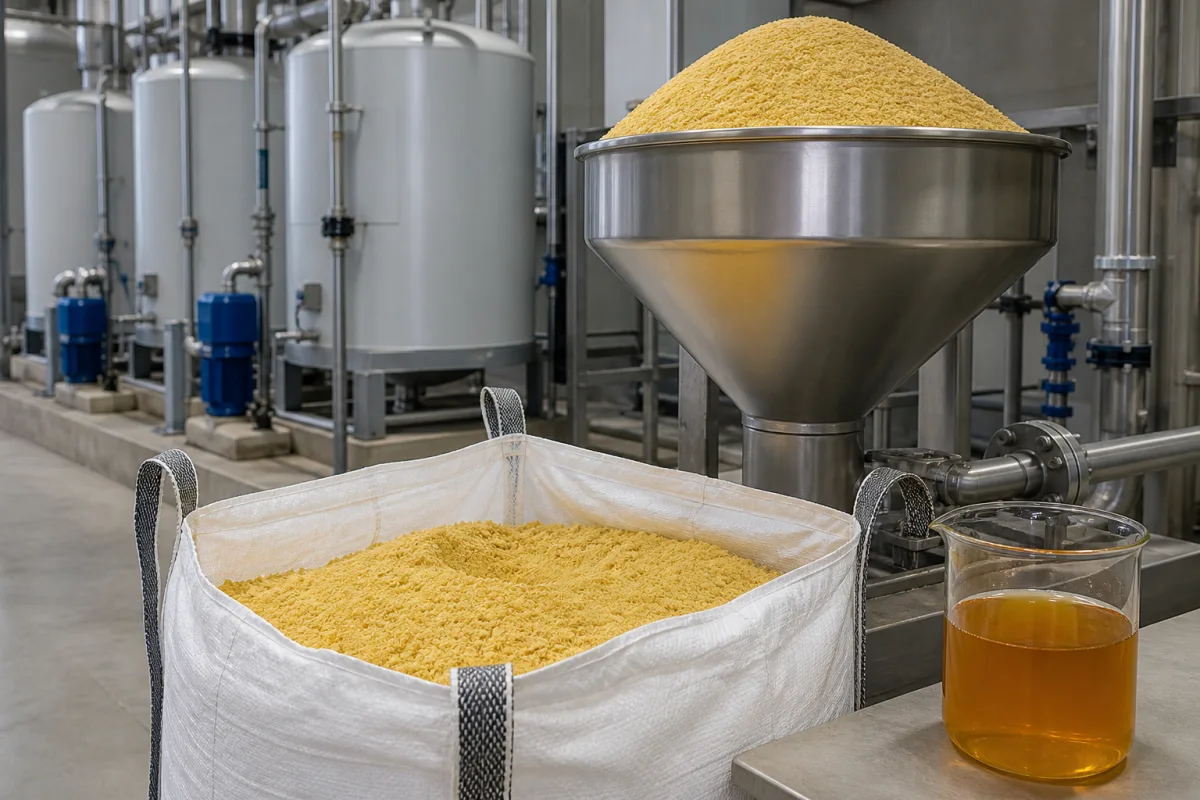
Polyaluminium chloride (PAC) is a prehydrolysed aluminium coagulant, supplied as a yellowish liquid or powder, dosed into raw water or wastewater to destabilise colloids so turbidity, colour and organic matter can be settled and filtered out. Ask three things first: what Al2O3 content and basicity the grade has, which standard and impurity limits it is certified to for your use, and how its dose in grams of aluminium per cubic metre compares with your present coagulant.
Liquid and solid polyaluminium chloride coagulants for drinking water, industrial water and wastewater treatment. Aluminium sulphate, ferric coagulants, polyacrylamide flocculants and aluminium chlorohydrate for cosmetics are outside this page.
CNFX editorial research · Sources checked October 12, 2026 · 4 sources
Choose Al2O3 strength, basicity and impurity limits
The Andhra Sugars, an Indian producer, lists four liquid PAC grades: PAC 18% at 16.5–18.0% Al2O3, 35–45% basicity and density 1.35–1.41 g/cm³; PAC 14% at 13.5–14.5% and 25–35%; PAC 10% medium basicity at 9.5–10.5% and 40–50%; and PAC 10% high basicity at 10.2–10.5% and 64–80%, with chloride, sulphate and pH (5% solution, 3.0–4.5) limits for each. [1]
A producer's technical data sheet to TS EN 17034 (the Turkish adoption of the European drinking-water PAC standard), listed by Indufarm, sets Al2O3 at 17.00% ± 1 minimum, basicity at least 35, pH (5%) at least 3.50, density at least 1.35 g/cm³ at 20 °C and water-insoluble matter at most 25 g/kg Al, with metal limits per kg of aluminium including arsenic 14 mg, cadmium 3 mg, chromium 30 mg, mercury 4 mg, nickel 20 mg, lead 40 mg, antimony 20 mg and selenium 20 mg. It gives a two-year shelf life, asks for storage away from freezing and high temperatures in plastic, FRP, epoxy-coated concrete, titanium or acid-proof or rubber-lined steel. [2]
Editorial note: impurity limits expressed per kg of aluminium scale with dose; ask for the certificate of analysis for each batch with the standard named, and check the limits required for drinking water where you operate.
Give the supplier the application (drinking water, industrial, wastewater), raw water quality (turbidity, colour, TOC, alkalinity, pH, temperature), required grade (Al2O3, basicity, liquid or powder), standard and certificates (e.g. EN 17034 or national drinking-water standard), monthly volume, packaging (drums, IBCs, bulk), storage materials and delivery.
02
Compare dose and residual aluminium against alum
Rak and Świderska-Bróż of Wrocław University of Technology compared alum (0% basicity) with five PACs of 35% to 85% basicity on Odra river water, dosing all in g Al/m³. All PACs destabilised colloids more effectively than alum; higher basicity lowered the dose needed, smaller PAC doses matched alum's removal, and PACs depended less on temperature and pH. [3]
They concluded that PACs, especially those of 70% basicity or more, were more useful than alum because they left lower residual aluminium and raised water corrosivity less, and removed coloured matter and organic substances more efficiently. Jar tests used rapid mixing at 200 rpm and slow mixing at 30 rpm before one hour of sedimentation. [3]
Editorial calculation: Al2O3 is 2 × 26.98 / 101.96 ≈ 52.9% aluminium, so a 17% Al2O3 liquid holds about 9.0% Al. A dose of 3 g Al/m³ then needs about 3 / 0.090 ≈ 33 g of product per m³ (33 mg/L), or about 25 mL/m³ at a density of 1.35 g/cm³. The dose is an assumed example; set it by jar testing on your water. [2][3]
03
Set the treated-water aluminium target
Residual aluminium from a coagulant is judged against drinking-water goals. In the United States, the EPA's secondary maximum contaminant levels for public water systems (40 CFR 143.3) list aluminium at 0.05 to 0.2 mg/L, alongside pH 6.5–8.5, chloride 250 mg/L, sulfate 250 mg/L, iron 0.3 mg/L, manganese 0.05 mg/L and total dissolved solids 500 mg/L. The rule describes these levels as reasonable goals for drinking water quality and allows states to set higher or lower levels where local conditions justify it. [4]
The Wrocław comparison above found that PACs matched alum's removal at smaller aluminium doses; state the 0.05–0.2 mg/L goal, or your own target, in the specification so jar tests can be judged against it. [3][1][2]
Editorial calculation: at a dose of 2 g Al/m³ (2 mg/L as Al), a residual of 0.2 mg/L would mean 10% of the dosed aluminium passes through; the 0.05 mg/L lower end would be 2.5%.
40 CFR 143.3 secondary level
Value
Why it matters for PAC dosing
Aluminium
0.05–0.2 mg/L
Residual aluminium after coagulation
pH
6.5–8.5
PAC and alum both affect treated-water pH
Chloride
250 mg/L
PAC adds chloride; alum adds sulfate
Sulfate
250 mg/L
Alum adds sulfate
Total dissolved solids
500 mg/L
Coagulant adds dissolved salts
State the treated-water aluminium target and the pH range at the dosing point, and ask the PAC supplier for jar-test data showing residual aluminium at your dose.
04
Three listed PAC sellers and what else they make
Aojin lists PAC beside aluminium sulphate, Xinqi beside polyacrylamides, and Runjin lists both an industrial PAC and a PAC solution beside refractories; ask each for the Al2O3 grade, basicity and any drinking-water approval behind its product.
Listings include liquid and solid PAC alongside aluminium sulphate and polyacrylamide; ask each for Al2O3, basicity, insolubles and metal limits on a batch certificate.
05
Al2O3, basicity, impurities and anions in a PAC specification
Basicity is the property that moves the dose: in the Wrocław study, higher-basicity PACs needed lower doses, and smaller PAC doses matched alum's removal. [3]
Grade values for Al2O3, basicity, density, pH and residual aluminium
Liquid grades in the reviewed data span 9.5–18.0% Al2O3 and 25–80% basicity; the last row ties the order to the US secondary aluminium level of 0.05–0.2 mg/L in treated water. [1][4]
3 companies list this product among what they make. Company figures are quoted from each
company's own website; every card states where the relationship came from.
Shandong Aojin Chemical Technology Co., Ltd.
Manufacturing site to be confirmed for the order
Lists polyaluminium chloride and aluminium sulphate among water treatment chemicals.
Explore company information and manufacturing capabilities, then discuss the scope of your project with a relevant supplier.
Share this page
Compiled and source-reviewed by the CNFX editorial team.
Each manufacturer above links to the page on that company's own website where the product is listed, with the date we checked it. How we source and review
· Page last updated 13 October 2026
Buyer questions
What does basicity mean for PAC?
The degree of prehydrolysis; Wrocław University tests found higher-basicity PACs needed lower doses than alum. [3]
How strong is liquid PAC?
Andhra Sugars lists liquid grades from about 10% to 18% Al2O3. [1]
What impurity limits apply to drinking-water PAC?
An EN 17034 data sheet limits, per kg Al, arsenic to 14 mg, lead to 40 mg and mercury to 4 mg, among others. [2]
Is PAC better than alum?
In Wrocław tests PACs, especially of 70% basicity or more, left lower residual aluminium and raised corrosivity less. [3]
What residual aluminium is acceptable in drinking water?
The US EPA's secondary maximum contaminant level for aluminium in public water systems is 0.05 to 0.2 mg/L (40 CFR 143.3), which the rule calls a reasonable goal that states may set higher or lower. [4]
Sources and what still needs a direct check
Sources checked 2026-10-12. The Andhra Sugars and the EN 17034 data sheet are producers' specifications; Rak and Świderska-Bróż published a peer-reviewed comparison of PAC and alum. The standards themselves govern drinking-water approval.