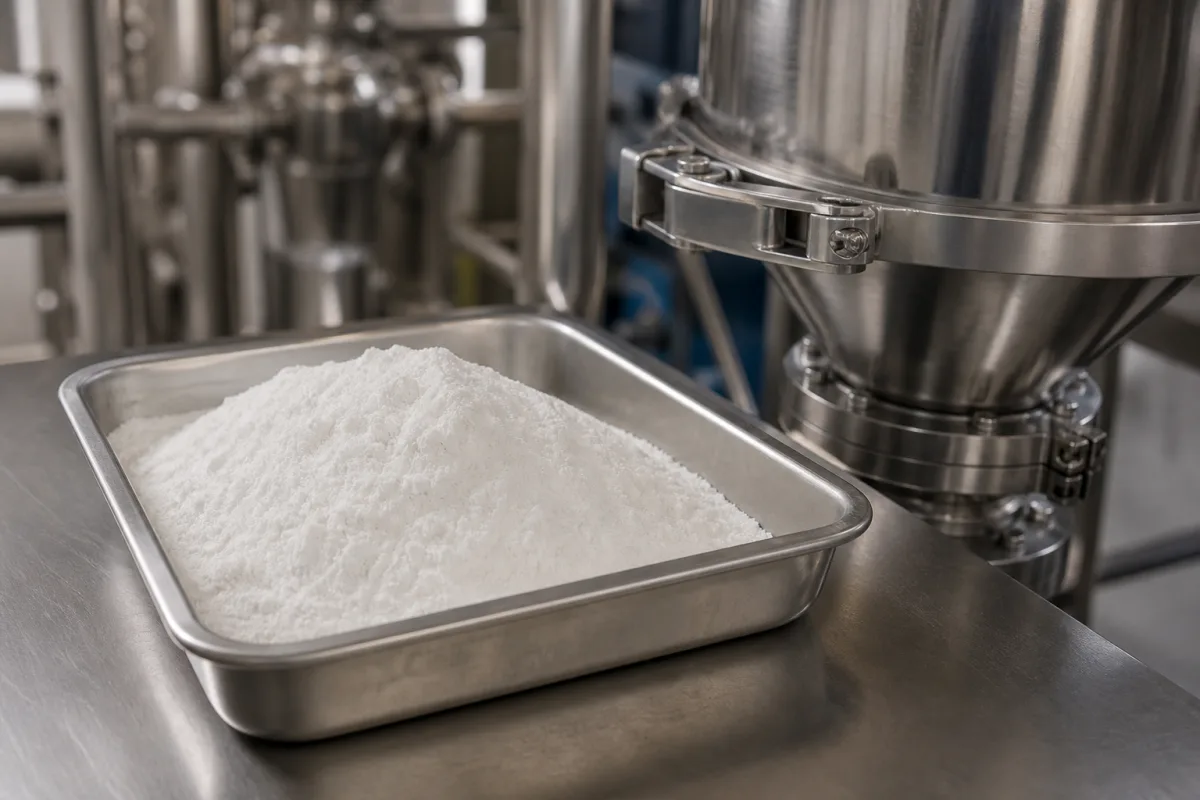
Polyvinyl alcohol (PVA, PVOH) powder and granules for binders · degree of hydrolysis (mol%), 4% solution viscosity at 20 °C, volatiles, ash, pH, molecular weight, bulk density, fine-powder grades, dissolution, binder use in adhesives, paper, textile sizes and ceramics
Polyvinyl alcohol (PVA or PVOH) is a water-soluble polymer made by alcoholysis (hydrolysis) of polyvinyl acetate, sold as granules, flakes or fine powder and dissolved in water to bind pigments, paper coatings, textile sizes, adhesives and ceramic powders. Its behaviour is set by two numbers: the degree of hydrolysis in mol% and the viscosity of a 4% aqueous solution at 20 °C, which stands for molecular weight. Ask three things first: which hydrolysis and viscosity grade the binder needs, the volatiles, ash and pH limits, and the physical form and dissolution route your plant can handle.
Polyvinyl alcohol resin supplied as powder, granules or flakes for use as a binder in adhesives, paper and pigment coatings, textile sizes and ceramic forming, covering partially, intermediate and fully hydrolyzed grades. PVA fibres, PVA film, PVA solutions sold ready-made, polyvinyl acetate emulsions, PVB resins and redispersible powders are outside this page except where compared.
CNFX editorial research · Sources checked October 11, 2026 · 5 sources
Pick the degree of hydrolysis and the 4% viscosity grade
Kuraray explains that in its grade names the first number is the viscosity of the 4% aqueous solution at 20 °C, as a relative measure of molar mass, and the second is the degree of hydrolysis of the polyvinyl acetate it is made from. Its data sheet lists partially hydrolyzed 5-88 at 4.6–5.4 mPa·s and 86.5–89.0 mol%, 22-88 at 20.5–24.5 mPa·s and 87.0–89.0 mol%, medium-hydrolyzed 17-94 at 14.5–18.5 mPa·s and 92.5–94.5 mol%, and fully hydrolyzed 28-98 at 25.0–31.0 mPa·s and 98.0–99.0 mol%. [1] Kuraray's FAQ gives its viscosity range as about 3 to 225 mPa·s (4% solution, 20 °C) and groups hydrolysis as partially (about 87–89 mol%), intermediately (about 92–96 mol%) and fully hydrolyzed (about 98–99 mol%). [2]
Sekisui's Selvol brochure uses the same 4% viscosity as its measure of molecular weight: 3–6 cP corresponds to a degree of polymerization of 150–650 and a weight-average molecular weight of 13,000–50,000; 22–30 cP to 1000–1500 and 85,000–124,000; 45–72 cP to 1600–2200 and 146,000–186,000. It classes partially hydrolyzed grades at 87.0–89.0 mol%, fully at 98.0–98.8 and super at 99.3+. [3]
Chinese makers name grades differently. Wanwei lists more than thirty PVA grades including PVA17-99, PVA26-99, PVA04-99, PVA05-99, PVA17-88 and PVA05-88, and defines the polymer as (CH3CHCOOCH3)x(CH2CHOH)y, where x + y is the degree of polymerization and y/(x + y) the degree of alcoholysis. [4] Editorial note: because Kuraray's first number is a viscosity and the Wanwei page does not state viscosity for its grades, ask any supplier of a 17-88 or 24-88 grade for the measured 4% viscosity at 20 °C and the alcoholysis range on the certificate of analysis rather than comparing grade names.
Give the supplier the binder use (adhesive, paper or pigment coating, textile size, ceramic pressing), the target degree of hydrolysis in mol%, the 4% solution viscosity range at 20 °C, volatiles, ash and pH limits with the test method, the form (granules, flakes or fine powder) and any particle-size requirement, methanol limit, packaging, and quantity.
02
Set volatiles, ash and pH limits, form and dissolution
Kuraray's standard grades carry volatiles ≤5.0%, ash ≤0.4% (≤0.6% for the low-viscosity fully hydrolyzed 3-98, 5-98 and 11-98) and pH 5.0–7.0, and its low-ash grades go to ≤0.09% ash; it states non-volatile content of at least 95% after 3 hours at 105 °C and methanol under 3%. [1] Selvol standard grades list volatiles 5.0% max, ash 0.5–1.2% max expressed as Na2O, methanol 0.9% max, and pH 4.5–6.5 for partially hydrolyzed and 5.0–7.0 for fully hydrolyzed grades, all on a 4% solution. [3]
Form: Kuraray supplies granules and fine powder with defined grain size, including fine-powder S2 versions of 5-88, 22-88, 30-88, 44-88 and 28-98 with the same viscosity and hydrolysis ranges as the standard grades. [1] Wanwei describes PVA as white flake, granular or powder solid, or a white flocculent solid depending on the alcoholysis process, with specific gravity 1.23–1.31 g/cm³ and bulk density 0.42–0.52 g/cm³ for flake versus 0.20–0.27 g/cm³ for flocculent PVA; it notes no marked change below 40 °C, gradual colouring with long heating above 160 °C and decomposition above 220 °C. [4]
Dissolution depends on hydrolysis. Kuraray's FAQ says fully hydrolyzed grades are added to room-temperature water with stirring and heated for about 60 minutes after reaching about 95 °C, while partially hydrolyzed grades, which dissolve readily in cold water and can form lumps, should be charged below 25 °C and held at 93–95 °C for 30–60 minutes. [2] Kuraray's data sheet adds that dissolution slows as the 4% viscosity rises, and that the powder must be kept dry because it absorbs moisture and can form blocks. [1]
For ceramics, a Kuraray patent on a compression-molding binder (US 6,737,013 B1) describes drying an aqueous kneaded mix of ceramic powder, water and a modified vinyl alcohol polymer binder into granules, pressing the granules and sintering, with 0.1 to 20 weight parts of binder per 100 weight parts of ceramic powder (0.2 to 15 preferred), and a polymerization degree of 200 to 2,000 for its polymer. [5]
03
Grade table, certificate of analysis and form to request from each PVA bidder
When requesting quotations, ask each supplier for its grade table with hydrolysis and 4% viscosity ranges, a certificate of analysis, test methods, available forms (granules, flakes, fine powder), packaging and samples.
04
Vinyl alcohol and residual acetate units, chain length, volatiles and ash
The first three rows are what a grade name encodes: in Kuraray's 22-88, 22 reads chain length as 4% solution viscosity and 88 is the degree of hydrolysis, the share of acetate units converted to vinyl alcohol. [1]
Hydrolysis, 4% viscosity, ash, volatiles, pH and bulk density for a PVA order
Ash needs its basis stated: Kuraray quotes ≤0.4% for standard grades and ≤0.09% for low-ash grades, while Selvol's 0.5–1.2% maxima are given as Na2O. [1][3]
Field
What it means and published values
Ask the supplier for
Degree of Hydrolysis (%)
86.5–89.0 mol% (5-88) to 98.0–99.0 mol% (28-98). [1]
1 company lists this product among what they make. Company figures are quoted from each
company's own website; every card states where the relationship came from.
Anhui Wanwei Updated High-Tech Material Industry Co., Ltd.
Manufacturing site to be confirmed for the order
Its website lists polyvinyl alcohol (PVA) in flake, granular or powder form, in more than 30 grades including PVA17-88 and PVA05-88.
Explore company information and manufacturing capabilities, then discuss the scope of your project with a relevant supplier.
Share this page
Compiled and source-reviewed by the CNFX editorial team.
Each manufacturer above links to the page on that company's own website where the product is listed, with the date we checked it. How we source and review
· Page last updated 13 October 2026
Buyer questions
What do the numbers in a PVA grade such as 22-88 mean?
In Kuraray's naming, 22 is the 4% solution viscosity at 20 °C and 88 the degree of hydrolysis; its 22-88 is 20.5–24.5 mPa·s and 87.0–89.0 mol%. [1]
How is PVA powder dissolved?
Kuraray charges partially hydrolyzed grades below 25 °C and holds 93–95 °C for 30–60 minutes; fully hydrolyzed grades are heated about 60 minutes after reaching about 95 °C. [2]
How much PVA-type binder goes into ceramic pressing granules?
A Kuraray patent gives 0.1 to 20 weight parts of its vinyl alcohol polymer binder per 100 weight parts of ceramic powder, 0.2 to 15 preferred. [5]
Sources and what still needs a direct check
Sources checked 2026-10-11. Sources are maker data sheets and pages from Kuraray, Sekisui and Wanwei, and a Kuraray patent on ceramic binders.