Industry-Verified Manufacturing Data (2026)

Pharmaceutical Tablet Press Compression Roller

Based on aggregated insights from multiple verified factory profiles within the CNFX directory, the standard Pharmaceutical Tablet Press Compression Roller used in the Pharmaceutical and Medicinal Chemical Manufacturing sector typically supports operational capacities ranging from standard industrial configurations to heavy-duty production requirements.

Technical Definition & Core Assembly

A canonical Pharmaceutical Tablet Press Compression Roller is characterized by the integration of Roller Body and Surface Coating. In industrial production environments, manufacturers listed on CNFX commonly emphasize Hardened Tool Steel construction to support stable, high-cycle operation across diverse manufacturing scenarios.

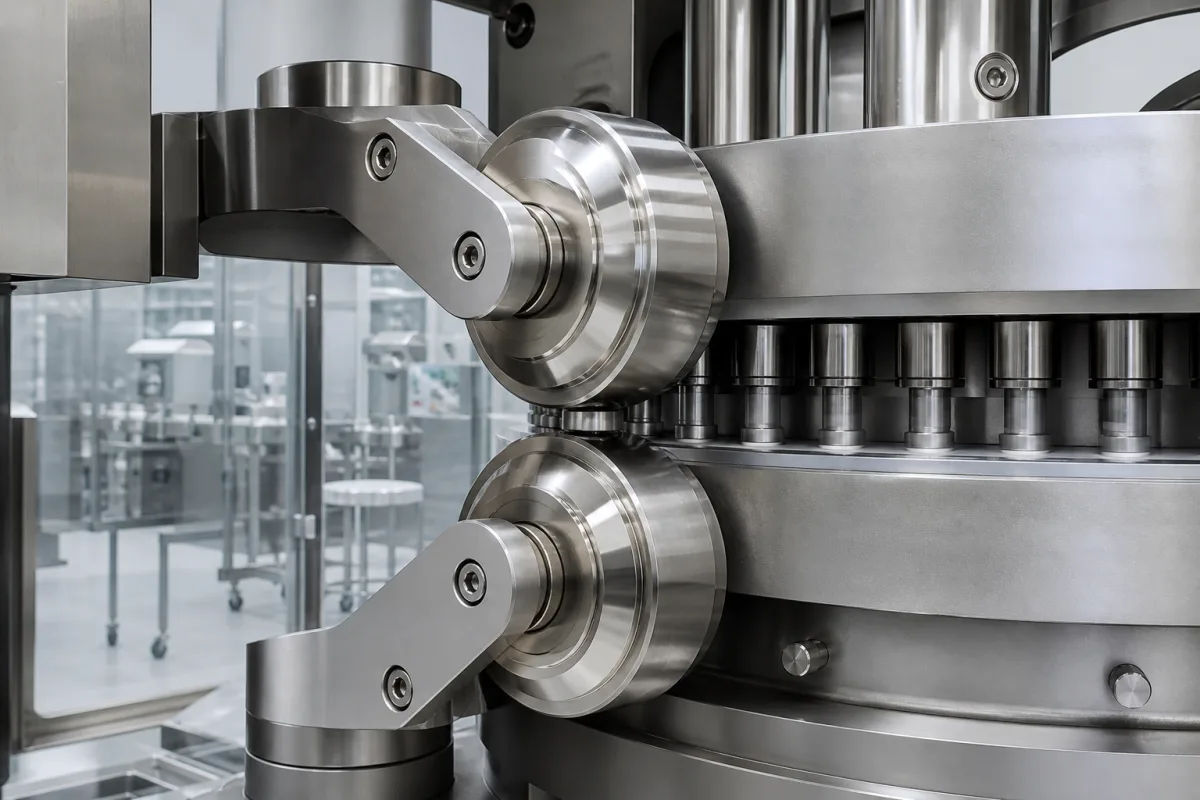
Precision cylindrical roller that applies controlled pressure to pharmaceutical powder in tablet presses
Product Specifications

Technical details and manufacturing context for Pharmaceutical Tablet Press Compression Roller

Definition
A critical rotating component within pharmaceutical tablet compression machines that directly contacts powder blends during the tablet formation process. It applies precise, uniform pressure to compress pharmaceutical formulations into solid tablets with consistent weight, thickness, and hardness. The roller's surface finish and dimensional accuracy directly impact tablet quality, preventing capping, lamination, and weight variation defects. Proper roller design ensures efficient powder compression while minimizing wear and contamination risks in GMP manufacturing environments.
Working Principle
Rotates against upper and lower punches to compress powder between them, transferring mechanical force from the press mechanism to create solid tablets through controlled pressure application.
Common Materials
Hardened Tool Steel, Stainless Steel 316L, Chromium-Plated Steel
Technical Parameters
  • Critical dimension affecting compression force distribution and tablet thickness control (mm) Standard Spec
  • Determines wear resistance and longevity in continuous pharmaceutical production (HRC) Standard Spec
Components / BOM
  • Roller Body
    Main cylindrical structure that applies compression force
    Material: Hardened tool steel or stainless steel
  • Surface Coating Optional
    Wear-resistant layer reducing friction and contamination
    Material: Chromium plating or ceramic coating
  • Keyway
    Machined slot for positive drive connection to shaft
    Material: Same as roller body
  • Lubrication Grooves Optional
    Channels for controlled lubricant distribution
    Material: Same as roller body
Engineering Reasoning
50-300 kN compression force, 0.1-0.5 mm/s linear speed, 20-80°C operating temperature
Material yield strength exceeded at 350 MPa compressive stress, surface temperature >150°C causing thermal expansion mismatch >0.02 mm, Hertzian contact stress >1.5 GPa causing subsurface cracking
Design Rationale: Cyclic Hertzian contact fatigue from repeated powder compression cycles leads to subsurface crack initiation at 10⁶-10⁷ cycles; differential thermal expansion between roller core (steel, α=11×10⁻⁶/°C) and surface coating (chromium, α=6×10⁻⁶/°C) causes interfacial delamination; abrasive wear from pharmaceutical excipient particles (50-200 μm) exceeding Archard wear coefficient K=5×10⁻⁶
Risk Mitigation (FMEA)
Trigger Misalignment exceeding 0.05 mm between upper and lower rollers
Mode: Asymmetric loading causing bending moment >500 N·m and premature bearing failure
Strategy: Laser alignment system with 0.01 mm precision and automatic correction feedback loop
Trigger Coolant flow reduction below 2 L/min causing heat accumulation
Mode: Thermal expansion exceeding 0.15 mm radial clearance, leading to seizure at roller-powder interface
Strategy: Redundant cooling circuits with flow sensors and Peltier-assisted heat extraction

Industry Taxonomies & Aliases

Commonly used trade names and technical identifiers for Pharmaceutical Tablet Press Compression Roller.

Industrial Ecosystem & Supply Chain DNA

Complementary Systems
Downstream Applications
Specialized Tooling

Application Fit & Sizing Matrix

Operational Limits
pressure: Up to 100 kN (typical), 150 kN (max)
other spec: Surface finish: Ra ≤ 0.2 μm, Hardness: 58-62 HRC, Runout tolerance: ≤ 0.01 mm
temperature: 20-40°C (operating), -10 to 60°C (storage)
Media Compatibility
✓ Pharmaceutical powder blends (lactose-based) ✓ Direct compression excipients (microcrystalline cellulose) ✓ Granulated APIs with binders (PVP, HPMC)
Unsuitable: Highly abrasive or corrosive media (e.g., metal powders, acidic slurries)
Sizing Data Required
  • Tablet press model and die station configuration
  • Required compression force range (kN) for target tablet hardness
  • Roller diameter and width to match press specifications

Reliability & Engineering Risk Analysis

Failure Mode & Root Cause
Surface fatigue and spalling
Cause: Cyclic compressive loading from tablet compression leads to subsurface crack initiation and propagation, exacerbated by material imperfections or improper heat treatment.
Bearing seizure or excessive wear
Cause: Inadequate lubrication, contamination from powder ingress, or misalignment causing increased friction and thermal stress on bearing surfaces.
Maintenance Indicators
  • Audible grinding or knocking noises during operation indicating bearing wear or roller surface damage
  • Visible scoring, pitting, or uneven wear patterns on roller surfaces during inspection
Engineering Tips
  • Implement precision alignment procedures during installation and regular laser alignment checks to prevent uneven loading and premature wear
  • Establish a proactive lubrication regimen with pharmaceutical-grade lubricants and contamination control measures to prevent powder ingress into bearing assemblies

Compliance & Manufacturing Standards

Reference Standards
ISO 9001:2015 - Quality management systems CE Marking - EU Machinery Directive 2006/42/EC ASTM E18-22 - Standard Test Methods for Rockwell Hardness of Metallic Materials
Manufacturing Precision
  • Surface finish: Ra ≤ 0.4 μm
  • Diameter tolerance: ±0.01 mm
Quality Inspection
  • Dimensional verification via CMM (Coordinate Measuring Machine)
  • Hardness testing per ASTM E18-22

Factories Producing Pharmaceutical Tablet Press Compression Roller

Verified manufacturers with capability to produce this product in China

✓ 95% Supplier Capability Match Found

P Procurement Specialist from Brazil Mar 01, 2026
★★★★★
"The technical documentation for this Pharmaceutical Tablet Press Compression Roller is very thorough, especially regarding Roller Diameter (mm)."
Technical Specifications Verified
T Technical Director from Canada Feb 26, 2026
★★★★★
"Reliable performance in harsh Pharmaceutical and Medicinal Chemical Manufacturing environments. No issues with the Pharmaceutical Tablet Press Compression Roller so far."
Technical Specifications Verified
P Project Engineer from United States Feb 23, 2026
★★★★★
"Testing the Pharmaceutical Tablet Press Compression Roller now; the Roller Diameter (mm) results are within 1% of the laboratory datasheet."
Technical Specifications Verified
Verification Protocol

“Feedback is collected from verified sourcing managers during RFQ (Request for Quote) and factory evaluation processes on CNFX. These reports represent historical performance data and technical audit summaries from our B2B manufacturing network.”

12 sourcing managers are analyzing this specification now. Last inquiry for Pharmaceutical Tablet Press Compression Roller from Germany (48m ago).

Frequently Asked Questions

What materials are best for pharmaceutical tablet press compression rollers?

Our rollers use hardened tool steel for durability, stainless steel 316L for corrosion resistance in clean environments, or chromium-plated steel for enhanced wear resistance and smooth operation.

How do I maintain tablet press compression rollers?

Regularly inspect lubrication grooves for proper oil flow, check surface coating for wear, and monitor runout tolerance to ensure consistent tablet compression and prevent press damage.

What specifications should I consider when ordering replacement rollers?

Key specs include bore diameter, roller diameter, roller width for press compatibility, runout tolerance for precision, surface hardness (HRC) for durability, and surface roughness (Ra) for smooth operation.

Can I contact factories directly on CNFX?

CNFX is an open directory, not a transaction platform. Each factory profile provides direct contact information and production details to help you initiate direct inquiries with Chinese suppliers.

Get Quote for Pharmaceutical Tablet Press Compression Roller

Request technical pricing, lead times, or customized specifications for Pharmaceutical Tablet Press Compression Roller directly from verified manufacturing units.

Your business information is encrypted and only shared with verified Pharmaceutical Tablet Press Compression Roller suppliers.

Thank you! Your message has been sent. We'll respond within 1–3 business days.

Need to Manufacture Pharmaceutical Tablet Press Compression Roller?

Connect with verified factories specializing in this product category

Add Your Factory Contact Us
Previous Product
Pharmaceutical Tablet Counting and Bottling Machine
Next Product
Pharmaceutical Tablet Press Compression Roller Bearing