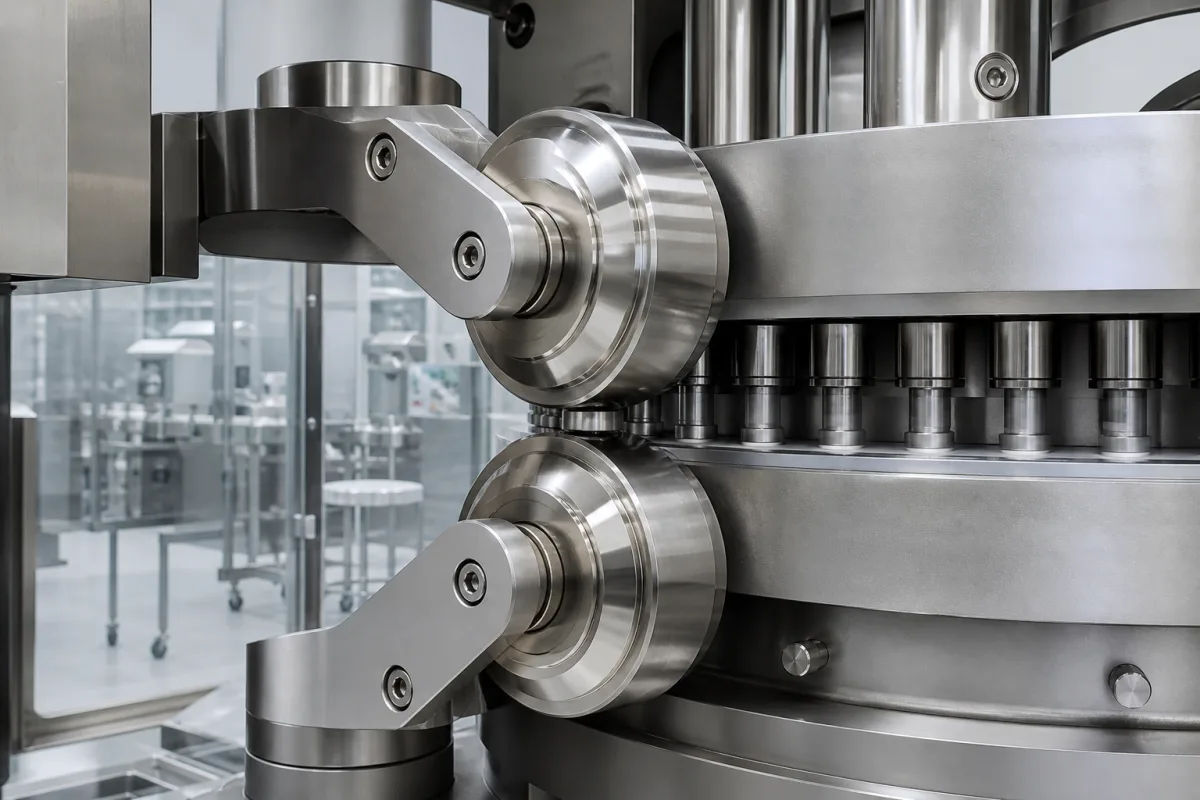
Tablet press compression roller: pre- and main compression roller diameters, force on the roller axles and the overload station behind them
The pre-compression and main compression rollers of a rotary tablet press and the station that holds them · roller diameter and the time a punch spends under load, equal pre- and main forces, force measurement on the roller axle, and overload release
Every punch in a rotary press is pushed into the die by a pair of rollers, first at the pre-compression station and then at the main compression station. The rollers decide how far the turret travels while the punch is being driven in, how much force each station can apply, and where that force is measured. When a press is bought, rebuilt or uprated, the roller diameters, their force rating and the station they sit in are the figures to pin down, separately from the punches and the turret.
Pre-compression and main compression rollers for rotary tablet presses, with their axles, bearings and pressure roller stations, including force measurement on the roller axles and overload protection. Complete rotary tablet presses chosen by stations, output, tooling standard and GMP construction are covered on the Rotary tablet press (pharmaceutical) page; punch tips and multi-tip tooling on the Pharmaceutical tablet press punch tip page; forced and gravity feeders on the Pharmaceutical tablet press feed frame page. Roller compactors for dry granulation are outside this page.
CNFX editorial research · Sources checked October 12, 2026 · 3 sources
A 44 mm pre-roller against a 250 mm one: roller diameter sets how long the punch is being driven in
Published press settings put roller diameters anywhere from 44 mm to 250 mm. Zakowiecki and co-authors set a compaction simulator to mimic a small rotary press with a 180 mm turret diameter, a 44 mm pre-compression roll, a 160 mm main compression roll and 65 degrees between the rollers, run at 70 rpm with 5 kN pre-compaction and 10 to 50 kN main compaction on 11.28 mm flat-faced punches. [2] IMA describes its Prexima 300 press with pre-compression and main compression rollers of the same 250 mm diameter, both supported on two sides inside two cast-iron structures, and rates both stations to 100 kN. [1]
Editorial calculation (geometry, punch head treated as a point and its flat ignored): a roller of radius R pushes a punch down by a depth h over a horizontal distance of √(2Rh − h²) before its lowest point. For the last 2 mm of punch travel, that is about 9.2 mm under a 44 mm roller, 17.8 mm under a 160 mm roller and 22.3 mm under a 250 mm roller.
Editorial calculation: assuming the punches run on the simulated 180 mm turret diameter, they move at about 0.66 m/s at 70 rpm (π × 180 mm × 70 / 60). The last 2 mm of travel would then take about 14 ms under the 44 mm pre-compression roll and about 27 ms under the 160 mm main roll. [2]
Equal roller diameters let the pre-compression station carry as much force as the main station. In IMA's trial on a 33-station Eu-B turret with 8 mm round biconvex tooling, a starch-rich placebo at 250 mg and a fixed main compression force of 21 kN, tablet hardness rose from 64 N with no pre-compression to 69, 71, 84 and 95 N at 5, 10, 15 and 20 kN pre-compression. IMA reports an average gain of 10 N for every 5 kN from 10 kN upward and almost 50% overall, and notes that this matters when the main force cannot be raised further, for example near the maximum tooling load. [1]
Editorial calculation: 95 / 64 ≈ 1.48, consistent with IMA's "almost 50%". IMA's own scaling example is that the same 400 MPa on 12 mm round flat tablets would need about 45 kN at both stations; a 12 mm circle has an area of about 113 mm², and 400 MPa × 113 mm² ≈ 45 kN. [1]
Ask for the pre-compression and main compression roller diameters, the force rating of each station, whether the rollers are supported on one or both sides, and the angle between the stations on the turret.
02
Strain gauges on the roller axles, disk springs that let the roller yield, and a 2–4 bar air cushion for moving the station
Korsch's patent on pressure roller stations for rotary presses (US 10,500,807 B2) places the upper and lower pressure roller axles on mutually adjustable upper and lower receptacles guided by an open guide profile. It measures the pressing force with strain gauges on the axles, preferably the lower one, covering a force range of 20 to 100 kN in steps. [3]
The lower roller receptacle is held through an overload protection of layered disk springs, which the patent says can provide biasing forces of up to 100, 125 or 150 kN in the available space. If the pressing force exceeds the bias, for example when remains of earlier pressings that cannot be compressed further are left in a die, or when a die is overfilled, the springs give way, and the overload protection returns to its starting position by itself once the force drops below the set bias. [3]
The same station can be moved on its base plate on an air cushion: a flat cavity of 1 to 2 mm height under the station is pressurised at 2 to 4 bar from the press's own pneumatics through a pressure-reduction valve, after the clamping is released. [3]
Editorial note: these are patent embodiments with preferred values, not the specification of a particular press; ask the press maker which of them the offered roller station actually uses, and at what force the overload is set relative to the station's rating.
Ask where the compression force is measured (axle, carrier or punch), its range and calibration, the overload release force and how it resets, and how the roller station is removed or adjusted.
03
Roller, force and station data for tablet press compression rollers
Paste it into your enquiry below or into an email to a maker, then replace every bracket.
Press: [model; turret diameter; stations; tooling standard]
Rollers: [pre-compression diameter; main compression diameter; width]
Support: [one-sided or two-sided; bearing type]
Force rating: [pre-compression kN; main compression kN]
Force measurement: [axle strain gauge or other; range; calibration]
Overload: [release force; reset behaviour]
Adjustment: [how the roller station is moved or exchanged]
Materials: [roller and axle material; surface hardness]
Explore company information and manufacturing capabilities, then discuss the scope of your project with a relevant supplier.
Share this page
Compiled and source-reviewed by the CNFX editorial team.
Each manufacturer above links to the page on that company's own website where the product is listed, with the date we checked it. How we source and review
· Page last updated 13 October 2026
Buyer questions
Why does compression roller diameter matter?
A larger roller pushes the punch in over a longer stretch of turret travel. By editorial geometry, the last 2 mm of punch travel spans about 9.2 mm under a 44 mm roller and 22.3 mm under a 250 mm roller. [2][1]
Does pre-compression force change tablet hardness?
In IMA's Prexima 300 trial at a fixed 21 kN main force, hardness rose from 64 N without pre-compression to 95 N at 20 kN pre-compression, almost 50%. [1]
Where is compression force measured in a roller station?
Korsch's patent places strain gauges on the pressure roller axles, preferably the lower one, covering 20 to 100 kN in steps. [3]
What protects the rollers from overload?
In Korsch's patent a layered disk-spring overload protection, biased up to 150 kN, lets the lower roller yield on overpressing or overfilled dies and resets itself. [3]
Sources and what still needs a direct check
Sources checked 2026-10-12. Roller diameters come from IMA's Prexima 300 white paper and from the press settings in a 2025 Pharmaceutics paper; the roller station design from a Korsch AG patent.