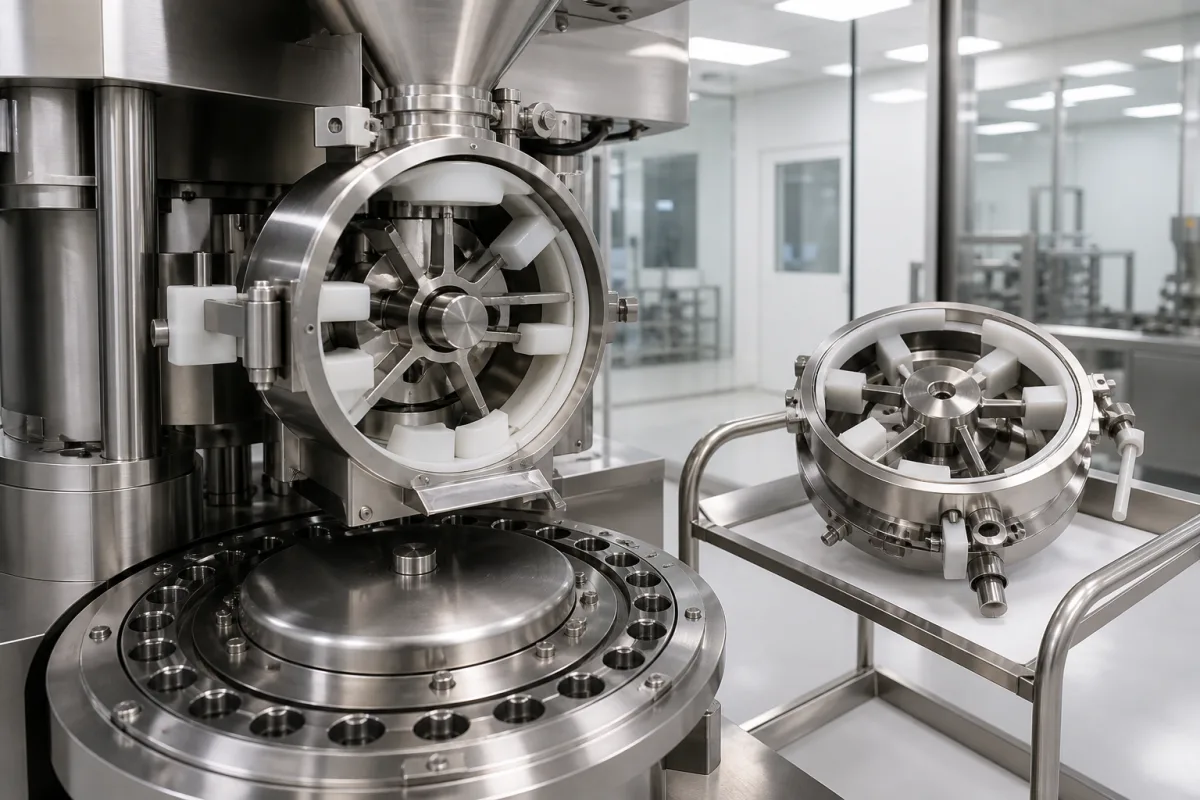
Tablet press feed frames (paddle feeders) · Gravity versus forced feeding, feeding and metering wheels, turret and paddle speed against die filling and weight variation, densification and overfill, product-contact materials and cleaning under 21 CFR 211
A tablet press feed frame is the housing that sits on the die table of a rotary tablet press under the hopper and delivers powder into each die as it passes; forced (paddle) feeders turn one to three paddle wheels inside it to push powder into the dies and return the excess. Ask three things first: which press model, turret and die table the frame must fit, how the blend flows and what turret and paddle speeds the product needs for full and even die filling, and which product-contact materials, seals and cleaning method the frame uses.
Feed frames, forced (paddle) feeders, gravity feed frames and their paddle wheels, wipers and seals for rotary pharmaceutical and nutraceutical tablet presses, as original or replacement parts. Complete tablet presses, punches and dies (see pharmaceutical tablet press punch tip), hoppers and powder blenders are outside this page except where compared.
CNFX editorial research · Sources checked October 12, 2026 · 4 sources
Schomberg, Kwade and Finke (TU Braunschweig, Pharmaceutics 12:248, 2020) explain that die filling sets tablet weight and drug content and affects compaction and ejection. Industrial rotary presses use forced feeding through a feed frame with one to three stirrers (a paddle feeder): in the two-wheel setup the feeding wheel delivers powder into the dies and the metering wheel returns excess powder to the frame, with a third wheel in some designs feeding both. Dosing depth equals the fill depth set by the fill cam minus the overfill, which the lower punch pushes back out for weight control. [1]
On a Korsch XL 100 with a single feeding wheel, four 9 mm Euro-D punch stations, fill depths of 10, 14 and 16 mm, overfill of 0.5–5.5 mm, turret speeds of 20–60 rpm and paddle speeds of 5–60 rpm, they found that the dies fill completely only up to a critical turret speed, beyond which filling yield falls roughly linearly and weight variation rises; higher paddle speed raises the critical turret speed and lowers variation, and better-flowing powders need less paddle speed. At low turret speeds, high paddle speed or a high overfill ratio densified the powder in the dies, up to tapped density for a good-flowing dicalcium phosphate blend. [1]
A follow-up study by Kohlhaas and Finke (TU Braunschweig, International Journal of Pharmaceutics: X 10:100405, 2025) used the same Korsch XL 100 with a feed frame carrying a single paddle wheel of twelve square spokes, 6 mm spoke height, four sets of 9 mm EU-D tools, 16 mm filling height and 15.5 mm dosing height. It ran turret speeds of 20–60 rpm against paddle speeds of 5–60 rpm with dicalcium phosphate, microcrystalline cellulose and lactose. On the rotary press, filling yield rose with higher paddle speed and lower turret speed; for microcrystalline cellulose, paddle speeds of 5 and 10 rpm could not supply enough powder at high turret speeds, and 60 rpm could not be run at turret speeds of 20 and 30 rpm because powder compressed inside the feed frame, risking damage to the machine. [3]
The same study compared a conventional fill cam with a 'stearate' fill cam that pulls the punch down 4.7 mm before it enters the filling zone, a geometry needed if external lubrication is used. With microcrystalline cellulose the stearate cam gave noticeably lower filling at high turret speeds, approaching the conventional cam only at high paddle speeds. The authors conclude that paddle rotation is necessary on the rotary press, especially at high production speed, because the filling time is shorter. [3]
Editorial note: if the press will use external lubrication or a stearate-type fill cam, ask the feed-frame supplier for filling data with that cam and your blend, and for the paddle speed limit at low turret speed. [3]
Editorial calculation: at 20 rpm the turret turns once every 3 s and at 60 rpm once every 1 s, so a die passing under a feed-frame opening that spans an assumed 60° of the die table has about 0.5 s to fill at 20 rpm and about 0.17 s at 60 rpm; ask the supplier for the opening arc on your press and test the blend over the turret and paddle speed range you intend to run. [1]
Give the supplier the press make and model, die table size and number of stations, punch type (B, D or other), turret speed range, current feeder type, number of wheels and paddle geometry wanted, blend flow data and lubricant content, paddle speed range and drive, product-contact materials, seals and wipers, containment needs, cleaning method (manual, wash-in-place) and documentation such as material certificates.
02
Fix product-contact materials and cleaning
21 CFR 211.65 requires equipment surfaces that contact components, in-process materials or drug products not to be reactive, additive or absorptive so as to alter the safety, identity, strength, quality or purity of the drug product, and lubricants or coolants needed for operation not to contact the product in a way that does so. [2]
21 CFR 211.67 requires equipment to be cleaned, maintained and, as appropriate, sanitised or sterilised at appropriate intervals, under written procedures that include responsibilities, schedules, methods and materials, how to disassemble and reassemble equipment for cleaning, protection of clean equipment and inspection immediately before use, with records kept. [2]
Editorial note: ask the supplier for material certificates for every product-contact part (metal, plastic wear parts and seals), how the paddle-wheel bearings are sealed from the powder, and a disassembly and cleaning instruction that fits your written procedures.
03
Buying a feeder from someone other than the press maker
No feed-frame maker has been checked for this page. A feeder from a third party still has to fit your die table and come with the filling, contact-material and cleaning evidence asked for above.
04
Ask which paddle set was tested on a blend like yours
IMA's 2020 white paper reports feed-frame trials on its Prexima 300 rotary press with 41 stations and round 8 mm Euro-B punches with a 12 mm radius of curvature. The blend was lactose-based (74.0% GranuLac 200, 24.5% Tablettose 70, 1.5% magnesium stearate), with a Carr Index of 28, classed as poorly flowable, and 0.12% loss on drying at 105 °C. [4]
A standard feeder with two flat paddles gave no benefit in preliminary trials; a three-paddle feeder showed clear improvement. IMA writes that “the paddle on the left is more responsible for powder loading in dies, instead the one on the right is responsible for die filling”, and the third paddle as delivering powder from the hopper. The final set was round off-set paddles with reduced rods on the left, flat slanted paddles on the right and round off-set as the third. In the output trial the limit was 2% weight RSD, and the white paper says all five competing presses reached 92% to 100% of nominal output. [4]
Editorial note: these are one press maker's trials for one blend. Give the feed-frame supplier your blend's flow data and ask which number of paddles and paddle shapes it recommends, with weight RSD results from a trial.
Housing, feeding and metering wheels, centre wheel, drive and table seals
The wheel arrangement comes from the TU Braunschweig description of forced feeders, where the feeding wheel pushes powder into the dies and the metering wheel returns the excess; the drive, bearing and seal rows are where 21 CFR 211.65 applies, because lubricants needed for operation must not contact the product so as to alter it. [1][2]
Press model, wheel geometry, turret and paddle speeds, overfill and fill cam for a feeder quotation
The speed and overfill ranges in this table are the settings studied on one Korsch XL 100, not limits for your press; ask the supplier for the range it has validated on your model. [1][3]
Explore company information and manufacturing capabilities, then discuss the scope of your project with a relevant supplier.
Share this page
Compiled and source-reviewed by the CNFX editorial team.
Each manufacturer above links to the page on that company's own website where the product is listed, with the date we checked it. How we source and review
· Page last updated 13 October 2026
Buyer questions
What does a tablet press feed frame do?
It delivers powder into each die as it passes; in a two-wheel paddle feeder the feeding wheel fills the dies and the metering wheel returns excess powder. [1]
Why does tablet weight vary at high press speed?
Above a critical turret speed the time under the feed frame is too short to fill the dies completely, so filling yield falls and weight variation rises. [1]
What rules apply to feed frame materials?
Under 21 CFR 211.65, product-contact surfaces must not be reactive, additive or absorptive so as to alter the drug product. [2]
Does the fill cam change how well the feed frame fills the dies?
Yes. In a 2025 TU Braunschweig study, a cam pulling the punch down 4.7 mm before the filling zone gave lower filling for microcrystalline cellulose at high turret speeds unless paddle speed was high. [3]
Does a three-paddle feed frame help with poorly flowing powders?
In IMA's 2020 white paper, a standard two-flat-paddle feeder gave no benefit for a lactose blend with a Carr Index of 28 on a 41-station press, while a three-paddle feeder showed clear improvement. [4]
Sources and what still needs a direct check
Sources checked 2026-10-12. The two TU Braunschweig studies (Pharmaceutics 2020, with five formulations, and International Journal of Pharmaceutics: X 2025) used one Korsch XL 100 laboratory press; IMA's white paper reports a press maker's trials with one blend on its own press; 21 CFR 211 is the US GMP rule for finished pharmaceuticals. Settings for your product must come from your own trials and the press maker.