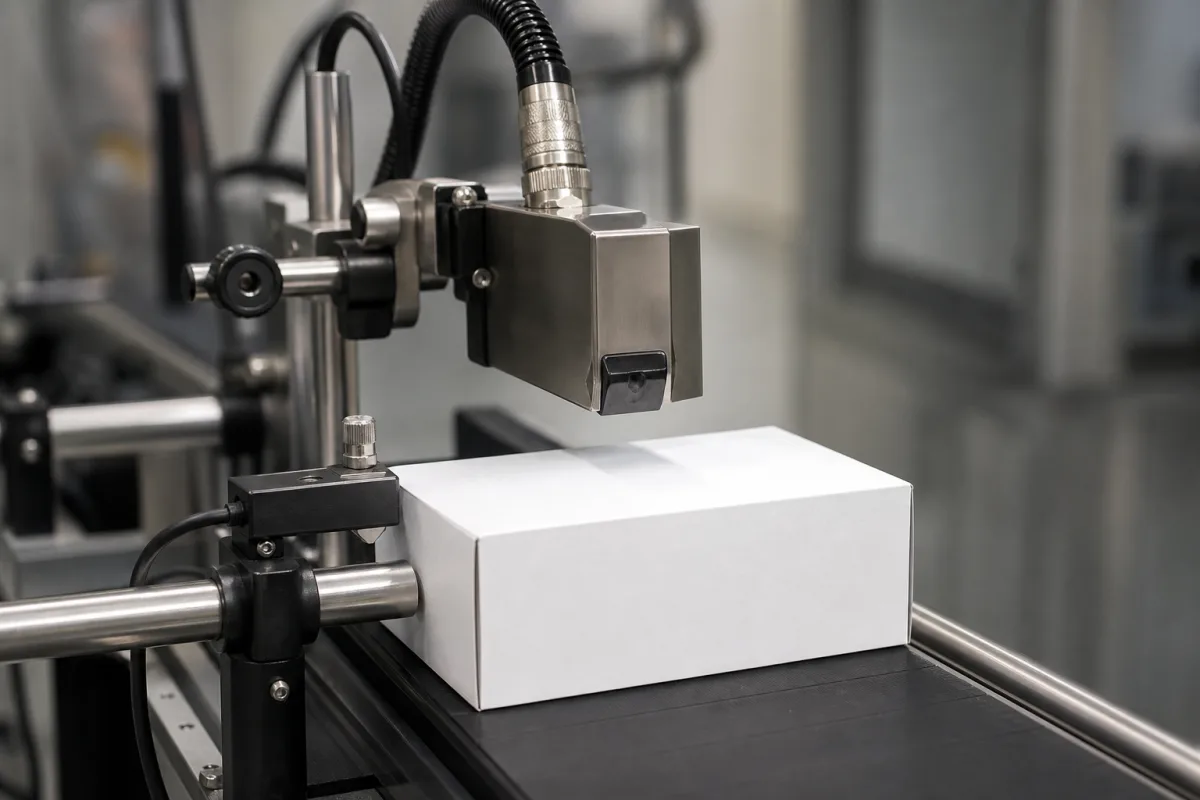
Industrial inkjet print heads for coding and marking · thermal inkjet (TIJ) cartridges, piezo drop-on-demand heads and continuous inkjet (CIJ) printheads, nozzle count and dpi, drop volume, firing frequency, print height, ink path and nozzle plate, ink compatibility
A print head is the part of a coding or industrial printing unit that puts ink on the product: a thermal inkjet (TIJ) cartridge with an integrated printhead, a piezo drop-on-demand head with a nozzle plate over an actuator array, or a continuous inkjet (CIJ) printhead fed by a pump-driven ink system. Ask three things first: which jetting technology fits the line, what nozzle count, resolution and drop volume the code or image needs, and which inks the ink path and nozzle plate are rated for.
Industrial inkjet print heads for coding, marking and industrial printing — TIJ cartridges and TIJ printhead housings, piezo drop-on-demand heads, and CIJ printheads — including their nozzle plates, actuator arrays, ink channels and manifolds, and the ink systems and pumps that feed them. Thermal transfer and label-printer printheads, office and home printer heads, laser markers and complete coding printers are outside this page except where compared.
CNFX editorial research · Sources checked October 11, 2026 · 6 sources
Compare nozzles, resolution, drop volume and firing frequency
HP lists its TIJ 2.5 thermal inkjet technology at up to 600 dpi, 300 nozzles, a print width of 0.5 inch and speeds up to 400 feet per minute; each print cartridge carries its own printhead. [1] HSA Systems' F-type printheads hold one to four TIJ 2.5 pens for a print height of 12.7–50.8 mm, at a print distance of 0.5–2.0 mm from nozzle to print surface. [2]
Piezo drop-on-demand heads carry larger nozzle arrays. Fujifilm Dimatix's SAMBA G3L and G5L each have 2048 addressable jets over a 43 mm print width at 1200 dpi native resolution; native and largest drop sizes are 2.4 and 10 pL (G3L) and 3.5 and 13 pL (G5L), with firing frequency over 100 kHz. [4] Xaar's printhead matrix lists the Xaar Nitrox with 1000 active nozzles over 70.49 mm at 360 npi, up to 48 kHz, drop volumes of 3, 6, 12 or 40 pL and up to 8 grey levels, and the Xaar Irix with 128 nozzles over 17 mm, up to 8.3 kHz and 40 or 80 pL binary drops; Xaar states these values depend on printhead model and ink type. [3]
Continuous inkjet works differently. A Videojet patent describes a printhead emitting a continuous ink jet from a 60 micron orifice at about 20 m/s, broken into droplets at 77 kHz by a piezoelectric element; selected droplets are charged and deflected by plates onto the substrate and uncharged droplets are collected in a gutter. It names 40, 50 or 70 micron orifices and 64–128 kHz as alternatives. [6] Videojet's 1580 CIJ printer prints 1 to 5 lines at up to 278 m/min (single line, 10 characters per inch), with nominal character heights of 2–10 mm and a throw distance of 5–15 mm, optimal 12 mm. [5]
HSA's F-type speed table shows the trade between resolution and speed for TIJ 2.5: at 600 dpi vertical resolution the head runs 304 m/min at 75 dpi horizontal resolution, 76 m/min at 300 dpi, 38 m/min at 600 dpi and 10 m/min at 2400 dpi. [2]
Editorial calculation: dot pitch is 25.4 mm ÷ dpi, so 1200 dpi gives about 21 µm and 600 dpi about 42 µm, and the Xaar Nitrox's 1000 nozzles across 70.49 mm give about 70.5 µm nozzle spacing, and 25.4 mm ÷ 360 npi gives the same 70.6 µm to rounding. [4][3]
Give the supplier the jetting technology (TIJ, piezo drop-on-demand or CIJ), print height or swath width, resolution in both directions, line speed, drop volume or grey levels, code content (text lines, barcodes, 2D codes), print distance to the product, mounting orientation, controller and interface, ink type and substrate, ambient temperature and humidity, and quantity.
02
Check the ink path, nozzle plate and ink compatibility
Fujifilm Dimatix lists the SAMBA nozzle plate as silicon MEMS with a protective REDIJET coating, with non-wetting and internal protective coating options; the head uses sputtered PZT actuators, dual recirculation, fluid thermal transfer temperature control, an operating temperature up to 60 °C and an integrated temperature sensor. The G3L is listed for UV, aqueous, latex and solvent fluids at 4–8 cP, and the G5L for aqueous, latex and solvent fluids at 5–9 cP. [4] Xaar lists a viscosity range of 6–100 cP for the Nitrox and 6–20 cP for the Irix, and up to 2 fluid paths on the Xaar 2002. [3]
In TIJ the ink path is in the cartridge. HP describes self-contained, customer-replaceable print cartridges that deliver a fresh printhead with each replacement, offers pigment-based and dye-based inks, and rates its Durable Black ink for coated, aqueous-overcoated and varnished media at up to 100 ft/min. [1] HSA's F-type heads have a switch in every cartridge stall that cuts power to the printhead if a cartridge is removed during printing; housings are stainless steel. [2]
In CIJ the ink system sits in the printer cabinet. The Videojet patent describes a main pump that draws ink from a reservoir through a filter and delivers it under pressure to the printhead, with ink caught by the gutter recirculated to the ink supply by a pump. [6] The 1580 uses a heated printhead 41.3 mm in diameter and 269.8 mm long on a 3 m umbilical (6 m optional), 750 ml ink and make-up Smart Cartridges, and make-up fluid consumption of 5.0 ml per hour (MEK at 20 °C). [5]
Ask the supplier which inks and viscosity range the head is qualified for, the nozzle plate material and coating, whether the head recirculates ink, the number of fluid paths, the temperature control method, filtration, and for CIJ the pump, make-up and gutter return arrangement and solvent consumption.
03
HP-based TIJ heads in 33, 108 and 297 mm widths and a Ricoh piezo head on the linked sites
Listings reviewed range from HP-based thermal inkjet print heads in 33, 108 and 297 mm widths for coding printers to a Ricoh piezo printhead offered for UV flatbed printers and coding machines.
04
Nozzle plate, actuator, manifold, TIJ cartridge, CIJ pump and deflection, housing
Some rows belong to one technology only: the self-contained cartridge to TIJ, where HP delivers a fresh printhead with each replacement, and the pump, gutter return and charge-and-deflection parts to CIJ. [1][6]
Part
Role
Fix in the order
Nozzle plate
Silicon MEMS with protective coating in one piezo head; 60 µm orifice in one CIJ example. [4][6]
Material, coating, nozzle size.
Actuator array
Sputtered PZT (piezo); piezoelectric drop stimulation in CIJ. [4][6]
Resolution, swath, speed, drop volume, firing frequency, ink and environment for a print head order
The supply, power and IP rows quote the complete Videojet 1580 printer rather than its head, so ask for the head's own figures; nozzle diameter is stated only for the CIJ patent example. [5][6]
Field
What it means and published values
Ask the supplier for
Print Resolution (dpi)
Up to 600 dpi (TIJ 2.5); 1200 dpi native (SAMBA); 360 npi (Xaar Nitrox). [1][4][3]
dpi in both directions.
Print Width (mm)
12.7–50.8 mm with 1–4 TIJ pens; 43 mm (SAMBA); 70.49 mm (Nitrox); CIJ characters 2–10 mm. [2][4][3][5]
Swath or character height.
Print Speed (m/min)
Up to 278 m/min CIJ, single line; TIJ 2.5 from 304 to 10 m/min by horizontal dpi. [5][2]
Speed at your dpi.
Nozzle Diameter (μm)
60 µm CIJ orifice in one patent, with 40, 50 and 70 µm alternatives; not stated for the DOD heads reviewed. [6]
2 companies list this product among what they make. Company figures are quoted from each
company's own website; every card states where the relationship came from.
Wuhan VZ Information Technology Co., Ltd.
Manufacturing site to be confirmed for the order
Lists HP-based inkjet print heads in 33, 108 and 297 mm widths alongside TIJ and CIJ coding printers.
Explore company information and manufacturing capabilities, then discuss the scope of your project with a relevant supplier.
Share this page
Compiled and source-reviewed by the CNFX editorial team.
Each manufacturer above links to the page on that company's own website where the product is listed, with the date we checked it. How we source and review
· Page last updated 13 October 2026
Buyer questions
What nozzle counts do industrial print heads have?
The heads reviewed run from 128 nozzles (Xaar Irix) and 300 (HP TIJ 2.5) to 1000 (Xaar Nitrox) and 2048 (Fujifilm Dimatix SAMBA G3L and G5L). [3][1][4]
How does a continuous inkjet print head form a code?
In the Videojet patent, a jet from a 60 micron orifice is broken into droplets at 77 kHz; selected droplets are charged and deflected onto the product and the rest return through a gutter for reuse. [6]
Which inks can a piezo print head jet?
Fujifilm Dimatix lists the SAMBA G3L for UV, aqueous, latex and solvent fluids at 4–8 cP; Xaar lists 6–100 cP for the Nitrox and notes values depend on model and ink. [4][3]
Sources and what still needs a direct check
Sources checked 2026-10-11. HP, HSA Systems, Xaar, Fujifilm Dimatix and Videojet publish their own data sheets; the Videojet patent describes a CIJ printhead and ink supply. Values for your head must come from the supplier's datasheet and print trials.