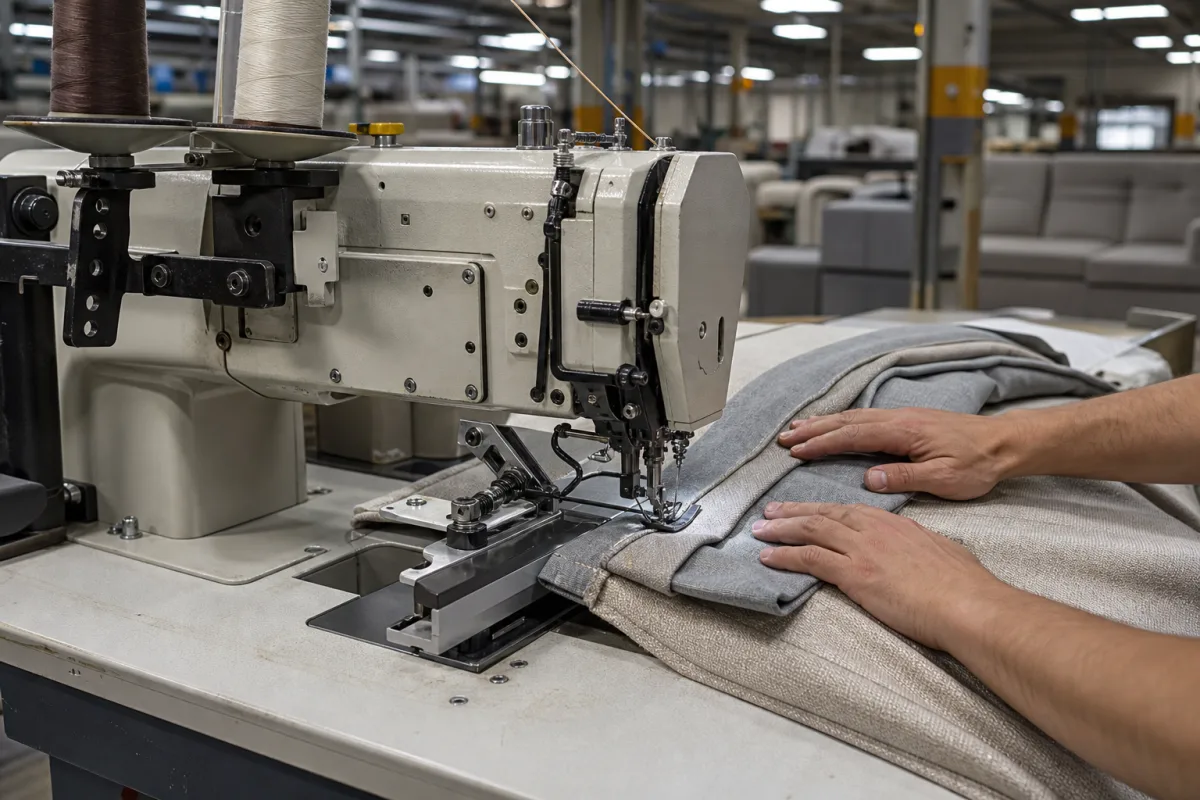
Heavy-material lockstitch · Unison (compound) feed and walking foot, stitch length, presser lift and arm space, hook capacity and thread size
An industrial upholstery sewing machine is a heavy-duty lockstitch machine that moves thick, slippery layers of fabric, leather, foam-backed cover and piping together without them shifting, for example by combining a feed dog, a needle that moves with the material and alternating walking presser feet. Ask three things first: what feed system it uses and how far the walking feet lift, what stitch length, presser-foot lift and space under the arm it gives for your products, and which needle, thread and hook size it is built for.
Single- and twin-needle unison-feed (compound-feed, walking-foot) lockstitch machines for furniture, car seats and similar heavy work. Domestic machines, cylinder-bed and post-bed machines, long-arm quilting machines and automatic sewing units are outside this page.
CNFX editorial research · Sources checked October 12, 2026 · 4 sources
Juki's LU-2810N instruction manual describes a one-needle, unison-feed lockstitch machine for medium- to heavy-weight materials, car seats and furniture: a box feed with top and bottom feed driven by timing belt, an alternating vertical movement of the walking feet adjustable from 1 mm to 9 mm by dial, a full-rotary vertical-axis 2-fold hook and a 40 mm needle bar stroke. [1]
Juki's LU-2800V-7 catalogue lists direct-drive unison-feed models with automatic thread trimming at up to 3,500 sti/min, with 2.0-fold or 2.7-fold capacity vertical-axis hooks; it says the larger hook reduces bobbin changes, and that a shorter-thread-remaining model clamps and trims the needle thread so operators need not nip threads at the start and end of seams. [2]
Kinglead describes its KD-4400 as a single-needle compound-feed walking-foot lockstitch for sofas and furniture with a large vertical-axis hook, automatic lubrication and a safety clutch to protect the hook and bevel gears if the machine jams or overloads. [3]
Give the supplier the materials and layer build-ups (fabric, leather, foam-backed cover, piping), total thickness under the foot, stitch lengths for structural seams and topstitching, thread sizes, the largest product passed under the arm, twin-needle or single-needle work, thread trimming and back-tack needs, motor and power supply, and table and stand requirements.
02
Size stitch length, presser lift, arm space, needle and thread
For the LU-2810N, Juki gives a maximum stitch length of 9 mm forward and reverse, presser-foot lift of 10 mm by hand lifter and 20 mm by knee lifter, a bed of 643 × 178 mm and space under the arm of 347 × 127 mm. It uses Groz-Beckert 135 × 17 needles from Nm 125 to Nm 180 (standard Nm 160) and threads from #30 to #5. Maximum speed is 3,000 sti/min for the one-needle and 2,700 sti/min for the two-needle LU-2860N. [1]
Juki's catalogue states that a high, long-arm model suits car seats, sofas and bags and that a 12 mm maximum stitch length is best suited to topstitching sofas. [2] Kinglead's KD-4400 lists 2,000 r.p.m., 0–9 mm stitch length, presser-foot lift of 8 mm by hand and 16 mm by knee, a 250 × 100 mm operating space and DP × 17 needles in sizes 18–23. [3]
Editorial calculation: maximum speed × stitch length bounds the feed rate, so 3,000 sti/min × 9 mm allows at most about 27 m/min and 2,000 r.p.m. × 9 mm about 18 m/min of seam; actual speed on thick, curved work is set by the operator and the manual's speed table. [1][3]
03
Read a second maker's heavy-duty specification table
Dürkopp Adler's page for its M-TYPE CLASSIC Goldline cylinder-arm machines gives full figures for heavy-duty lockstitch (301) sewing with bottom feed, needle feed and alternating top feet, used for three-dimensional or tubular work in technical textiles, leather goods, shoes and soft luggage. For the 869-180322-M it lists a maximum of 2,800 stitches per minute (3,000 for the 669-180312), a 9 mm stitch length, a 9 mm alternating-foot stroke with an integrated quick second stroke, a sewing-foot clearance of 10 mm when sewing and 20 mm when lifted, a 335 × 125 mm cylinder-arm clearance, needle system 134-35 in sizes 90–180, thread up to 10/3 synthetic, a large Ø26 mm hook, and a 15 mm thread trimmer length. It runs from a 375 W integrated direct drive on single-phase 230 V, 50/60 Hz, uses 0.7 litres of air per stroke at 6 bar for pneumatic functions, has a sewing head weighing 54–59 kg, and measures 1,200 × 550 × 1,700 mm with its stand. [4]
Editorial calculation: 6 bar is 0.6 MPa; 2,800 stitches per minute at 9 mm bounds the feed at about 25 m/min, between the 27 and 18 m/min worked out above for the Juki and Kinglead machines. The 20 mm lift matches Juki's knee-lift figure, so thicker upholstery build-ups need a machine whose lift and foot stroke are stated for your layers. Ask each supplier for the same rows: stitch rate, stitch length, foot stroke, lift, needle system and size, thread size, drive power and air use. [4][1][3]
Suppliers linked to this page list upholstery sewing machines; each card links to the page reviewed.
The supplier reviewed lists compound-feed walking-foot machines for sofas and furniture; ask for the feed type, walking-foot lift range, stitch length, presser lift, arm space, hook size, needle system and motor.
05
Trace the machine components
This is a functional reference built from the sources cited; it is not one maker's design.
Fill the specification fields with values for your products
An upholstery sewing machine quotation needs values for your products. The table explains each field, gives published values where a reviewed source states them, and says what to obtain from the supplier.
Explore company information and manufacturing capabilities, then discuss the scope of your project with a relevant supplier.
Share this page
Compiled and source-reviewed by the CNFX editorial team.
Published product pages show what a company offers, not tested performance. Confirm the legal seller, factory and scope for your order. How we source and review
· Page last updated 13 October 2026
Buyer questions
What feed system do upholstery sewing machines use?
Unison (compound) feed with alternating walking feet; Juki's LU-2810N combines box feed with 1–9 mm alternating foot movement. [1]
What stitch length is used for sofa topstitching?
Juki's catalogue says a 12 mm maximum stitch length is best suited to sofa topstitching. [2]
How much presser-foot lift does a heavy-duty walking-foot machine give?
One maker's cylinder-arm walking-foot machine lists 10 mm clearance when sewing and 20 mm when lifted, with a 9 mm alternating-foot stroke and 2,800 stitches per minute. [4]
Sources and what still needs a direct check
Sources checked 2026-10-12. Juki's instruction manual and catalogue and Kinglead's product page describe their own machines; specifications for another model must come from its manual.