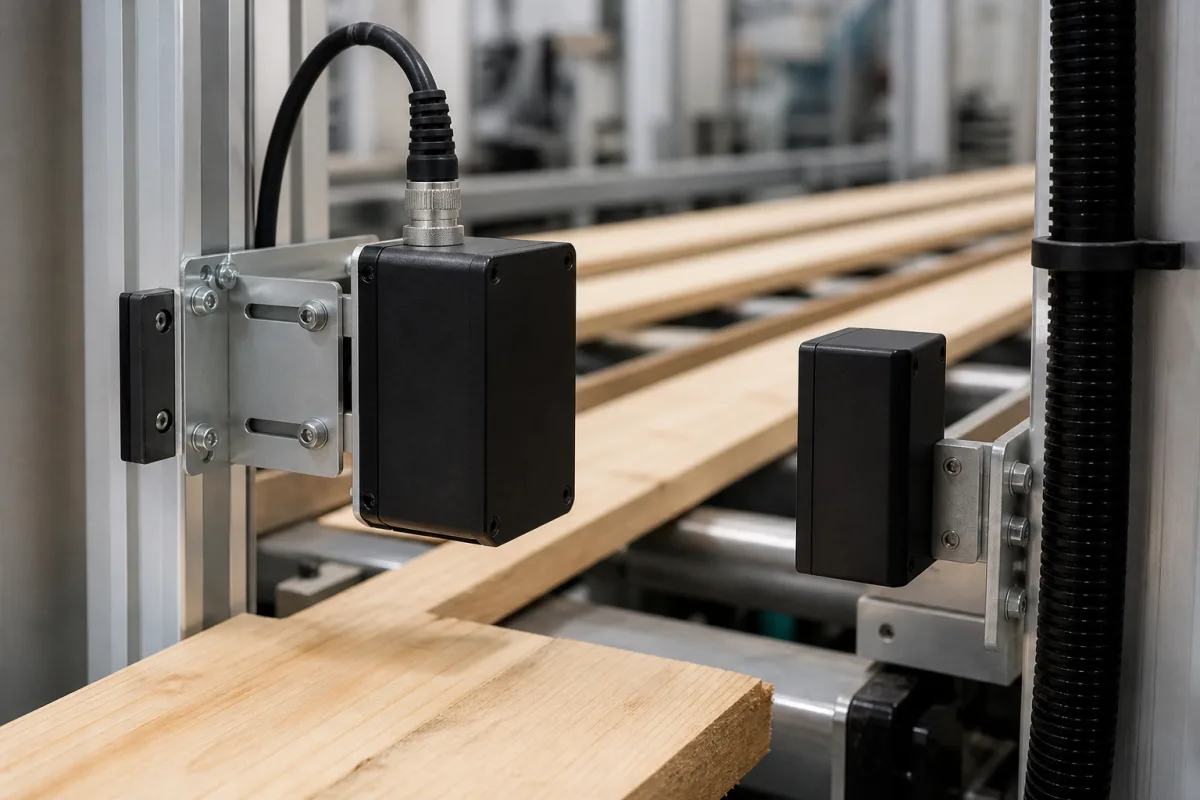
Measurement sensor for in-line wood moisture: non-contact sensor heads that read each board as it passes on the conveyor
Non-contact in-line moisture sensor heads for boards on conveyors · Capacitance-bridge heads read at 312 Hz and 10 kHz against free-space microwave sensors near 1.25 GHz, 6–27% range and ±0.5% reproducibility, 200 boards a minute or 600 m/min, and product programs that sort wet and dry boards
This page covers the sensor heads of in-line wood moisture analyzers: non-contact heads mounted across or along a board conveyor, with the electronics that turn their signal into a moisture value for every board. Ask three things first: which sensing principle the head uses and how it deals with density, at what line speed and board orientation it measures, and how its readings were checked against oven-dry samples of your species.
Non-contact sensor heads for in-line measurement of moisture in boards, lumber and wood products on conveyors, by capacitance or microwave methods. Handheld pin and pinless wood moisture meters with species and temperature corrections are covered on the Wood moisture meter page, Bluetooth handheld meters for lot records on the Portable digital wood moisture analyzer page, and leather moisture on the Leather moisture analyzer page. Distance, pressure and torque sensors are outside this page.
CNFX editorial research · Sources checked October 12, 2026 · 3 sources
Capacitance bridge read at two tones, or free-space microwave near 1.25 GHz
Lignomat's in-line sensor head encloses a pair of copper foil sheets that form one leg of a capacitance bridge; a board passing over it changes that leg's capacitance and unbalances the bridge, and the degree of unbalance is read at two audio frequencies, 312 Hz and 10 kHz, which Lignomat states keeps readings accurate regardless of density changes within a species; the head measures 6% to 27% (saturation) with reproducibility of ±0.5% or better. [1]
A 2025 study in Sensors built a low-cost free-space microwave sensor for rubberwood in an industrial drying process: microwaves pass through the air into the board between a transmitting and a receiving antenna, and instead of attenuation and phase it uses only the reflection (S11) and transmission (S21) magnitudes to keep the sensor simple; simulation put the natural frequency of 5 in. thick rubberwood at 1.25 GHz. Installed in the factory, its readings deviated from the oven-dry reference by 7.67–15.38%, reduced to 3.58–5.21% after error compensation. [3]
Editorial note: the field deviation before compensation in that study is the reason to ask any supplier how its head was calibrated on your species and thickness, and what correction it applies on the line.
Give the supplier the species and densities, board thickness, width and length ranges, the moisture range of interest, the conveyor type, speed and board orientation, the space for the head, the reject or sorting device, and the oven-dry check method you will use.
02
Across or along the conveyor: speeds, head widths and product programs that sort
Brookhuis's FMI, as listed by Scott+Sargeant, measures without contact while the wood travels past its sensors, with an FMI L sensor for longitudinal feed and an FMI X sensor for transverse feed, at up to 200 planks a minute transversely or 600 m a minute longitudinally; its control unit stores 250 or 1,000 product programs with species, specific weight, dimensions, measuring method and too-wet and too-dry limits, and sorts the wood accordingly. [2] Lignomat offers transverse and longitudinal configurations, with heads 18, 21 or 28 in. wide. [1]
Editorial calculation: 600 m/min is 10 m/s, so a 4 m board passes a longitudinal head in 0.4 s; 200 planks a minute leaves 0.3 s per plank in transverse feed. [2]
Explore company information and manufacturing capabilities, then discuss the scope of your project with a relevant supplier.
Share this page
Compiled and source-reviewed by the CNFX editorial team.
Each manufacturer above links to the page on that company's own website where the product is listed, with the date we checked it. How we source and review
· Page last updated 13 October 2026
Buyer questions
How does a non-contact in-line moisture head measure a board?
Lignomat's head is a capacitance bridge whose unbalance, read at 312 Hz and 10 kHz, changes as a board passes over it. [1]
Can microwaves measure wood moisture on a line?
A 2025 study used a free-space microwave sensor at about 1.25 GHz on rubberwood, reaching 3.58–5.21% deviation from oven-dry values after error compensation. [3]
How fast can in-line moisture meters run?
Brookhuis lists its FMI at 200 planks a minute transversely or 600 m a minute longitudinally. [2]
Sources and what still needs a direct check
Sources checked 2026-10-12. Lignomat describes its own head; Scott+Sargeant lists Brookhuis's FMI; a 2025 peer-reviewed study reports a microwave sensor on a rubberwood line.