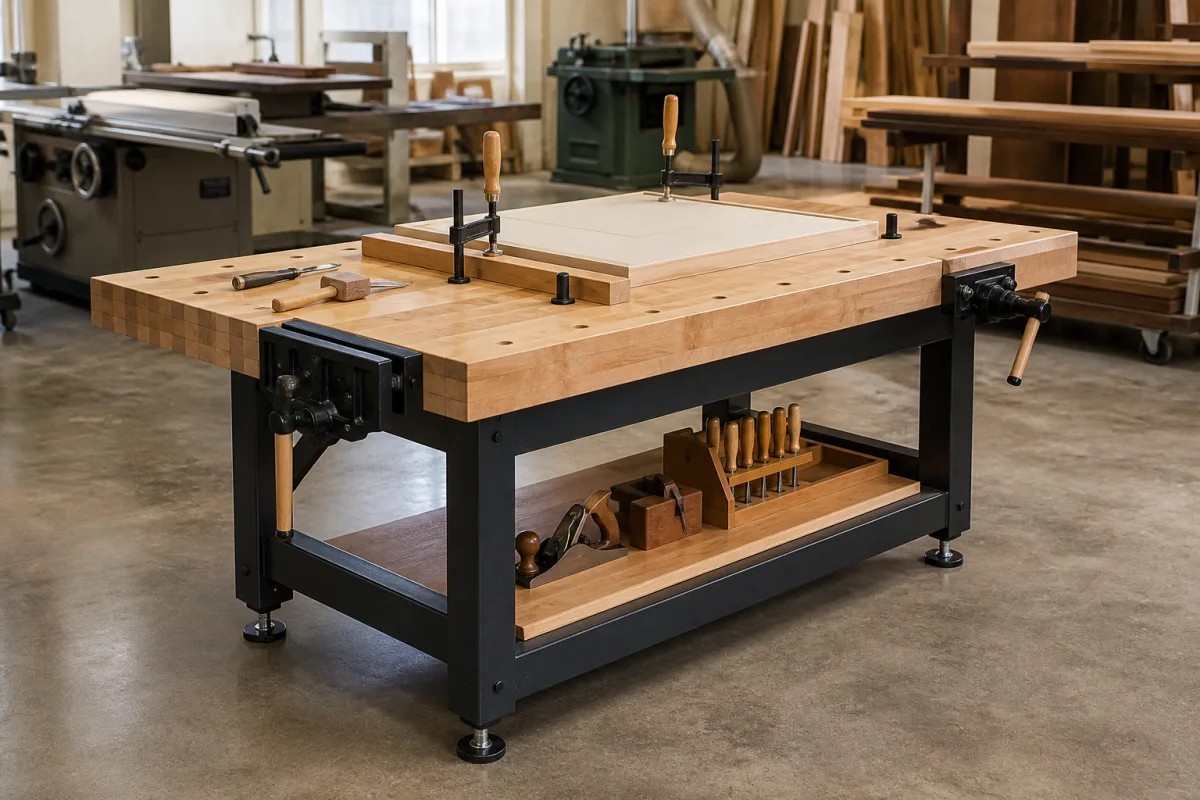
Woodworking work table (cabinetmaker's workbench): solid hardwood top, face and tail vises, bench-dog and holdfast holes
The woodworker's bench: a thick solid beech or hard maple top, a face or shoulder vise and a tail vise working with rows of bench-dog holes, at a height chosen for planing — and a top that moves millimetres with the seasons
In a joinery or furniture shop the central work table is the bench the work is held on for hand and power-tool operations. It has to stay flat, resist dents and hold a board on its face, its edge or its end. That is why benchtops are thick solid hardwood, why there are two vises at different corners, and why the top is drilled with rows of holes for bench dogs and holdfasts. Lie-Nielsen sums the requirement up as flat, stable and heavy.
Woodworking (cabinetmaker's) workbenches for joinery and furniture making: solid hardwood tops, face, shoulder and tail vises, bench-dog and holdfast holes, working height and care of the top. Welding tables, fixture bases and toggle-clamp fixtures for metalwork are covered on the Welding fixtures and Toggle-clamp clamping fixture for welding pages; machine vises for CNC machining on the Clamping jaws / vise page; panel saws with sliding tables on the Panel saw page.
CNFX editorial research · Sources checked October 12, 2026 · 3 sources
The top: 85 mm of beech or 4 inches of hard maple, and how far it moves with moisture
Sjöbergs builds its Elite 2000 entirely in European beech with an 85 mm thick solid beech top thickened to 110 mm at the front edge; [1] Lie-Nielsen uses a 4-inch solid hard maple top. [2] The USDA Forest Products Laboratory gives these clear-wood figures for the American species of the two woods:
The handbook gives those coefficients for estimating dimension changes between 6% and 14% moisture content: change = initial dimension × coefficient × change in moisture content. [3] Editorial calculation: if the 600 mm wide beech top of the Elite 2000 [1] swung 4 percentage points in moisture content, it would change width by about 600 × 0.00431 × 4 ≈ 10 mm with the tangential direction across the width, or about 4.6 mm with the radial direction across it; a 2 ft (610 mm) hard maple top [2] would move about 8.6 mm or 4.0 mm. Fittings that fix the top rigidly across its width have to allow for that.
Lie-Nielsen recommends re-oiling its bench one to two times a year, covering end grain well to help stabilise the wood, and re-flattening the top over time with a No. 7 or No. 8 jointer plane, working diagonally across the grain first and finishing along it. [2]
Specify species, top thickness, whether the top is laminated from edge-grain strips, the moisture content at delivery and the finish; ask how the top is fixed to the base so it can move.
02
Vises and dog holes: 145 mm or 8 inches of opening, round or square bench dogs
Lie-Nielsen pairs a shoulder vise on the front edge with a tail vise at the end; Sjöbergs lists a front vise that can be moved for left- or right-handed users and a double row of round dog holes, so work is held in the jaws or flat between dogs.
The twin-screw shoulder vise is specified by what it holds: with 12 inches between its screws, Lie-Nielsen notes it holds a 12-inch-wide board. [2] Editorial calculation: Sjöbergs' 145 mm opening is about 5.7 in, against 8 in (203 mm) on the Lie-Nielsen shoulder vise; its 85 mm top is about 3.3 in against Lie-Nielsen's 4 in (102 mm).
Editorial note: round and square dogs, and different hole sizes, are not interchangeable between benches; if you already own holdfasts or dogs, give their diameter or section with the order.
Sjöbergs Elite 2000
Lie-Nielsen 7' Standard Workbench
Front vise
Position changeable for right- or left-handed use; maximum vise opening listed as 145 mm [1]
Twin-screw chain-drive shoulder vise, screws 12 in apart, 1-1/8 in Acme thread, hard maple jaw opening 8 in [2]
Tail vise
Not detailed on the maker's page
1 in Acme screw; opening given as 6–7 in in one place and 6½ in travel in another [2]
Dog holes
Double row of round dog holes; 4 steel dogs supplied [1]
Along the front edge, 1.150 × 0.950 in; 2 square wooden dogs supplied [2]
Working height: 900 mm as built or 32 to 38 inches to order
Sjöbergs lists a working height of 900 for the Elite 2000; the unit is not stated on the page and is read here as millimetres. [1] Lie-Nielsen writes that “most benches currently on the market are approximately 35" (88.9cm) high” and that “for many modern hand tool woodworkers, a taller bench is more comfortable”, and builds its bench to order between 32 in (81.28 cm) and 38 in (96.52 cm). [2]
Editorial calculation: 900 mm is 35.4 in, close to the 35 in Lie-Nielsen gives for “most benches currently on the market”. A bench fixed at that height suits users for whom it matches the work; heavy hand planing and fine chisel or marking work pull in opposite directions, so ask whether the base can be built taller or shorter before ordering.
04
What to give a workbench maker
Paste it into your enquiry below or into an email to a maker, then replace every bracket.
Use: [hand-tool joinery / power-tool assembly / school or training]
Top: [species; thickness; length × width; finish; moisture content at delivery]
Vises: [face, shoulder or leg vise; tail vise; opening; right- or left-handed]
Workholding: [dog hole shape and size, rows and spacing; holdfast holes]
Height: [working height; levelling feet]
Base: [wood or steel; storage cabinet or shelf; total weight]
Explore company information and manufacturing capabilities, then discuss the scope of your project with a relevant supplier.
Share this page
Compiled and source-reviewed by the CNFX editorial team.
Each manufacturer above links to the page on that company's own website where the product is listed, with the date we checked it. How we source and review
· Page last updated 13 October 2026
Buyer questions
Which wood is used for workbench tops?
Sjöbergs uses European beech (85 mm top) and Lie-Nielsen hard maple (4 in top). USDA lists American beech at 5,800 N and sugar maple at 6,400 N side hardness at 12% moisture content. [1][2][3]
How much does a solid wood benchtop move?
USDA coefficients for beech are 0.00190 radial and 0.00431 tangential per 1% moisture change; across a 600 mm top that is roughly 4.6–10 mm for a 4-point moisture swing (editorial calculation). [3][1]
What height should a workbench be?
Lie-Nielsen says “most benches currently on the market are approximately 35" (88.9cm) high” and builds 32–38 in to order; Sjöbergs lists 900 for the Elite 2000. [2][1]
How is a bench top maintained?
Lie-Nielsen re-oils one to two times a year, covering end grain, and re-flattens the top with a No. 7 or No. 8 jointer plane. [2]
Sources and what still needs a direct check
Sources checked 2026-10-12. Bench dimensions, vises and dog holes come from the Sjöbergs Elite 2000 and Lie-Nielsen 7' Standard Workbench product pages; hardness, shrinkage and dimensional change coefficients from the USDA Forest Products Laboratory Wood Handbook (2010 edition).