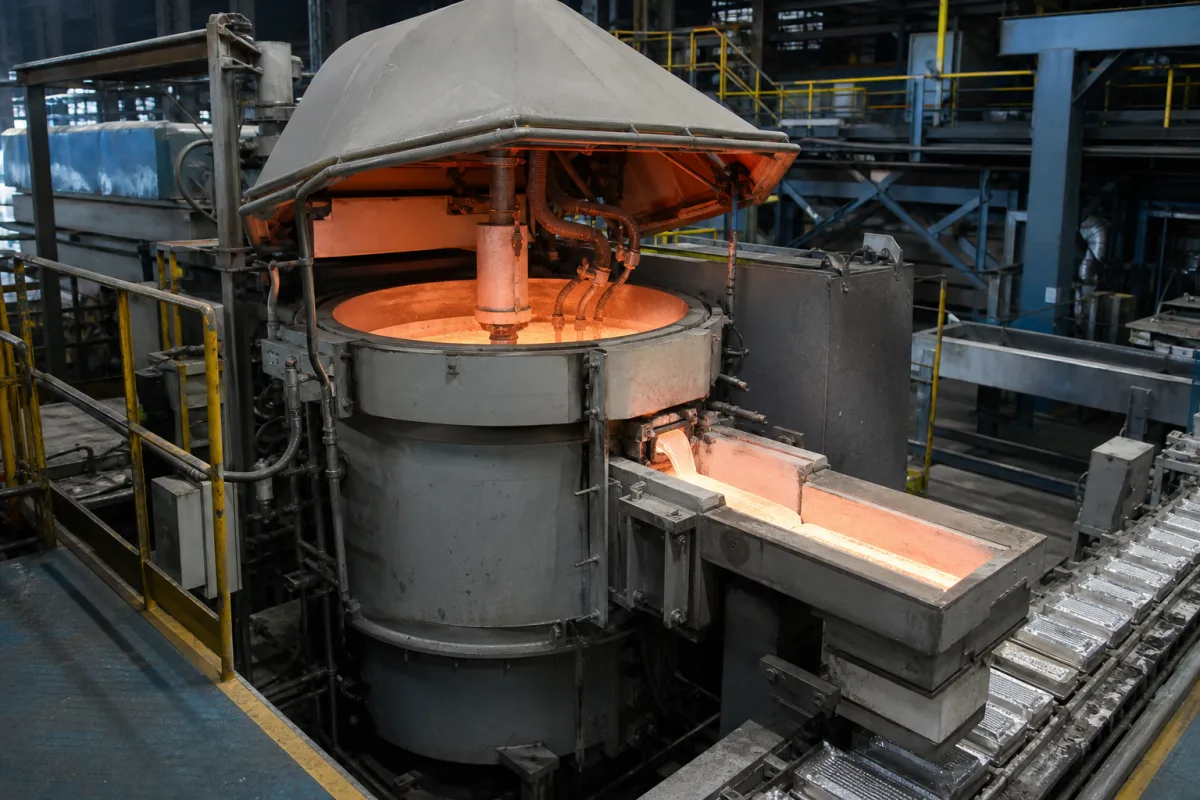
Strukturierte Fertigungsdaten · 2026

Smart Molten Metal Degassing and Filtration System

Auf Basis strukturierter CNFX-Herstellerprofile wird Smart Molten Metal Degassing and Filtration System im Bereich Grundmetallherstellung anhand von Maximaler Durchfluss bis Betriebstemperaturbereich eingeordnet.

Technische Definition und Kernbaugruppe

Ein typisches Smart Molten Metal Degassing and Filtration System wird durch die Baugruppe aus Entgasungskammer und Rotationsgasinjektor beschrieben. Für industrielle Anwendungen werden Materialauswahl, Fertigungsprozess und Prüfbarkeit gemeinsam bewertet.

Integrated system for removing gases and impurities from molten metals

Technische Definition

A comprehensive industrial system designed to purify molten metals by simultaneously removing dissolved hydrogen and oxygen gases while filtering out solid inclusions. This integrated solution combines degassing chambers with multi-stage filtration modules to improve metal quality and mechanical properties. The system is essential for producing high-integrity castings and wrought products in aluminum, magnesium, and copper alloys. Automated controls optimize the purification process based on real-time metal composition and temperature data.

Funktionsprinzip

Molten metal flows through a sealed chamber where inert gas is injected to create bubbles that absorb dissolved gases, then passes through ceramic foam filters that trap solid impurities before exiting the system.

Technische Parameter

Maximaler Durchfluss
Spitzenkapazität der Metallschmelzeverarbeitungkg/min
Betriebstemperaturbereich
Kompatible SchmelzmetalltemperaturenGrad Celsius
Entgasungswirkungsgrad
Wasserstoffentfernungsleistung%
Filterporengröße
Keramikfilter-Porosität (Poren pro Zoll)PPZ
Systemleistungsaufnahme
Gesamter elektrischer LeistungsbedarfkW
Inertgasverbrauch
Verbrauchsrate von Argon oder Stickstoffl/min

Hauptmaterialien

Refractory ceramics High-temperature steel alloys Quartz glass viewports

Komponenten / BOM

Primärbehälter zur Gasentfernung aus Metallschmelze
Material: Feuerfest ausgekleideter Stahl
Verteilt Inertgasblasen im gesamten Schmelzmetall
Material: Grafit oder Keramik
Entfernt feste Einschlüsse durch Keramikschaumfilter
Material: Siliziumkarbidkeramik
Kontinuierliche Messung der Schmelzmetalltemperatur
Material: Thermoelemente mit Keramikschutzrohren
Automatisierte Systemsteuerung und Parameteranpassung
Material: Gehäuse aus Edelstahl
Überträgt Metall durch das Reinigungssystem
Material: Graphit oder feuerfest beschichteter Stahl

FMEA · Fehleranalyse

Ursache → Fehlermodus → Engineering-Maßnahme

Argon purity below 99.995% Oxide inclusion formation in molten metal Install dual-stage molecular sieve filtration with 0.01μm particle retention
Thermal cycling exceeding 200°C/hour Ceramic filter thermal shock fracture Implement PID-controlled preheating system with 50°C/hour maximum ramp rate

Technische Bewertung

Betriebsbereich
Betriebsbereich
0.5-2.0 bar vacuum pressure, 700-850°C molten aluminum temperature, 15-60 L/min argon flow rate
Belastungs- und Ausfallgrenzen
Vacuum pressure exceeding 2.5 bar causes bubble implosion damage; temperature below 680°C leads to filter clogging; argon flow above 75 L/min creates excessive turbulence
Cavitation erosion from vacuum pressure exceeding bubble collapse threshold; solidification-induced filter blockage at eutectic temperature; turbulent flow separation exceeding Reynolds number 4000
Fertigungskontext
Smart Molten Metal Degassing and Filtration System wird innerhalb von Grundmetallherstellung nach Material, Prozessfenster und Prüfanforderungen bewertet.

Weitere Produktbezeichnungen

Molten Metal Purification System Integrated Degassing and Filtration Line Metal Melt Treatment System

Taxonomie und Suchbegriffe

Suchbegriffe, Aliase und technische Bezeichnungen für diesen CNFX Datensatz.

Eignung und Auslegungsdaten

Betriebsgrenzen
Traglast:0.5 to 2.5 bar
Verstellbereich / Reichweite:50 to 500 kg/min
Einsatztemperatur:600°C to 1200°C
slurry concentration:Up to 15% solids by weight
Montage- und Anwendungskompatibilität
Aluminum alloysCopper alloysZinc alloys
Nicht geeignet: Molten reactive metals (e.g., titanium, magnesium) due to high reactivity with degassing agents
Auslegungsdaten
  • Required metal throughput (kg/hr)
  • Target gas removal efficiency (%)
  • Initial impurity concentration (ppm)

Zuverlässigkeits- und Risikoanalyse

Ausfallmodus und Ursache
Thermal fatigue cracking
Cause: Repeated thermal cycling from molten metal contact and cooling cycles, leading to stress concentration and crack initiation in refractory linings or structural components.
Corrosive degradation
Cause: Chemical attack from reactive elements in molten metal (e.g., aluminum, magnesium) or fluxing agents, accelerated by high temperatures and mechanical erosion.
Wartungsindikatoren
  • Unusual vibration or audible knocking from rotating components (impellers, shafts) indicating imbalance or bearing wear
  • Visible discoloration, warping, or localized overheating on external surfaces suggesting refractory failure or insulation breakdown
Technische Hinweise
  • Implement predictive maintenance using infrared thermography to monitor thermal gradients and detect refractory degradation before catastrophic failure
  • Establish strict material handling protocols for consumables (e.g., degassing tablets, filter media) to prevent contamination-induced corrosion and optimize reaction efficiency

Compliance & Manufacturing Standards

Reference Standards
ISO 9001:2015 Quality Management SystemsCE Marking (EU Machinery Directive 2006/42/EC)ASTM E1552 Standard Test Method for Determining Hafnium in Zirconium and Zirconium Alloys
Manufacturing Precision
  • Degassing Rotor Shaft Runout: +/-0.01mm
  • Filter Plate Flatness: 0.05mm over 300mm span
Quality Inspection
  • Helium Leak Test (Vacuum Integrity)
  • Metallographic Analysis of Filter Media

Hersteller, die dieses Produkt fertigen

Herstellerprofile mit passender Produktionsfähigkeit in China.

Die Herstellerliste dient der Vorrecherche und Einordnung von Fertigungskapazitäten. Sie ist keine Zertifizierung, kein Ranking und keine Transaktionsgarantie.

Beispielhafte Bewertungskriterien aus Einkaufsprozessen

Keine Kundenbewertung und keine Echtzeitdaten. Die Werte zeigen typische Prüfkriterien in RFQ- und Lieferantenbewertungsprozessen.

Technische Dokumentation
4/5
Fertigungsfähigkeit
4/5
Prüfbarkeit
5/5
Lieferantentransparenz
3/5

Die Kriterien dienen als Orientierung für technische Einkaufsprüfungen. Konkrete Kunden, Länder, Bewertungsdaten oder Live-Nachfragen werden nur angezeigt, wenn entsprechende belastbare Daten vorliegen.

Supply ChainRelated Products and Components

Legierungsdosiersystem

Ein System, das Legierungselemente präzise dosiert und in den Schmelz- oder Mischbehälter der Legierungsstation einbringt.

Spezifikationen ansehen ->
Legierungsstation

Eine spezialisierte Station innerhalb eines integrierten Schmelzsystems, in der die präzise Legierung von Nichteisenmetallen durch kontrollierte Zugabe von Legierungselementen erfolgt.

Spezifikationen ansehen ->
Atmosphärenregelsystem

Ein System, das die spezifische Gaszusammensetzung in einem Wärmebehandlungsofen regelt und aufrechterhält, um gewünschte metallurgische Eigenschaften zu erzielen.

Spezifikationen ansehen ->
Atmosphärensystem

Ein System, das in einem industriellen Wärmebehandlungsofen eine kontrollierte Gasatmosphäre erzeugt und aufrechterhält, um Oxidation zu verhindern, spezifische chemische Reaktionen zu ermöglichen oder gewünschte Materialeigenschaften während der thermischen Behandlung zu erreichen.

Spezifikationen ansehen ->

Häufige Fragen

What is the degassing efficiency of this system?

The Smart Molten Metal Degassing and Filtration System achieves high degassing efficiency (typically 85-95%) through optimized rotary gas injection and chamber design, significantly reducing hydrogen and oxygen content in molten metals.

What materials make this system suitable for high-temperature applications?

This system utilizes refractory ceramics for thermal insulation, high-temperature steel alloys for structural components, and quartz glass viewports for monitoring, ensuring durability at operating temperatures up to 1600°C.

How does the PLC control panel improve metal processing?

The integrated PLC control panel automates degassing cycles, monitors temperature and flow rates, adjusts inert gas consumption, and provides real-time data logging for consistent, repeatable metal quality in basic metal manufacturing.

Kann ich Hersteller direkt kontaktieren?

CNFX ist ein offenes Verzeichnis, keine Handelsplattform und kein Beschaffungsagent. Herstellerprofile und Formulare helfen bei der Vorbereitung des direkten Kontakts.

CNFX Industrial Index v2.6.05 · Grundmetallherstellung

Datenbasis

CNFX-Herstellerprofile, technische Klassifikation, öffentlich verfügbare Produktinformationen und fortlaufende Plausibilitätsprüfung.

Vorläufige technische Einordnung
Diese Seite dient der strukturierten Vorbereitung von Recherche, RFQ und Lieferantenbewertung. Sie ersetzt keine Lieferantenqualifizierung, keine Normenprüfung und keine technische Freigabe durch den Käufer.

Beschaffungsinformationen anfragen für Smart Molten Metal Degassing and Filtration System

Informationen zu Einsatzbereich, Spezifikationsgrenzen, Lieferantentypen und RFQ-Vorbereitung anfragen.

Ihre Geschäftsdaten werden nur zur Bearbeitung dieser Anfrage verwendet.

Vielen Dank. Ihre Anfrage wurde gesendet.
Vielen Dank. Ihre Anfrage wurde empfangen.

Fertigung für Smart Molten Metal Degassing and Filtration System?

Herstellerprofile mit passender Produkt- und Prozesskompetenz vergleichen.

Herstellerprofil anlegen Kontakt
Vorheriges Produkt
Signalprozessor
Nächstes Produkt
Spindelpresse