Strukturierte Fertigungsdaten · 2026

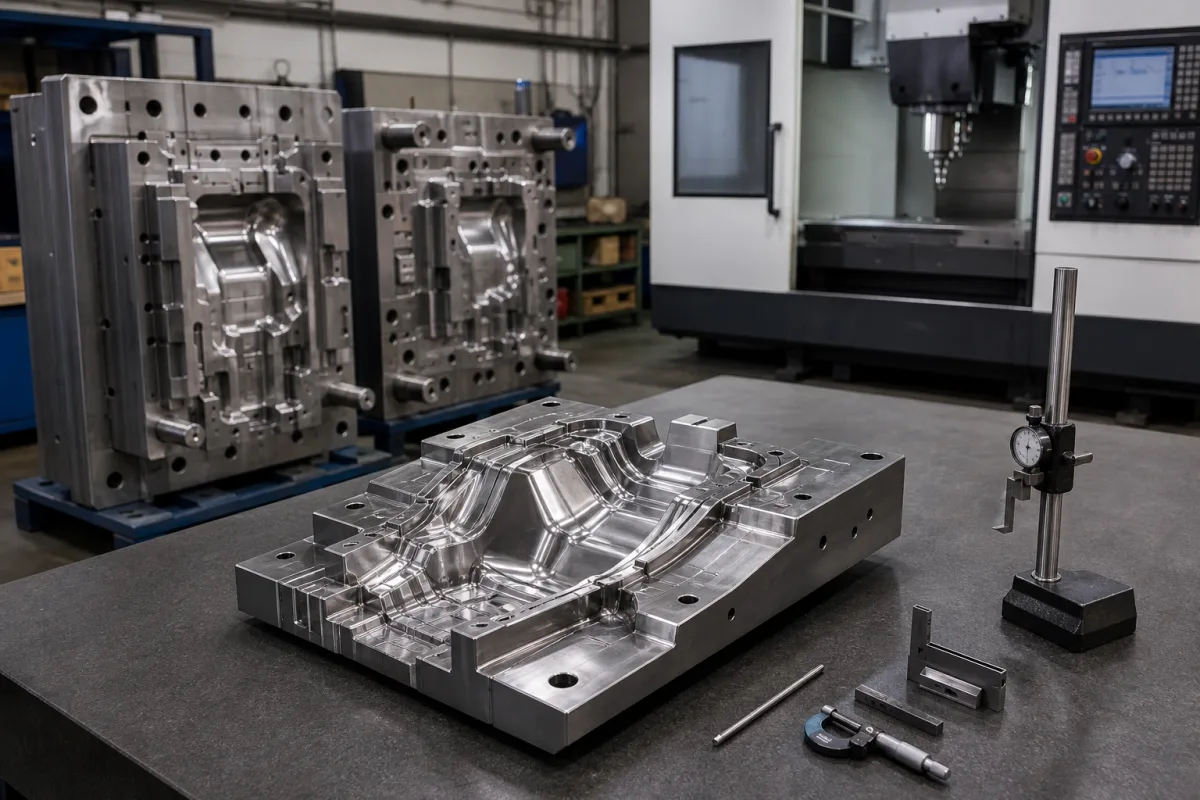
Precision Casting Mold Cavity Insert

Auf Basis strukturierter CNFX-Herstellerprofile wird Precision Casting Mold Cavity Insert im Bereich Gießereien anhand von Einschubtiefe bis Einbaubreite eingeordnet.

Technische Definition und Kernbaugruppe

Ein typisches Precision Casting Mold Cavity Insert wird durch die Baugruppe aus Einsatzkörper und Montageflansch beschrieben. Für industrielle Anwendungen werden Materialauswahl, Fertigungsprozess und Prüfbarkeit gemeinsam bewertet.

Removable mold component that forms the internal shape of cast metal parts

Technische Definition

A precision-engineered insert that fits into the main mold body to create the internal cavities and features of cast metal components. These inserts are critical for achieving complex geometries, fine surface finishes, and dimensional accuracy in investment casting, die casting, and sand casting processes. They allow for easier mold maintenance, replacement of worn sections, and production of parts with intricate internal details that would be difficult to machine directly into the main mold block. Their modular design reduces overall mold costs and extends tooling life.

Funktionsprinzip

The insert is precisely machined to the negative shape of the desired cast part feature and secured within the mold assembly. During casting, molten metal flows around the insert, solidifying to form the corresponding positive feature in the final component. After casting, the mold opens and the insert remains with the mold for reuse in subsequent cycles.

Technische Parameter

Einschubtiefe
Gesamtlänge des Einsatzelementsmm
Einbaubreite
Gesamtbreite des Einbauelementsmm
Einbauhöhe
Gesamthöhe/Dicke des Einsatzesmm
Ausformwinkel
Konischer Winkel für die Entformung von Teilen aus der FormGrad
Härte
Materialhärte für VerschleißfestigkeitHRC
Betriebstemperatur
Maximale Dauerbetriebstemperatur°C

Hauptmaterialien

Tool Steel (H13) Carbide Copper Alloy

Komponenten / BOM

Einsatzkörper
Bildet die Hauptform des Gussmerkmals
Material: Werkzeugstahl oder Hartmetall
Montageflansch
Sichert Einlage an Hauptformplatte
Material: Gleiches Material wie Gehäuse
Kühlkanal
Innere Durchgang für Temperaturregelung
Material: Gefräste Kavität
Auswerferstiftbohrung
Aufnahme für Stift zur Teileentnahme
Material: Gebohrtes Merkmal

FMEA · Fehleranalyse

Ursache → Fehlermodus → Engineering-Maßnahme

Inadequate draft angle (<1°) Part seizure during ejection Implement 2° minimum draft angle with DLC coating (coefficient <0.15)
Localized overheating (>1600°C) Surface melting and dimensional distortion Embedded thermocouples with PID control maintaining ±10°C

Technische Bewertung

Betriebsbereich
Betriebsbereich
0-1500°C, 0-200 MPa
Belastungs- und Ausfallgrenzen
Thermal stress exceeds 350 MPa yield strength at 1200°C, or erosion depth exceeds 0.5 mm
Thermal fatigue from cyclic heating/cooling (ΔT>800°C) causes crack initiation at stress concentrations; molten metal erosion at velocities >2 m/s
Fertigungskontext
Precision Casting Mold Cavity Insert wird innerhalb von Gießereien nach Material, Prozessfenster und Prüfanforderungen bewertet.

Weitere Produktbezeichnungen

mold cavity insert die insert core insert mold core

Taxonomie und Suchbegriffe

Suchbegriffe, Aliase und technische Bezeichnungen für diesen CNFX Datensatz.

Industrielles Ökosystem und Lieferkette

Eignung und Auslegungsdaten

Betriebsgrenzen
Traglast:Up to 100 MPa (14,500 psi) injection pressure
other spec:Slurry concentration: 30-70% solids by weight, Flow rate: 0.5-5.0 L/min per cavity
Einsatztemperatur:Ambient to 1200°C (2192°F) continuous, 1400°C (2552°F) peak
Montage- und Anwendungskompatibilität
Molten aluminum alloys (e.g., A356, 380)Investment casting wax patternsCeramic slurry (alumina-silica based)
Nicht geeignet: Molten magnesium alloys (due to high reactivity and thermal shock)
Auslegungsdaten
  • Casting part volume and geometry (CAD data)
  • Required surface finish (Ra value in microns)
  • Production cycle time and thermal cycling requirements

Zuverlässigkeits- und Risikoanalyse

Ausfallmodus und Ursache
Thermal fatigue cracking
Cause: Repeated heating and cooling cycles during casting cause thermal stress, leading to crack initiation and propagation in the mold insert material, often exacerbated by rapid temperature changes or inadequate preheating.
Erosion and wear from molten metal flow
Cause: High-velocity molten metal impingement during injection erodes the cavity surface over time, particularly in gate areas and sharp corners, accelerated by abrasive particles in the alloy or improper gating design.
Wartungsindikatoren
  • Visible surface cracks or crazing on the cavity insert, especially around edges or high-stress areas, indicating thermal fatigue failure.
  • Dimensional inaccuracies or surface defects in cast parts, such as flashing, incomplete filling, or poor surface finish, signaling wear or damage to the insert.
Technische Hinweise
  • Implement controlled heating and cooling protocols, including proper preheating before use and gradual cooling after casting, to minimize thermal shock and stress on the insert material.
  • Apply protective surface coatings, such as ceramic or refractory metal layers, to enhance wear resistance and reduce direct contact with molten metal, extending the insert's operational life.

Compliance & Manufacturing Standards

Reference Standards
ISO 8062:2020 (Geometrical product specifications (GPS) - Dimensional and geometrical tolerances for moulded parts)ASTM A781/A781M-21 (Standard Specification for Castings, Steel and Alloy, Common Requirements, for General Industrial Use)DIN EN 10204:2004 (Metallic products - Types of inspection documents)
Manufacturing Precision
  • Cavity dimensions: +/-0.05mm
  • Surface finish: Ra 0.8μm
Quality Inspection
  • Coordinate Measuring Machine (CMM) dimensional verification
  • Hardness testing (Rockwell C scale)

Hersteller, die dieses Produkt fertigen

Herstellerprofile mit passender Produktionsfähigkeit in China.

Die Herstellerliste dient der Vorrecherche und Einordnung von Fertigungskapazitäten. Sie ist keine Zertifizierung, kein Ranking und keine Transaktionsgarantie.

Beispielhafte Bewertungskriterien aus Einkaufsprozessen

Keine Kundenbewertung und keine Echtzeitdaten. Die Werte zeigen typische Prüfkriterien in RFQ- und Lieferantenbewertungsprozessen.

Technische Dokumentation
4/5
Fertigungsfähigkeit
4/5
Prüfbarkeit
5/5
Lieferantentransparenz
3/5

Die Kriterien dienen als Orientierung für technische Einkaufsprüfungen. Konkrete Kunden, Länder, Bewertungsdaten oder Live-Nachfragen werden nur angezeigt, wenn entsprechende belastbare Daten vorliegen.

Häufige Fragen

What materials are available for precision casting mold cavity inserts?

Our inserts are manufactured from Tool Steel (H13), Carbide, and Copper Alloy to suit different casting applications and durability requirements.

What specifications should I consider when selecting a mold cavity insert?

Key specifications include draft angle (degrees), hardness (HRC), insert dimensions (height, length, width in mm), and operating temperature (°C) to ensure proper fit and performance.

What components are included in the BOM for these mold cavity inserts?

The bill of materials includes Insert Body, Mounting Flange, Cooling Channel, and Ejector Pin Hole for complete functionality in casting operations.

Kann ich Hersteller direkt kontaktieren?

CNFX ist ein offenes Verzeichnis, keine Handelsplattform und kein Beschaffungsagent. Herstellerprofile und Formulare helfen bei der Vorbereitung des direkten Kontakts.

CNFX Industrial Index v2.6.05 · Gießereien

Datenbasis

CNFX-Herstellerprofile, technische Klassifikation, öffentlich verfügbare Produktinformationen und fortlaufende Plausibilitätsprüfung.

Vorläufige technische Einordnung
Diese Seite dient der strukturierten Vorbereitung von Recherche, RFQ und Lieferantenbewertung. Sie ersetzt keine Lieferantenqualifizierung, keine Normenprüfung und keine technische Freigabe durch den Käufer.

Beschaffungsinformationen anfragen für Precision Casting Mold Cavity Insert

Informationen zu Einsatzbereich, Spezifikationsgrenzen, Lieferantentypen und RFQ-Vorbereitung anfragen.

Ihre Geschäftsdaten werden nur zur Bearbeitung dieser Anfrage verwendet.

Vielen Dank. Ihre Anfrage wurde gesendet.
Vielen Dank. Ihre Anfrage wurde empfangen.

Fertigung für Precision Casting Mold Cavity Insert?

Herstellerprofile mit passender Produkt- und Prozesskompetenz vergleichen.

Herstellerprofil anlegen Kontakt
Vorheriges Produkt
Oszillationstisch für Strangguss-Kokillen
Nächstes Produkt
Precision Casting Mold Ejector Pin