Strukturierte Fertigungsdaten · 2026

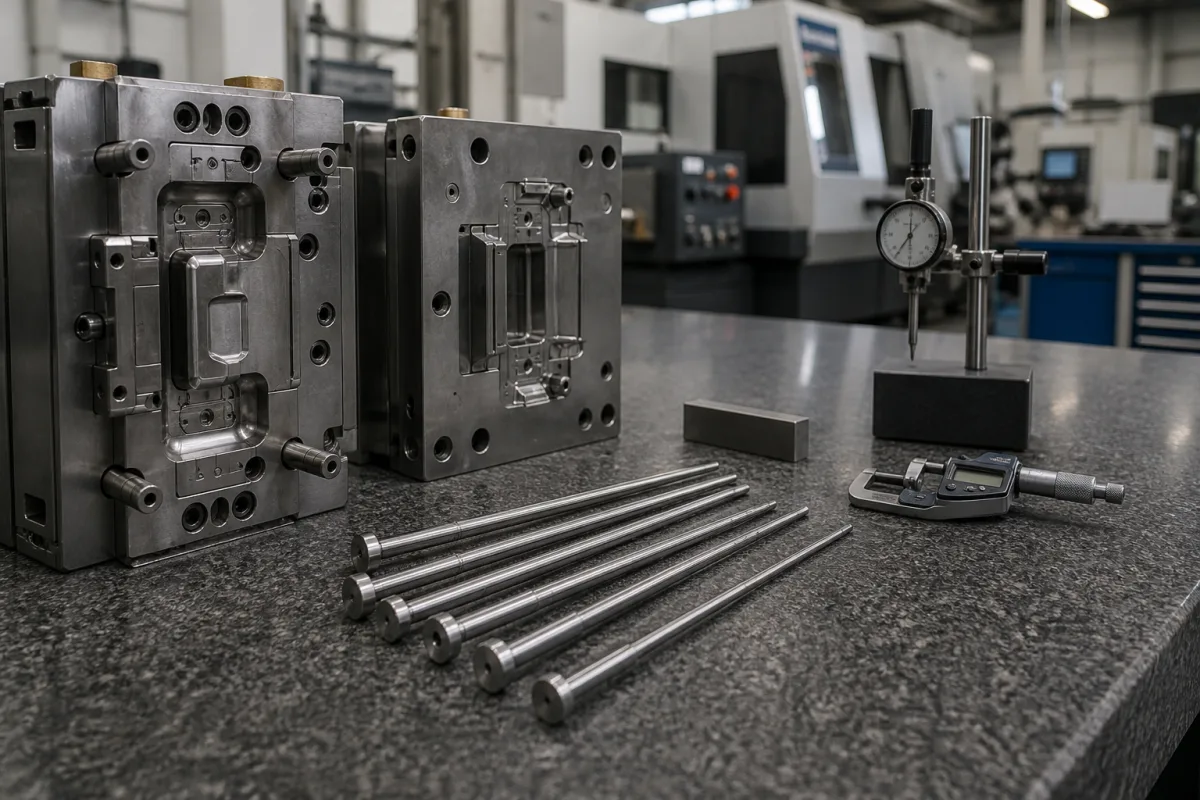
Precision Casting Mold Ejector Pin

Auf Basis strukturierter CNFX-Herstellerprofile wird Precision Casting Mold Ejector Pin im Bereich Gießereien anhand von Stiftdurchmesser bis Stiftlänge eingeordnet.

Technische Definition und Kernbaugruppe

Ein typisches Precision Casting Mold Ejector Pin wird durch die Baugruppe aus Stiftwelle und Kopf beschrieben. Für industrielle Anwendungen werden Materialauswahl, Fertigungsprozess und Prüfbarkeit gemeinsam bewertet.

Metal pin that ejects castings from molds in foundry operations

Technische Definition

A precision-engineered cylindrical component used in metal casting molds to forcibly eject solidified castings from mold cavities. These pins are critical for automated foundry production lines, ensuring consistent part release without damage to delicate castings. They withstand extreme thermal cycling and mechanical stress during repeated casting cycles. Proper ejector pin design prevents casting defects and maintains dimensional accuracy in high-volume manufacturing.

Funktionsprinzip

Hydraulic or mechanical force pushes the pin through the mold, contacting the casting surface to dislodge it from the cavity after solidification

Technische Parameter

Stiftdurchmesser
Nenndurchmesser mit Fertigungstoleranzmm
Stiftlänge
Gesamtarbeitslänge von Kopf bis Spitzemm
Oberflächenhärte
Rockwell-C-Härte für VerschleißfestigkeitHRC
Geradheitstoleranz
Maximale Abweichung von der idealen Geradheitmm/m
Wärmeleitfähigkeit
Wärmeübergangskoeffizient für thermische ZyklenW/(m·K)
Oberflächengüte
Mittlere Rauheit für glatten AuswurfRa

Hauptmaterialien

H13 Tool Steel SKD61 Alloy Steel Tungsten Carbide

Komponenten / BOM

Stiftwelle
Hauptzylindrischer Körper, der mit dem Gussstück in Kontakt kommt
Material: Werkzeugstahl oder legierter Stahl
Kopf
Haltevorrichtung, die verhindert, dass der Stift durch die Form fällt
Material: Gleiches Material wie die Welle
Spitze
Kontaktfläche zur Aufnahme des Gussstücks
Material: Vergüteter Stahl oder Hartmetall
Kühlkanal
Innere Durchgang für Kühlmittelzirkulation
Material: In die Welle integriert

FMEA · Fehleranalyse

Ursache → Fehlermodus → Engineering-Maßnahme

Mold misalignment exceeding 0.05 mm tolerance Pin bending deflection >1.5 mm causing binding Precision ground alignment surfaces with 0.01 mm flatness tolerance and hardened guide bushings
Insufficient lubricant film thickness <5 μm at 450°C Gallowing and adhesive wear at pin-mold interface Molybdenum disulfide coating with 15 μm thickness and automated lubrication system with 0.1 mL/cycle minimum

Technische Bewertung

Betriebsbereich
Betriebsbereich
150-450°C mold temperature, 20-80 MPa ejection force
Belastungs- und Ausfallgrenzen
650°C thermal softening threshold for H13 tool steel, 1200 MPa ultimate tensile strength limit
Thermal fatigue from cyclic heating (450°C) and cooling (150°C) during casting cycles, causing crack initiation at stress concentrations
Fertigungskontext
Precision Casting Mold Ejector Pin wird innerhalb von Gießereien nach Material, Prozessfenster und Prüfanforderungen bewertet.

Weitere Produktbezeichnungen

mold ejector pin die casting ejector casting knockout pin foundry ejector rod

Taxonomie und Suchbegriffe

Suchbegriffe, Aliase und technische Bezeichnungen für diesen CNFX Datensatz.

Industrielles Ökosystem und Lieferkette

Eignung und Auslegungsdaten

Betriebsgrenzen
Traglast:Up to 150 MPa (ejection force), 50 MPa (mold clamping)
other spec:Max ejection stroke: 300 mm, Surface finish: Ra 0.4 μm, Wear resistance: >100k cycles (typical)
Einsatztemperatur:Ambient to 1200°C (continuous), 1400°C (peak)
Montage- und Anwendungskompatibilität
Steel alloys (e.g., H13, P20)Aluminum alloys (e.g., A356, 380)Copper-based alloys (e.g., brass, bronze)
Nicht geeignet: Highly corrosive molten metals (e.g., magnesium alloys without protective atmosphere)
Auslegungsdaten
  • Mold cavity dimensions (diameter/depth)
  • Required ejection force (based on casting material and geometry)
  • Mold plate thickness and available stroke length

Zuverlässigkeits- und Risikoanalyse

Ausfallmodus und Ursache
Thermal fatigue cracking
Cause: Repeated thermal cycling during casting cycles causes expansion/contraction stresses, leading to micro-cracks that propagate through the pin material, especially at stress concentration points like grooves or diameter changes.
Abrasive wear and galling
Cause: Friction between the pin and mold guide bushings during ejection, combined with residual casting material (slag or oxide particles) acting as abrasives, leading to material loss, increased clearance, and eventual seizing.
Wartungsindikatoren
  • Visible scoring or galling marks on the pin surface, indicating excessive wear or material transfer.
  • Audible sticking or grinding noise during ejection, suggesting misalignment, insufficient lubrication, or debris accumulation.
Technische Hinweise
  • Implement a controlled cooling protocol post-ejection to minimize thermal shock, and use pins made from high-temperature alloys with enhanced thermal fatigue resistance.
  • Apply a specialized high-temperature, anti-galling coating (e.g., DLC or ceramic) and maintain strict alignment and lubrication schedules to reduce abrasive wear.

Compliance & Manufacturing Standards

Reference Standards
ISO 9001:2015 Quality Management SystemsASTM A681 Standard Specification for Tool Steels AlloyDIN 17350 Steel for Heat Treatment
Manufacturing Precision
  • Diameter: +/-0.01mm
  • Surface Roughness: Ra 0.4μm
Quality Inspection
  • Hardness Test (HRC 45-50)
  • Dimensional Verification with CMM

Hersteller, die dieses Produkt fertigen

Herstellerprofile mit passender Produktionsfähigkeit in China.

Die Herstellerliste dient der Vorrecherche und Einordnung von Fertigungskapazitäten. Sie ist keine Zertifizierung, kein Ranking und keine Transaktionsgarantie.

Beispielhafte Bewertungskriterien aus Einkaufsprozessen

Keine Kundenbewertung und keine Echtzeitdaten. Die Werte zeigen typische Prüfkriterien in RFQ- und Lieferantenbewertungsprozessen.

Technische Dokumentation
4/5
Fertigungsfähigkeit
4/5
Prüfbarkeit
5/5
Lieferantentransparenz
3/5

Die Kriterien dienen als Orientierung für technische Einkaufsprüfungen. Konkrete Kunden, Länder, Bewertungsdaten oder Live-Nachfragen werden nur angezeigt, wenn entsprechende belastbare Daten vorliegen.

Häufige Fragen

What materials are used for precision casting mold ejector pins?

Our ejector pins are made from H13 Tool Steel, SKD61 Alloy Steel, or Tungsten Carbide, chosen for their durability, heat resistance, and wear properties in foundry environments.

What are the key specifications to consider when selecting an ejector pin?

Key specs include pin diameter and length, straightness tolerance, surface finish (Ra), surface hardness (HRC), and thermal conductivity to ensure proper ejection and longevity in casting molds.

What is the BOM (Bill of Materials) for a typical ejector pin?

A standard ejector pin consists of a cooling channel, head, pin shaft, and tip, designed to efficiently eject castings while withstanding high temperatures and mechanical stress.

Kann ich Hersteller direkt kontaktieren?

CNFX ist ein offenes Verzeichnis, keine Handelsplattform und kein Beschaffungsagent. Herstellerprofile und Formulare helfen bei der Vorbereitung des direkten Kontakts.

CNFX Industrial Index v2.6.05 · Gießereien

Datenbasis

CNFX-Herstellerprofile, technische Klassifikation, öffentlich verfügbare Produktinformationen und fortlaufende Plausibilitätsprüfung.

Vorläufige technische Einordnung
Diese Seite dient der strukturierten Vorbereitung von Recherche, RFQ und Lieferantenbewertung. Sie ersetzt keine Lieferantenqualifizierung, keine Normenprüfung und keine technische Freigabe durch den Käufer.

Beschaffungsinformationen anfragen für Precision Casting Mold Ejector Pin

Informationen zu Einsatzbereich, Spezifikationsgrenzen, Lieferantentypen und RFQ-Vorbereitung anfragen.

Ihre Geschäftsdaten werden nur zur Bearbeitung dieser Anfrage verwendet.

Vielen Dank. Ihre Anfrage wurde gesendet.
Vielen Dank. Ihre Anfrage wurde empfangen.

Fertigung für Precision Casting Mold Ejector Pin?

Herstellerprofile mit passender Produkt- und Prozesskompetenz vergleichen.

Herstellerprofil anlegen Kontakt
Vorheriges Produkt
Precision Casting Mold Cavity Insert
Nächstes Produkt
Präzisions-Gießform-Entlüftungsstift