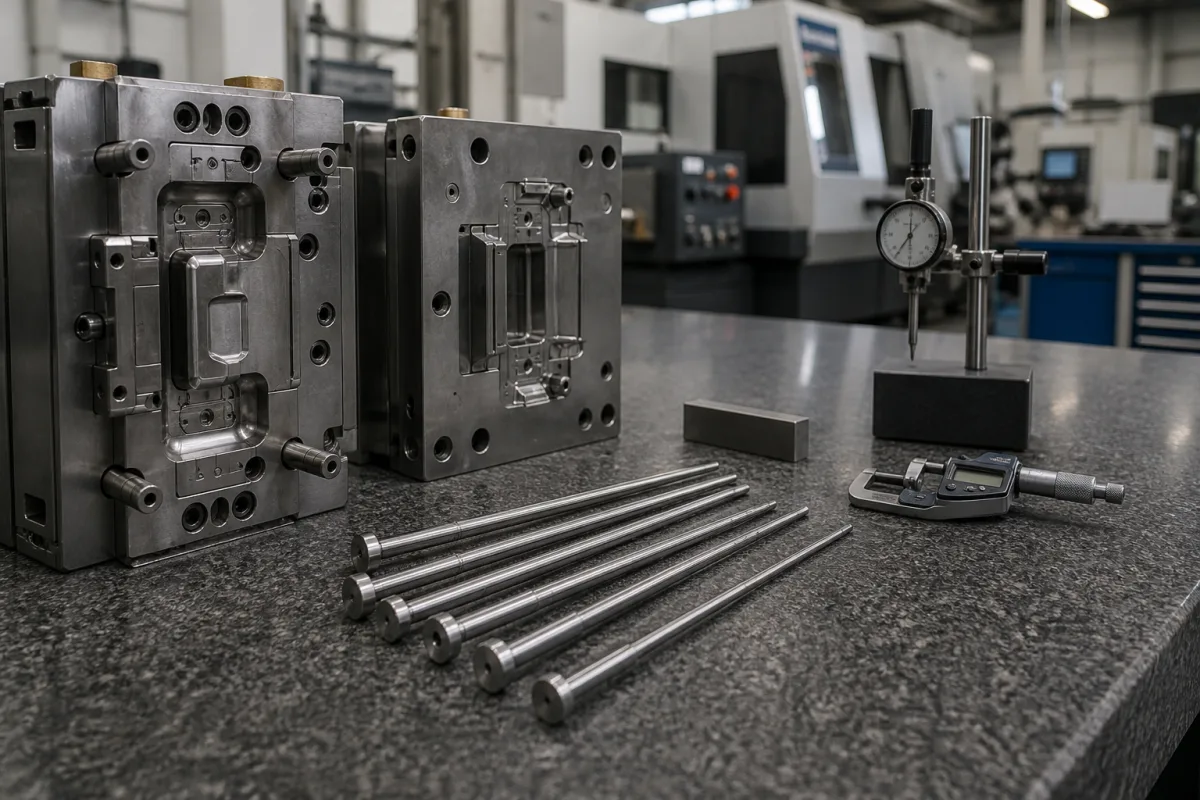
Mould ejector pins · DIN straight, stepped and blade types, nitrided versus through-hardened, g6 shaft tolerance, head and length tolerances
A mould ejector pin is a headed, ground steel pin that slides through the mould plates and pushes the solidified part off the cavity when the mould opens, the head seated in the ejector plate. Ask three things first: whether a straight pin, a stepped pin or an ejector blade suits the feature being pushed, which steel and heat treatment (nitrided or through-hardened) suit the mould's temperature and wear, and what shaft, head and length tolerances the fit requires.
Standard ejector pins, stepped pins and ejector blades for injection and die casting moulds, in hot-work tool steels, nitrided or hardened. Ejector sleeves, return pins, core pins sold as cavity inserts and punch pins for stamping dies are outside this page.
CNFX editorial research · Sources checked October 12, 2026 · 4 sources
Misumi's DIN 1530 ejector pin catalogue (July 2024) lists straight ejector pins in 1.2344-equivalent hot-work steel, nitrided to a surface of 900 HV or more over a material hardness of 40–45 HRC, in shaft diameters from 1 to 25 mm and standard lengths from 100 to 1,000 mm. [1]
Its stepped ejector pins, for small diameters from 0.8 mm at the tip, are 1.2344 equivalent through-hardened to 50–55 HRC, with the step position and tip length specified by the buyer. Its ejector blades for thin ribs are 1.2344 equivalent nitrided (surface 900 HV or more, material 40–45 HRC), and the catalogue notes they are not polished after nitriding. [2]
A second supplier's specification for nitrided and polished DIN 1530 A pins, which it describes as particularly suitable for pressure die-casting tools, gives a shaft surface of at least 950 HV 0.3 over a core strength of about 1,400 N/mm², a head of HRC 45 (+10/−5), hot-work steel 1.2343, 1.2344 or similar with temper resistance of at least 600 °C, a hot-forged cylindrical head and a fine-ground shaft; a nitrided and oxidised finish is also offered. [3]
Editorial note: nitriding gives a hard wear surface over a tougher core, while the through-hardened stepped pin keeps hardness through a thin tip; ask the supplier which treatment it recommends for your mould temperature and alloy.
Give the supplier the pin type (straight, stepped, blade), standard (DIN, ISO, JIS or maker), steel and treatment, shaft diameter and length (or length to cut), head diameter and thickness, tip shape or flats, quantity per size, and certificates.
02
Fix the shaft, head and length tolerances
The straight pins hold the shaft to g6 over a guaranteed precision length, for example −0.002/−0.008 mm for 1–3 mm shafts, −0.004/−0.012 mm for 3.5–5.5 mm, −0.005/−0.014 mm for 6–10 mm, −0.006/−0.017 mm for 12–16 mm and −0.007/−0.020 mm for 20–25 mm (sizes as listed in its length-specified table). Head diameter tolerance is 0/−0.2 mm and head thickness 0/−0.05 mm; standard-length pins carry +0.1/+5 mm length tolerance for cutting to size, while length-specified pins are held to +0.02 mm, +0.05 mm for 200–500 mm and +0.5 mm above 500 mm. [1]
For example, a 4 mm straight pin has an 8 mm head, 3 mm thick. Stepped pins hold the tip to g6 and the shank to 0/−0.02 mm, and blades hold width and thickness to 0/−0.015 mm with tip corner squareness within 0.02 mm. [1][2]
Editorial calculation: an ejection force of 2,000 N on a 4 mm pin gives a compressive stress of 2,000 ÷ (π × 2²) ≈ 159 MPa in the shaft; long, thin pins also need checking for buckling, so ask the supplier or mould designer to confirm the pin size for your ejection force and length.
Editorial calculation: the 159 MPa example above is about 11% of the 1,400 N/mm² core strength stated for nitrided die-casting pins (159 ÷ 1,400); buckling of long, slender pins, not crushing, sets the safe load in that case. [3]
03
Compare surface and core hardness across pins, sleeves and blades
DME's ejector pin page, which covers Imperial, DIN and JIS formats, gives hardness by component. Its straight and shoulder ejector pins are made from H-13 steel with a core hardness of 47–52 HRC to resist bending and a non-chipping surface treatment of 65–70 HRC to limit flashing, nicking and dishing, with annealed heads that can be machined and a centerless-ground diameter. Return pins and sprue puller pins are hot-work die steel with hot-forged heads and an outside diameter nitrided to 65–74 HRC. Ejector sleeves are nitrided to 65–74 HRC outside, while the inside bearing diameter is kept at 30–35 HRC and honed, with a lead-in taper for the pin. Ejector blades are one-piece M2 high-speed steel through-hardened to 58–62 HRC, with thickness and width held to +0.0000/−0.0003 in. Core pins are offered at 30–35 HRC or 50–55 HRC. [4]
Editorial calculation: −0.0003 in is about −0.008 mm, about half the 0/−0.015 mm band Misumi gives for the width and thickness of its blades. The split between a 47–52 HRC core and a 65–70 HRC skin is the same idea as the nitrided DIN 1530 pins above: a hard wear surface over a tougher core. When ordering, state the format (Imperial, DIN or JIS), the core and surface hardness for each component, and whether sleeves need a nitrided bore. [4][2][3]
Ejector pins alongside punch pins and mould inserts on the listed page
Listings include mould ejector pins, die punch pins and precision mould inserts.
05
Shaft, head, tip, steel, heat treatment and length
Misumi's DIN 1530 catalogue supplies the shaft, head, steel and length rows for its range (g6 shaft, 0/−0.2 mm head diameter, 1.2344-equivalent steel), and Berger adds a hot-forged head at HRC 45 for die-casting pins. [1][3]
Diameter, length, surface hardness, steel grade and temper resistance for an ejector pin order
Hardness figures differ by maker and treatment — 900 HV or more nitrided (Misumi), at least 950 HV 0.3 (Berger), 65–70 HRC over a 47–52 HRC core (DME) — so state surface and core values together. Straightness, thermal conductivity, impact toughness and weight are not published in these sources. [1][3][4]
1 company lists this product among what they make. Company figures are quoted from each
company's own website; every card states where the relationship came from.
OMET Technology Co., Limited
Manufacturing site to be confirmed for the order
Lists mould ejector pins, die punch pins and precision mould inserts.
Explore company information and manufacturing capabilities, then discuss the scope of your project with a relevant supplier.
Share this page
Compiled and source-reviewed by the CNFX editorial team.
Each manufacturer above links to the page on that company's own website where the product is listed, with the date we checked it. How we source and review
· Page last updated 13 October 2026
Buyer questions
What hardness do nitrided ejector pins have?
Misumi's DIN straight pins have a nitrided surface of 900 HV or more over a 40–45 HRC core. [1]
What tolerance is an ejector pin shaft?
g6, for example −0.004 to −0.012 mm for 3.5–5.5 mm pins in Misumi's DIN range. [1]
When are stepped ejector pins used?
For small tip diameters from 0.8 mm, through-hardened to 50–55 HRC with a specified step. [2]
What hardness do nitrided ejector pins for die casting have?
One DIN 1530 A specification gives at least 950 HV 0.3 at the shaft surface, about 1,400 N/mm² core strength and temper resistance of at least 600 °C. [3]
How hard are ejector pins at the core and surface?
One mould-component maker lists H-13 ejector pins with a 47–52 HRC core and a 65–70 HRC surface, sleeves nitrided to 65–74 HRC outside and 30–35 HRC inside, and M2 blades at 58–62 HRC. [4]
Sources and what still needs a direct check
Sources checked 2026-10-12. Misumi is a components distributor and maker; figures are for its DIN 1530 catalogue range. Other makers' standards and treatments differ.