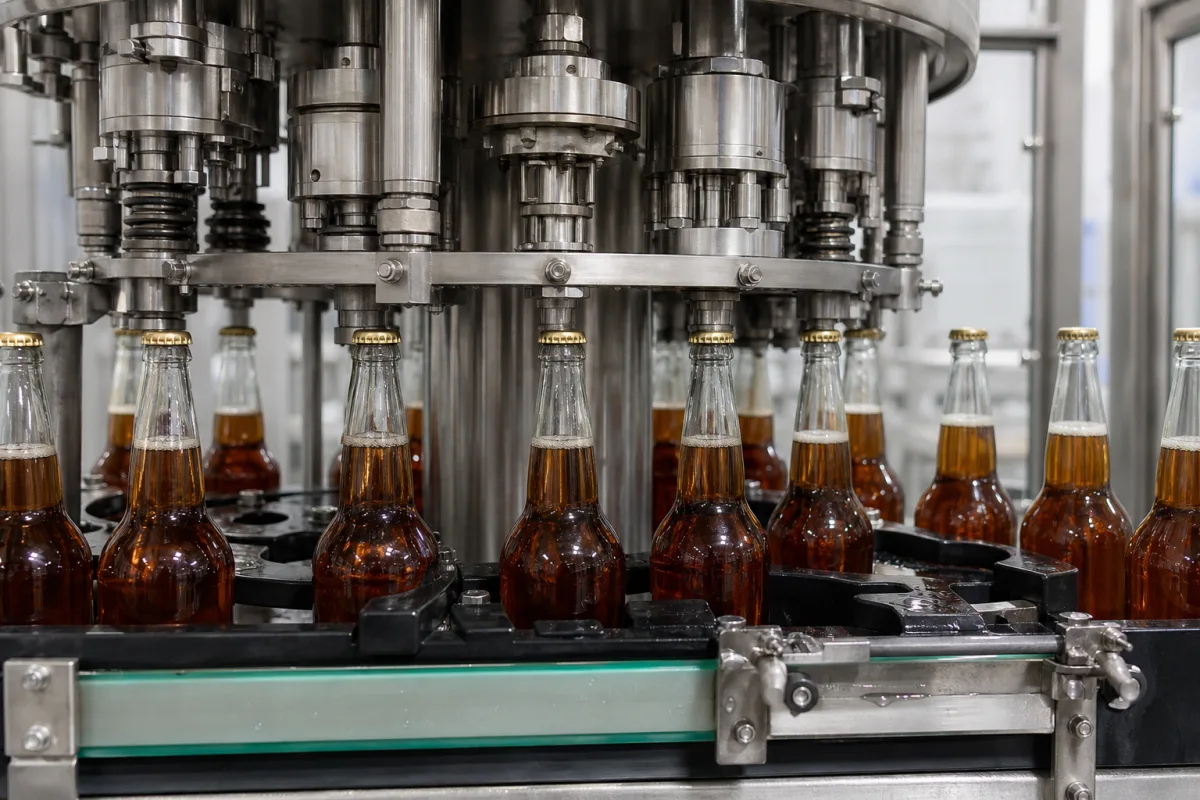
Automated bottle capping machine for crimped, rolled-on and corked closures
Beer, wine and spirits bottles · crown crimping, roll-on pilfer-proof (ROPP) capping and corking, with top and side loads
An automated bottle capping machine for beer, wine and spirits closes each bottle with a closure that is formed or pressed on rather than screwed: a crown crimped over the bottle lip, an aluminium roll-on pilfer-proof (ROPP) shell whose thread is rolled into the metal against the bottle neck, or a cork pressed into the bore. Decide three things first: which closure the bottle finish takes, how much top and side load the bottle can carry, and the output the line needs.
Automatic machines that apply crown caps, ROPP and other roll-on aluminium caps, and corks or bar-top stoppers to glass and metal bottles for beer, wine, spirits and similar drinks, including their capping heads, cap feeders and checks. Screw-capping machines that apply pre-threaded caps by torque are covered on the High-speed rotary bottle capping machine page; can seamers, the closures themselves and filling machines are outside this page.
CNFX editorial research · Sources checked October 12, 2026 · 5 sources
A roll-on head forms the closure on the bottle. Metal Closures Limited's patent application EP0005934A1 describes shaping the skirt of an unthreaded metal closure shell into conformity with the bottle thread using profiled thread rollers while the shell is pressed down on the bottle mouth. [2] Tedelta's CR-504-ST roll-on head, for aluminium, pilfer-proof and roll-on caps on glass and PET bottles, threads caps from 18 mm to 38 mm diameter with two skirting rollers, two threading rollers and a set top load, and stops rolling when no cap is detected to avoid neck damage. [3]
Ball Corporation's European patent EP3497050B1 on sealing bottles quantifies the loads. It states that glass bottles sealed with ROPP closures on similar apparatus receive a cumulative load of at least 227 kg (500 pounds), and that capping aluminium bottles reduces this to about 172 kg (380 pounds) with a range of ±5%, because aluminium bottles are more prone to deformation or collapse. [1]
For a known capping apparatus on aluminium bottles, the patent gives a nominal topload of about 113 kg (250 pounds) and a sideload of about 39 kg (86 pounds), leaving less than about 14 kg (30 pounds) of margin before the failure threshold. Its method limits the cumulative force to no more than about 145 kg (320 pounds), with a topload not above about 91 kg (200 pounds) and sideloads per roller not above about 14 kg (30 pounds) for thread rollers and 16 kg (35 pounds) for pilfer rollers. [1] Editorial calculation: 113 kg plus 39 kg is about 152 kg, the nominal load of the known apparatus.
Editorial note: ask the machine supplier for the top load and roller loads set for your bottle, glass or aluminium, and for how they are adjusted and checked at changeover.
Give the supplier the closure type and size (crown, ROPP, cork or bar-top), bottle material, neck finish drawing and height range, the load limits the bottle maker states, output in bottles per hour, cap feeding method, and the checks needed (missing cap, crimp or seal check).
02
Match the machine to the crown, ROPP cap or cork
Crowns are sized by diameter. Vigo Ltd lists crown caps of 26 mm diameter and champagne crown caps of 29 mm diameter, and sells stainless steel gauges with pass and fail holes, in 26 mm and 29 mm versions, for checking during capping that each crown has been adequately applied. [5]
Corks are pressed into the bottle. ZONESUN lists its ZS-XG440K automatic wine bottle corking machine with a rotary turret of 8 capping heads, about 6,000 bottles per hour, bottle heights of about 70 to 260 mm, machine power of 1.5 kW plus 0.18 kW, and a footprint of about 5750 × 3100 × 3500 mm including cap elevator and vibratory bowl sorter. [4] Editorial calculation: 6,000 bottles per hour over 8 heads is 750 bottles per head per hour, one bottle every 4.8 seconds per head.
Editorial note: crown, ROPP and cork machines use different heads, cap feeds and checks, so a machine changing between closure types needs the change parts listed in the quotation.
03
Crown, ROPP, Stelvin or cork: closure types per machine
Ask each supplier which closure types and sizes the machine applies, how top load and roller pressure are set, and which caps and bottles it was tested with.
04
Cap feed, roll-on head, crowning head and corker on one turret
Part
Role
Fix in the order
Cap feed
Sorts and delivers closures; cap elevator and vibratory bowl on one corker. [4]
Feed type and cap size.
Roll-on head
Thread and skirting rollers form the aluminium shell. [3][2]
Closures covered are crown caps on glass bottles, ROPP aluminium caps for liquor and wine, Stelvin caps and corks, the last including the ZS-XG440K automatic wine bottle corker.
ZONESUN
Manufacturing site to be confirmed for the order
Lists the ZS-XG440K automatic wine bottle corking machine, and ROPP and corking capper categories.
Explore company information and manufacturing capabilities, then discuss the scope of your project with a relevant supplier.
Share this page
Compiled and source-reviewed by the CNFX editorial team.
Each manufacturer above links to the page on that company's own website where the product is listed, with the date we checked it. How we source and review
· Page last updated 13 October 2026
Buyer questions
How much load does ROPP capping put on a bottle?
Ball Corporation's patent says glass bottles receive at least 227 kg cumulative load, and aims to limit aluminium bottles to about 145 kg. [1]
What cap sizes does a roll-on capping head handle?
Tedelta's CR-504-ST threads caps from 18 to 38 mm in diameter. [3]
How is a crown cap application checked?
With a pass/fail gauge for the crown size; Vigo lists gauges for 26 mm and 29 mm crowns. [5]
Sources and what still needs a direct check
Sources checked 2026-10-12. Ball Corporation and Metal Closures Limited describe roll-on capping in their patents; Tedelta and ZONESUN describe their own capping heads and machines; Vigo describes crown gauges it sells. Figures belong to the products and bottles named.