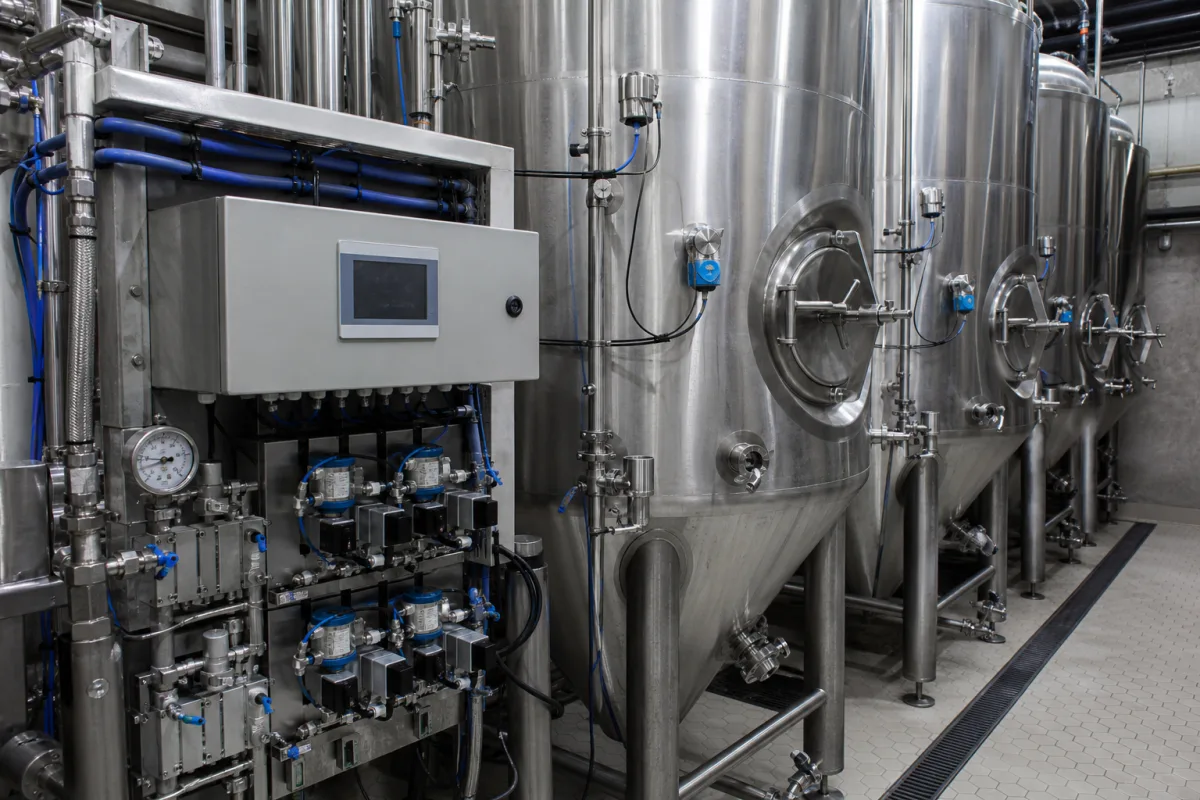
Automated fermentation control system for brewery cylindroconical fermenters: jacket zones, probes and glycol loop
Temperature control for brewery cylindroconical fermenters · wall and cone jacket zones, probe heights, a pitch-rise-cool program, and the glycol loop at 25–30 °F that carries the load
In a brewery, an automated fermentation control system holds each fermenter on its temperature program: a controller reads probes in the beer and opens the coolant to the jacket zones on the cylindrical wall and the cone, from pitching through the warm phase and diacetyl removal to cooling and cold maturation. The hardware is modest (probes, solenoid or ball valves on each jacket, a panel or PLC) but its layout follows the vessel: how many jacket zones, where the probes sit, and whether the glycol or ammonia supply can carry the cooling load when two or more tanks crash-cool together.
Temperature control systems for brewery cylindroconical fermenters and unitanks: jacket zone valves, temperature probes, controllers and temperature programs, and the glycol or direct-expansion cooling supply they draw on. PLC-based machine and motion control is covered on the Industrial control systems page; control cabinets on the Control system cabinet page; and DIN-rail multi-loop PID controller modules on the Feedback controller page. Automated viscosity control and mixing systems, which control a different variable in other process liquids, have their own page. Wort boiling, brewhouse automation and glycol chillers sold alone are outside this page.
CNFX editorial research · Sources checked October 12, 2026 · 3 sources
Wall and cone jacket zones, probe heights, and why the cone needs its own cooling
Convection moves colder beer down and warmer beer up in a cylindroconical vessel, so jacket zones and probe positions decide which part of the tank the controller actually holds.
Silveira and Razuk, analysing cylindroconical fermenters supplied by Dedini, give vessel capacities of 500 to 13,000 hL, heights up to 22 m, diameters of 2 to 8 m, 8–25% headspace for foam and a cone angle of 60 to 75°. During the main fermentation, CO₂ evolution mixes the tank; afterwards, colder beer sinks and warmer beer rises. Beer is densest at about +2.5 °C (about +1.0 °C for higher-extract and +3.0 °C for lower-extract beers), and to cool and lager beer at 0 to −2 °C the vessel must have cone cooling, otherwise that region cannot reach these temperatures. [1]
The Brewer's Handbook describes the fermentation temperature being controlled automatically on a preset program by a recorder-controller operating the jackets on the walls and the cone, with probes at different depths: one low on the tank so that it is immersed when the tank is only partly full, and an additional probe higher up when beer is cooled near freezing for conditioning. Unitanks, which ferment and condition in one vessel, carry jackets high in the vessel for fermentation and low for conditioning, and need enough cooling to reach and hold sub-zero temperatures. [2]
On the jacket side, Silveira and Razuk describe half-pipe coils divided into zones, which reduces the pressure drop of the cooling medium; with direct ammonia evaporation, 4 to 6 pipe coils form one zone, and flow velocities in half-pipe coils of 0.77 to 1.52 m/s are used for heat transfer calculations. [1]
For each fermenter, list the number of wall and cone jacket zones, the coolant (glycol or direct ammonia), the valve type per zone, the number and heights of probes, and the lowest beer temperature to be held.
02
Pitch at 8 °C, free rise to 12–14 °C, diacetyl removal, then cooling to maturation
The controller runs a program, not a single set point; the cooling demand peaks at the step from warm fermentation to cold maturation.
Editorial calculation: assuming a 12 °P wort with a density of about 1.048 kg/L, one hectolitre holds about 12.6 kg of extract; with 65% fermented, fermentation releases about 4.8 MJ per hectolitre (12.6 × 0.65 × 586.6 kJ), which the jackets must remove over the fermentation in addition to the cool-down load.
Cooling down of the beer in 24 to 48 h after primary fermentation [1]
Fermentation heat
586.6 kJ per kg of extract fermented; about two-thirds of the extract is fermented (65% real attenuation) [1]
Give the system supplier the program for each beer type (set points, ramp rates, hold criteria such as diacetyl), the number of tanks that may cool down at the same time, and whether set points are changed from the panel, a recipe system or a plant SCADA.
03
Glycol at 25–30 °F, 40% propylene glycol, and cooling loads per barrel of tank
Where fermenters are cooled with glycol, the control valves only work if the chiller and loop can carry the summed load of all tanks in their current program step.
The card's chiller set-up note gives a brewery fluid temperature of 25–30 °F with a mixture of 40% inhibited propylene glycol and 60% water, and states that the fluid should protect against freezing to the lowest expected ambient or 20 °F below the set point, and that sizing factors are an approximation only. Its typical tank piping shows ball valves, a solenoid valve on the glycol supply to each fermenter or brite tank switched by a temperature control from a temperature probe, and a pressure-reducing valve set to protect the tank from over-pressurisation. [3]
Editorial calculation: 25–30 °F is about −3.9 to −1.1 °C, and 75 to 35 °F is about 24 to 1.7 °C. The card's table gives 11,440 BTU/h for crash cooling a 20 bbl tank in 18 h (the formula gives 11,500), about 3.4 kW; two 20 bbl tanks crashing while four others ferment actively would need about 2 × 11,440 + 4 × 1,200 = 27,680 BTU/h, about 8.1 kW, before brite tanks are added.
Count the worst case: how many tanks crash-cool at once, which tanks are in active fermentation, and the brite and cold liquor tank loads, and give the glycol supply temperature and mixture so the valve and chiller sizing match.
04
Data for a fermentation temperature control system
Paste it into your enquiry below or into an email to a maker, then replace every bracket.
Vessels: [number; volume (hL or bbl); unitank or fermenter; wall and cone jacket zones]
Coolant: [glycol mixture and supply temperature, or direct ammonia]
Probes: [number and heights per tank; type]
Valves: [solenoid or modulating; per zone]
Programs: [set points; ramps; holds; maturation temperature]
Loads: [tanks crashing at once; active fermentation; brite tanks]
Control: [panel, PLC or SCADA; recipes; alarms; data logging]
Explore company information and manufacturing capabilities, then discuss the scope of your project with a relevant supplier.
Share this page
Compiled and source-reviewed by the CNFX editorial team.
Each manufacturer above links to the page on that company's own website where the product is listed, with the date we checked it. How we source and review
· Page last updated 13 October 2026
Buyer questions
Why does a cylindroconical fermenter need cone cooling?
Silveira and Razuk state that to cool and lager beer at 0 to −2 °C the vessel must have cone cooling; otherwise the cone region cannot reach these temperatures. [1]
Where should temperature probes be placed in a fermenter?
The Brewer's Handbook places one probe low enough to be immersed when the tank is partly full, and advises an additional higher probe when beer is cooled near freezing. [2]
How much glycol cooling does crash cooling need?
Advantage Engineering estimates BTU/h = barrels × 575 to cool from 75 °F to 35 °F in 18 hours, with glycol at 25–30 °F. [3]
Sources and what still needs a direct check
Sources checked 2026-10-12. Silveira and Razuk's COBEM 2009 paper analyses fermenter cooling at a Brazilian equipment maker; The Brewer's Handbook (Apex Publishers) describes fermentation systems; Advantage Engineering's sizing card gives approximate glycol loads.