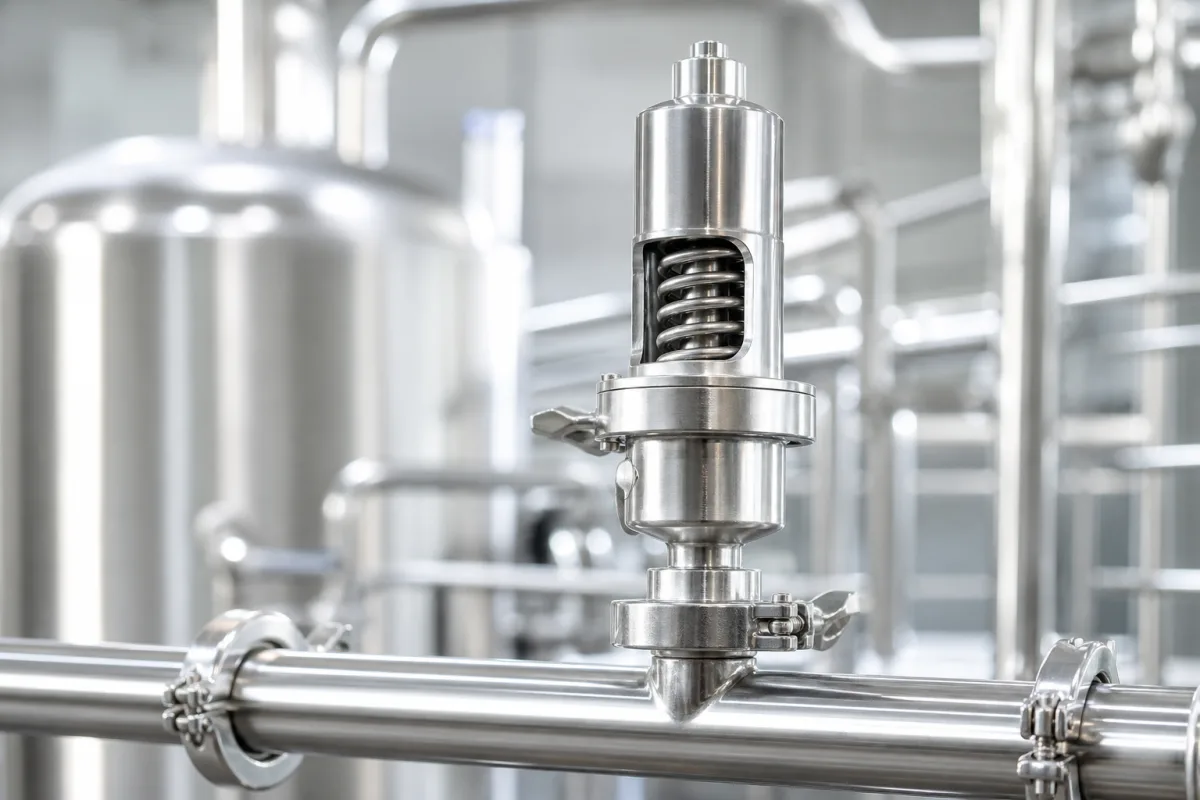
Sanitary pressure relief valve for hygienic tanks and pump lines
Hygienic process tanks and pump lines · Set pressure between operating and tank limits, cleaning the seat, polished 316L and food-contact seals
A sanitary pressure relief valve is a relief or safety valve built to hygienic rules: polished 316L product-wetted parts, food-contact elastomer seals, clamp or dairy-union connections, and a way to open the seat so cleaning fluid reaches it. It protects process tanks and vessels against overpressure or overfilling, and protects lines fed by positive displacement pumps. Ask three things first: where the set pressure sits between operating pressure and the tank's admissible pressure, how the seat is cleaned during CIP, and which surface finish and seal compliance the supplier certifies.
Hygienic spring-loaded, pneumatically adjustable and deadweight relief valves for food, beverage, brewery, dairy and similar clean process tanks and pump lines. Industrial spring-loaded and pilot-operated safety valves for boilers, steam, gas and general liquid service are covered on the Pressure relief valve page. Vacuum breakers, breathing valves, spunding valves and rupture discs are outside this page. Valves on the same hygienic lines that shut off or modulate flow rather than relieve pressure are described elsewhere: weir-type on/off valves on the Sanitary diaphragm valve for dairy processing page, and seat-type control valves with positioners on the Hygienic pneumatic regulating valve page.
CNFX editorial research · Sources checked October 12, 2026 · 5 sources
Place the set pressure between operating pressure and the tank limit
Alfa Laval's leaflet for its hygienic spring-loaded Safety Valve states the ordering principle as maximum admissible tank pressure > set pressure > operating pressure, with at least a 10% buffer between the tank's maximum admissible pressure and the set pressure, and a set pressure about 20% above the expected operating pressure so the valve does not open in normal operation. It also notes that a 10% rise above set pressure is needed for the valve to open fully, and that after opening the pressure must fall well below the set point before the valve is fully closed again. [1]
Editorial calculation, assuming the 10% buffer is taken on the set pressure: a tank operated at 2.0 bar would get a set pressure of 2.0 × 1.2 = 2.4 bar, and the tank's maximum admissible pressure would need to be at least 2.4 × 1.1 = 2.64 bar. Check the buffer basis with the supplier and the vessel's design documents.
The same valve comes in DN25 to DN100 with a spring set range of 0.2 to 12 bar overall, but the range narrows with size: the liquid charts cover 0.4–9.0 bar at DN65, 0.3–8.0 bar at DN80 and 0.3–3.2 bar at DN100. It is supplied with a PED certificate to PED 2014/68/EU and EN 4126-1 for fluid group II, and should be mounted vertically; mounted horizontally it opens somewhat below the specified set pressure because the piston's weight no longer acts on the seat. [1]
A deadweight tank-top relief valve follows a different margin rule: Alfa Laval's SB valve opens 0.1 bar above the tank working pressure when that pressure is below 1 bar, and 10% above it at 1 bar or more, with set ranges of 0.2–3.5 bar at 75 mm, 0.2–2.5 bar at 100 mm and 0.4–1.5 bar at 150 mm. [3] Editorial calculation: a tank worked at 0.5 bar gets a 0.6 bar opening pressure; one worked at 2.0 bar gets 2.2 bar.
Give the supplier the protected equipment (tank, vessel or pump line), its maximum admissible pressure, operating pressure range, medium (liquid or gas, product and CIP fluids), required relieving flow, temperature and sterilization conditions, connection standard and size, mounting orientation, and documents needed (PED certificate, material and seal certificates).
02
Make sure the seat is cleaned and the wetted materials are certified
A relief valve that stays shut during CIP leaves its seat uncleaned. Alfa Laval's SB tank-top valve is cleaned in the closed position by the tank cleaning head, which does not include the valve seating; to clean the seat, the valve can be fitted with a pneumatic force opener and a splash guard. [3] The Unique SSV pressure relief valve for pump lines opens fully during CIP regardless of its set pressure. [2] Jianen lists a handle that partly opens its sanitary safety valve so fluid can pass through it during field cleaning. [4]
Published finish and material values: Alfa Laval's Safety Valve has 316L (1.4404) wetted parts, EPDM seals, Ra 0.8 µm internal and Ra 1.5–2.5 µm external finish, a +4 to +95 °C working range and dry-steam sterilization up to 140 °C for at most 30 minutes. [1] The Unique SSV lists polished internal surfaces of Ra < 0.8 µm, a bead-blasted exterior, EPDM seals with NBR, HNBR and FPM as alternatives, −10 to +140 °C with EPDM, and up to 10 bar product pressure. [2] Jianen lists wetted parts in 304 or 316L with Ra ≤ 0.8 µm, an external surface of Ra < 0.8 µm, a 60Si2Mn spring and EPDM seals as standard. [4]
For seals sold into the United States, FDA's 21 CFR 177.2600 sets extraction limits for rubber articles intended for repeated use: in contact with aqueous food, total extractives in distilled water at reflux must not exceed 20 mg per square inch in the first 7 hours and 1 mg per square inch in the following 2 hours; for fatty foods the n-hexane limits are 175 mg and 4 mg per square inch. The section also requires repeat-use rubber articles to be thoroughly cleansed before their first use with food. [5] Editorial note: ask for the seal compound's compliance statement, not only the word EPDM.
03
Spring-loaded, air-adjusted or deadweight relief on a hygienic tank
The reviewed leaflets describe three working principles; match the principle to what is being protected.
Ask each valve maker which of these principles its valve uses, its set range per size, and how the seat is opened for cleaning.
Design
Protects
Published data
Spring-loaded tank safety valve
Tanks, vessels and equipment against blocked discharge, thermal expansion or reactions. [1]
DN25–DN100; 0.2–12 bar; manual or pneumatic lifting for cleaning; DN25 weighs 6.8 kg, DN100 28.2 kg. [1]
Pneumatically adjustable relief valve
Hygienic lines with positive displacement pumps. [2]
Normally closed setting 0–10 bar (0–8 bar at DN100); max 10 bar product pressure; actuator air 5–7 bar. [2]
Deadweight tank-top relief valve
Pressurized tanks against overfilling, including brewery tanks. [3]
75–150 mm; 0.2–3.5 bar; counterweight set and locked; Ra < 0.8 µm. [3]
04
Body, seat seal, spring and lifting device of a hygienic relief valve
End connections listed run from tri-clamp and sanitary union to flange, threaded or weld ends; where wetted parts are specified they are 316L or finished to Ra ≤ 0.8 µm, with EPDM seals.
China Sanitary Valve
Manufacturing site to be confirmed for the order
Lists sanitary safety relief valves with clamped ends.
Explore company information and manufacturing capabilities, then discuss the scope of your project with a relevant supplier.
Share this page
Compiled and source-reviewed by the CNFX editorial team.
Each manufacturer above links to the page on that company's own website where the product is listed, with the date we checked it. How we source and review
· Page last updated 13 October 2026
Buyer questions
How high should the set pressure be?
Alfa Laval's guideline is about 20% above operating pressure, with at least a 10% buffer below the tank's maximum admissible pressure. [1]
How is the valve seat cleaned?
By opening the valve during CIP: Alfa Laval's pump-line relief valve opens fully, and its tank-top valve needs a force opener and splash guard to include the seat. [2][3]
What limits apply to rubber seals in the US?
21 CFR 177.2600 limits water extractives from repeat-use rubber to 20 mg/in² in the first 7 hours and 1 mg/in² in the next 2 hours. [5]
Sources and what still needs a direct check
Sources checked 2026-10-12. Alfa Laval and Jianen are valve makers describing their own products; FDA's regulation sets extraction limits for rubber food-contact articles in the United States. The pressure equipment rules cited by the makers govern certification.