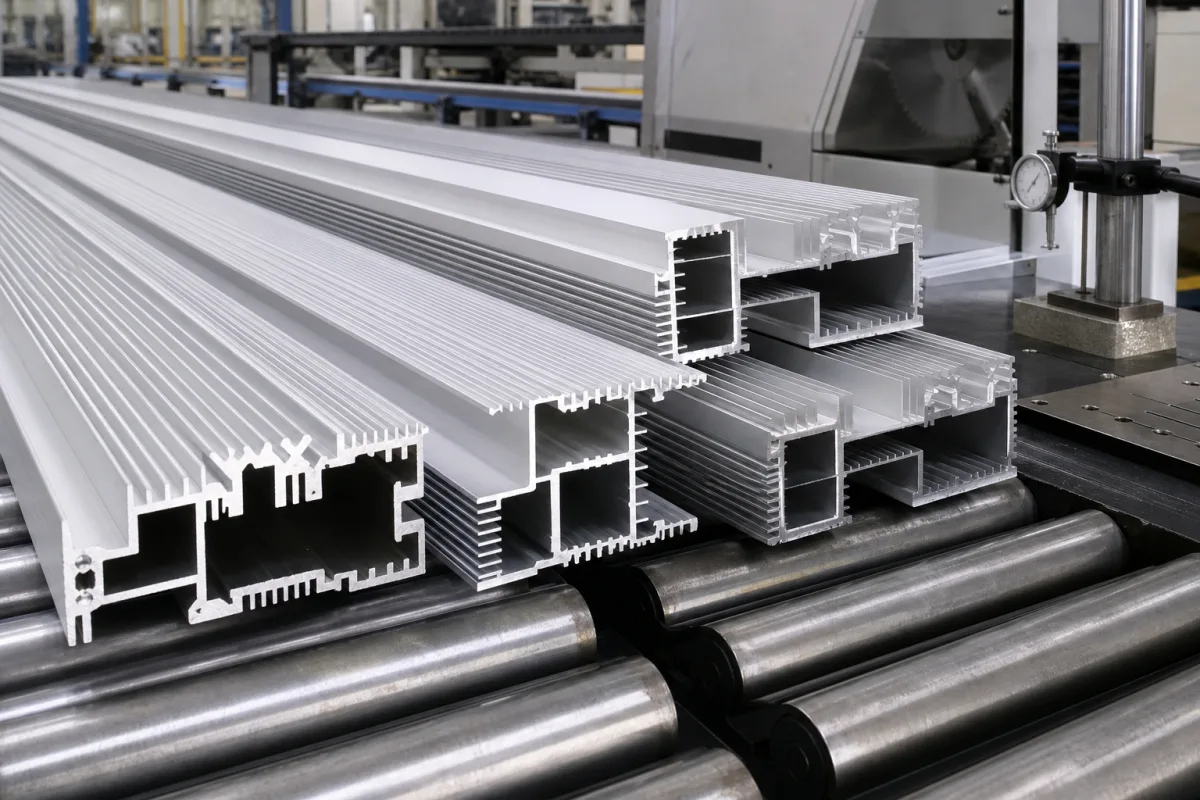
Aluminum extruded heat sink profile: the extruded fin section, supplied in lengths and cut lengths
Extruded heat sink profiles in stock and cut lengths · θsa per 3 in, weight per foot, fin height-to-thickness ratio, 6063 temper properties and the extrusion route
This page covers the extruded heat sink profile itself: the cross-section of base and fins produced by extrusion, sold as profile lengths or cut lengths before or after finishing. Ask three things first: the profile's published thermal resistance and the conditions behind it, the fin height-to-thickness ratio and base thickness the die can hold, and the alloy, temper, length and finish you will receive.
Aluminium heat sink profiles produced by extrusion, supplied as profile lengths or cut lengths with optional machining and finish, specified by cross-section, alloy and temper. Heat sinks made by die-casting, skiving, bonding or full machining, and finished heat sink assemblies across processes, are covered on the Aluminum heat sink page. Liquid cold plates, heat pipes and fans are outside this page.
CNFX editorial research · Sources checked October 12, 2026 · 5 sources
Read a profile's published data: θsa per 3 in, perimeter and weight per foot
Profile catalogues give each cross-section a perimeter, a weight per foot and a thermal resistance for a stated length. Wakefield's thermal extrusion profile guide lists each profile with "Per." in inches, "WT." in lb/ft and θsa in °C/W/3", and states that the θsa values are for a 3″ vertical length in natural convection with black anodized finish. [1]
For its 12 inch high-aspect-ratio cut lengths in 6063 aluminium (cut, deburred, washed, no finish), the same guide lists profile 19671 at 5.324 in wide, 1.63 in high, 0.625 in average base and 0.096 in average fin thickness; profile 15837 at 7 in wide, 2.275 in high, 0.525 in base and 0.085 in fin; and profile 19275 at 7.362 in wide, 2.165 in high, 0.292 in base and 0.051 in fin. Its notes state that thermal data is for reference only, that 0 LFM represents natural convection with a vertical heat sink, and that data is based on a fully distributed load on the base. [1]
Editorial calculation: taking fin height as overall height minus average base thickness, the fin height-to-average-thickness ratio is about (1.63 − 0.625) ÷ 0.096 ≈ 10.5 for profile 19671, (2.275 − 0.525) ÷ 0.085 ≈ 20.6 for 15837 and (2.165 − 0.292) ÷ 0.051 ≈ 36.7 for 19275. These are approximations from catalogue averages, not die limits; ask the extruder what ratio it will hold for your fin pitch. [1]
Give the supplier the heat load and source footprint, allowable temperature rise, airflow (natural or LFM), orientation, the envelope, the cut length and the finish, or name a catalogue profile and ask for its data at your length.
02
Check alloy, temper and the extrusion route
Wakefield describes the route: hot aluminium billets are pushed through a steel die; the initial sticks are 30–40 feet long and "very soft"; the material is stretched by grabbing both ends to produce a straight stick; it is then air or over aged depending on the final hardness required; and it is cut to final length before any holes, pockets or other machining. Wakefield names 6063-T5 and states that other 6XXX alloys can also be examined as needed. [2]
Hydro's EN AW-6063 extrusion datasheet lists heat sinks among its applications and gives EN 755-2:2016 minimum properties for T5 of Rp0.2 130 MPa, Rm 175 MPa and A 8% for wall thickness up to 10 mm, and 110 MPa, 160 MPa and 7% for 10–25 mm; it defines T5 as cooled from an elevated-temperature shaping process and then artificially aged. Its physical properties give a density of 2.70 g/cm³, a melting range of 615–655 °C and a thermal conductivity of 201 W/m·K for T6. [3]
Editorial note: Hydro's table states thermal conductivity for T6 only; ask the supplier for the value it uses for T5 when you compare thermal calculations. Hydro also notes that if a profile cross-section has thicknesses falling in more than one property band, the lowest specified value applies to the whole section. [3]
03
Wakefield, BY Thermal and Aluminum-artist profile data per cut length
Compare profiles at the same length, finish and airflow basis.
2 companies list this product among what they make. Company figures are quoted from each
company's own website; every card states where the relationship came from.
BY Thermal
Manufacturing site to be confirmed for the order
Lists a CNC 6063 T5 aluminium extruded fin heat sink.
Explore company information and manufacturing capabilities, then discuss the scope of your project with a relevant supplier.
Share this page
Compiled and source-reviewed by the CNFX editorial team.
Each manufacturer above links to the page on that company's own website where the product is listed, with the date we checked it. How we source and review
· Page last updated 13 October 2026
Buyer questions
What does θsa per 3 inches mean on a heat sink profile?
Wakefield's profile guide gives θsa for a 3″ vertical length in natural convection with black anodized finish; ask for data at your own length, airflow and finish. [1]
How are extruded heat sink profiles made?
Wakefield describes pushing hot billets through a steel die into 30–40 ft sticks, stretching them straight, ageing, then cutting to length before machining. [2]
What is the thermal conductivity of 6063 aluminium?
Hydro's EN AW-6063 datasheet lists 201 W/m·K for temper T6. [3]
Sources and what still needs a direct check
Sources checked 2026-10-12. Wakefield and Hydro publish their own profile and alloy data; BY Thermal and Aluminum-artist describe their own products.