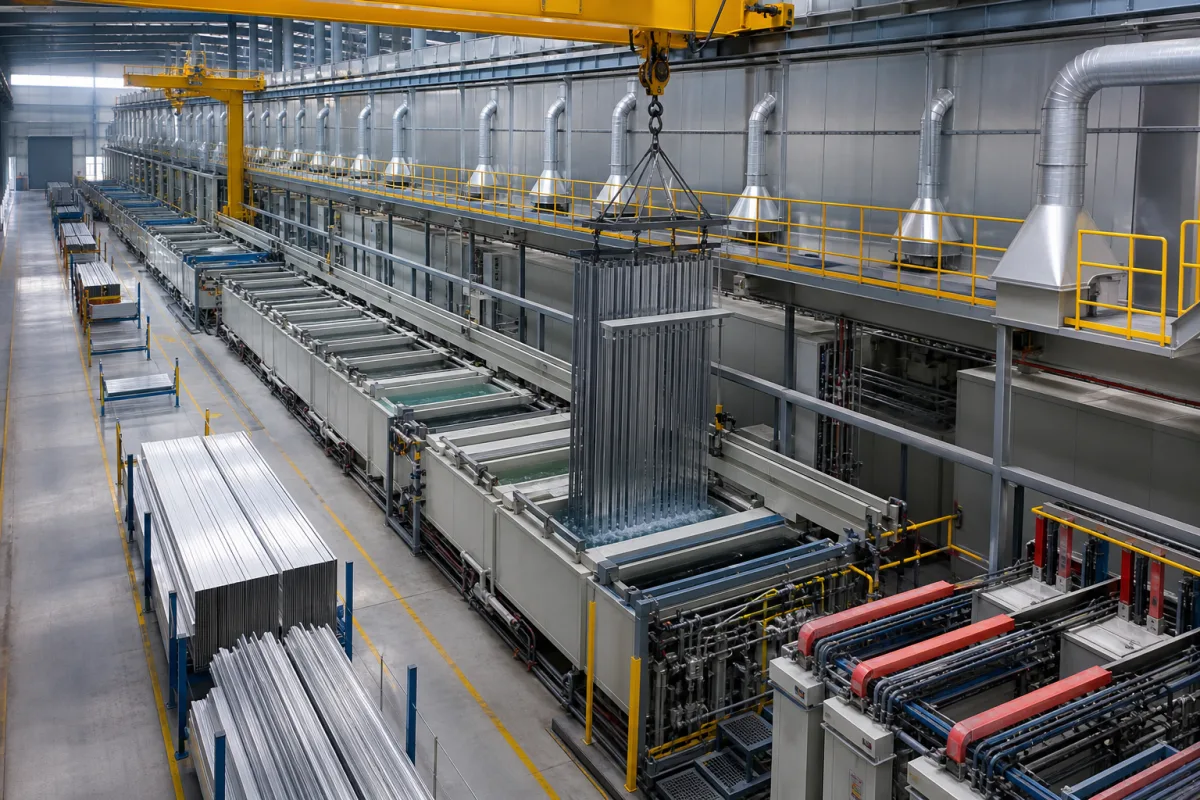
Batch anodizing lines for extrusions · Coating class and anodizing time, bath conditions and rectifier current, tank sequence, sealing quality and line capacity
An aluminium profile anodizing production line is a row of process tanks served by an overhead crane: racks of extrusions are cleaned, etched, anodized in acid under direct current, coloured and sealed, then unloaded. Fix three things before asking for a line: the coating class, thickness and colour your profiles must meet, the throughput in tonnes or square metres per month and the longest profile, and the rectifier, cooling and sealing capacity that follow from them.
Batch (rack-and-crane) anodizing lines for aluminium extrusions, including pretreatment, anodizing, colouring, sealing tanks, rectifiers and handling. Continuous coil anodizing lines, hard-anodizing cells for machined parts, powder-coating lines and stand-alone acid recovery units are outside this page.
CNFX editorial research · Sources checked October 11, 2026 · 5 sources
The Aluminum Anodizers Council's reference guide lists Aluminum Association anodic finishes made in 15% sulfuric acid at 20 °C and 12 A/ft²: A-211, A-212 and A-213 clear coatings of at least 2.5, 5 and 7.5 µm after 10, 15 and 20 minutes; architectural Class II (A-31) clear coatings of 10–18 µm, with coloured versions anodized for 30 minutes; and architectural Class I (A-41) clear coatings of 18 µm and more, with coloured versions anodized for 60 minutes. [1]
For Type II coatings the same guide gives minimum thickness of 18 µm for Class I and 10 µm for Class II, tested to ASTM B244 or B487; seal quality by ASTM B136, ASTM B680 or ISO 3210 with a maximum weight loss of 40 mg/dm²; and a Class I salt-spray requirement of 3,000 hours to ASTM B117. [1] Its process page summarizes sulfuric-acid anodizing as coatings of 0.1–1.0 mil formed in a 15% solution at 12 A/ft², 18–24 V and 70 °F for 10–60 minutes. [2]
The guide also lists pretreatment finishes the line must reproduce, such as C-22 medium matte etch in sodium hydroxide at 30–45 g/L and 60–65 °C for 5 minutes, and C-31 chemical brightening in a phosphoric-nitric acid dip. [1]
Editorial calculation: 12 A/ft² is about 1.29 A/dm² (12 ÷ 9.29 dm² per ft²), and 70 °F is about 21 °C.
Give the supplier the alloys and profile sizes, longest profile, output in tonnes and m² per month, coating class and thickness, colour process (clear, electrolytic, dyed), sealing method, site power, cooling water, steam or heating supply, waste-water limits and building dimensions.
02
Size the rectifier current and the anodizing tanks
The AAC describes batch anodizing as racking parts and immersing them in a series of treatment tanks, in five controlled stages: cleaning, etching or brightening, anodizing, colouring and sealing. [3] A linked line builder describes profiles clamped to the support bars of an overhead beam with anodizing clips, then hoisted by crane through degreasing, alkaline etching, neutralizing, anodizing, electrolytic colouring and sealing tanks. [4]
Editorial calculation: at the guide's 12 A/ft² (about 1.29 A/dm²), a rack carrying 100 m² of profile surface (10,000 dm²) draws about 12,900 A. Rectifier rating therefore follows from the largest surface load per tank, not from tonnage alone. [1]
Editorial calculation: because the guide lists 30 minutes of anodizing for coloured Class II coatings and 60 minutes for coloured Class I, a line making Class I needs about twice the anodizing tank time per rack. [1] To hold the same output, plan for more anodizing tanks or a longer cycle, and size cooling for the longer current-on time.
The same line builder reports a fully automatic profile anodizing line it designed and installed with a maximum capacity of up to 5,000 tonnes per month. [5] Ask any builder for the rack load, cycle time and coating class behind a capacity figure.
03
Turnkey profile lines from Foshan Dajia
The builder reviewed offers turnkey profile anodizing lines with design, installation and process support, alongside powder-coating and recovery equipment; ask for reference lines making your coating class and for rectifier and cooling sizing.
04
Racking, tanks and rectifiers along the line
The rectifier and anodizing tank rows are where the current calculation above turns into hardware.
Builds aluminium profile anodizing lines with crane-handled racks through degreasing, etching, neutralizing, anodizing, electrolytic colouring and sealing, with design, installation and process support.
Explore company information and manufacturing capabilities, then discuss the scope of your project with a relevant supplier.
Share this page
Compiled and source-reviewed by the CNFX editorial team.
Each manufacturer above links to the page on that company's own website where the product is listed, with the date we checked it. How we source and review
· Page last updated 13 October 2026
Buyer questions
How long does it take to anodize a Class I architectural coating?
The Aluminum Anodizers Council lists coloured Class I coatings anodized for 60 minutes at 12 A/ft² and 20 °C. [1]
What thickness is Class I and Class II anodizing?
The AAC guide gives Class I at 18 µm and more and Class II at 10–18 µm. [1]
What is the seal quality limit for anodized aluminium?
The AAC guide lists a maximum weight loss of 40 mg/dm² by ASTM B136, B680 or ISO 3210. [1]
Sources and what still needs a direct check
Sources checked 2026-10-11. The Aluminum Anodizers Council is a trade association publishing an anodizing reference guide and process descriptions; Dajia is a linked line builder publishing its line description and a project case.