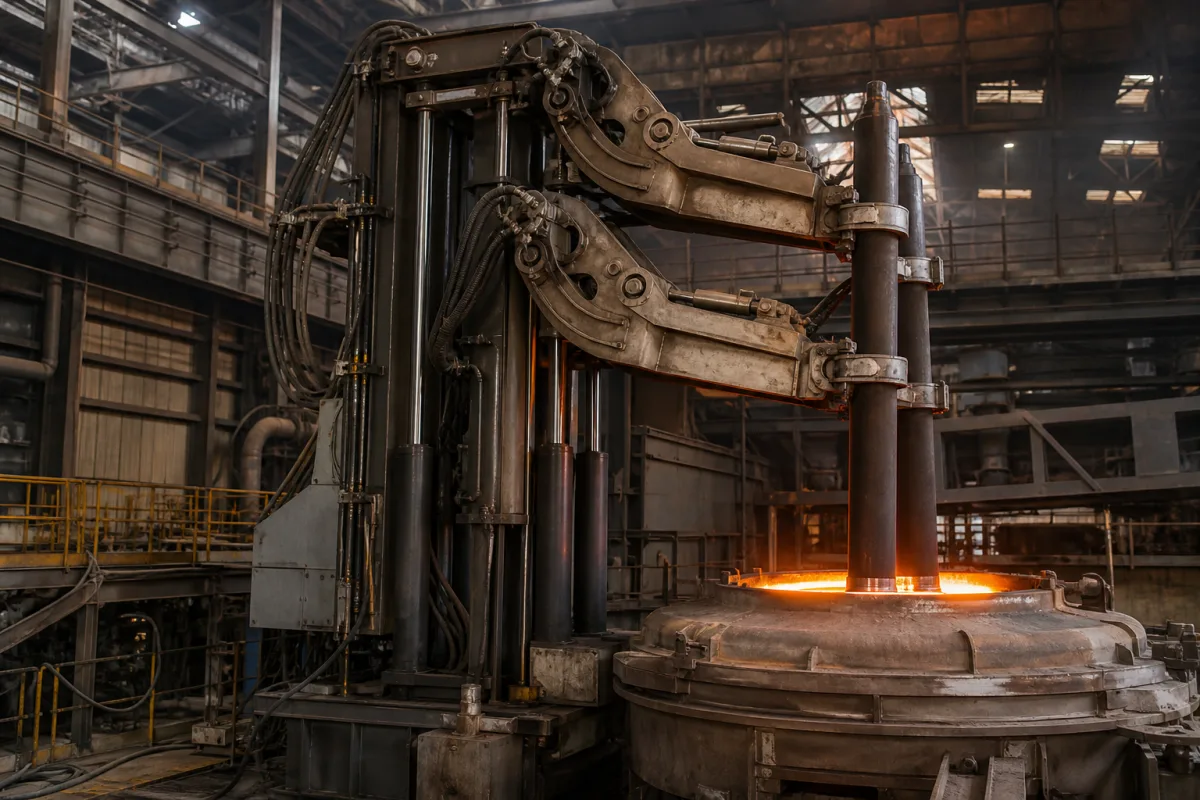
Electrode mast, current-carrying arm and clamp of an arc furnace: the unit that raises, lowers and holds each graphite column
The mechanical unit that holds and moves each graphite electrode column · hydraulic mast, current-carrying arm, spring-clamped holder, mast swing for charging, and the lift plug used to add electrodes
Each graphite electrode column of an arc furnace hangs from one of these units. A vertical mast beside the shell is driven up and down by a hydraulic cylinder; a horizontal arm runs from the top of the mast over the roof; at its tip a holder grips the electrode and passes the arc current into it. The regulator decides how far the electrode should move, but the mast, arm and clamp decide how quickly and smoothly it can, how the current reaches the graphite without overheating a joint, and how the column is let down through the clamp or lengthened with a new electrode as the tip burns away.
Electrode positioning units of electric arc furnaces and ladle furnaces: electrode masts (columns) with their hydraulic lifting cylinders, guides and locks, electrode carrier arms including current-carrying (hot) arms of copper-clad steel or aluminium, electrode holders and clamps with spring clamping and hydraulic release, cooling-water paths, mast swing or lift for roof opening, and the lift plugs used to hoist and add graphite electrodes. Electrode regulation software and Level 2 process models are covered on the Process control system for electric arc furnace steelmaking page; manipulators that position oxygen and carbon lances at the slag door on the Lance manipulator for electric arc furnace oxygen and carbon lances page; the complete furnace on the Electric arc furnace page; resistance-welding electrode holders on the Electrode holder for resistance welding page; Söderberg electrode paste on the Electrode paste cylinders page.
CNFX editorial research · Sources checked October 12, 2026 · 4 sources
The mast and its hydraulic cylinder: lifting the electrode and clearing the roof for charging
ASEA's US patent 4,473,903 describes the arrangement in a top-charged arc furnace: a tubular electrode mast, movable both vertically and horizontally, with the electrode arm extending horizontally from it and the electrode holder on the arm's outer end. The whole assembly swings clear so that the top of the furnace can be opened for charging. [1]
In that design the hydraulic lifting cylinder sits inside the mast with its upper end fixed to the mast. Its double-acting piston rod rests on a stationary support below the level of the workmen's platform beside the furnace; pressurising the cylinder above the piston moves the mast, and the patent states that admitting and withdrawing fluid there gives accurate electrode adjustment during normal operation. [1]
To swing the mast, it is first raised to its top position and locked against descent; fluid is then fed below the piston to draw the piston rod up above the platform level, so that mast, arm and electrode can move horizontally over the platform. The piston rod is made of two concentric tubes, the inner one feeding the space above the piston and the outer one the space below it. [1]
How fast the mast must move is set by the regulator's demands. A 2025 modelling study of a 30-tonne furnace (EAF-30) in the Bulletin of Tomsk Polytechnic University controlled electrode speed between −4 and +3 cm/s, with negative values meaning movement away from the melt, and found that the electrodes should be raised at −4 cm/s when arc current exceeded 37 kA. [4] Editorial calculation: 4 cm/s is 2.4 m/min upward and 3 cm/s is 1.8 m/min downward, figures to compare with the lifting speeds a mast supplier quotes. [4] The study reports a 5.1% reduction in energy consumption from its fuzzy-logic controller; that is a modelling result for the controller, not a property of the mast. [4]
Ask for the mast stroke, the hydraulic lifting speed up and down at full column weight, the lock used when the mast is swung, and the clearance the swing needs above the working platform.
02
Current through the arm: copper, copper-clad steel or aluminium, and a water-cooled flange at the clamp
A patent by Uwe Kark and Karl-Heinz Klein, listed under Badische Stahl Engineering (US 5,200,974), sets out the arm options. Arms carrying separate high-current lines cost effort to build and maintain; an arm made wholly of copper and carrying the current has, in the patent's assessment, an unfavourable strength-to-weight ratio for larger furnaces; and a steel arm plated with copper or aluminium involves a very high outlay. [2]
The patent's answer is a current-carrying arm of light metal, which it defines as aluminium or aluminium alloys such as AlMg4.5Mn, made as an internally ribbed hollow body filled with cooling water. The arm is bolted to the electrode holder through a current-carrying flange whose plates enclose cooling-water cavities on both sides and contain passage orifices for the water, so that the flange is cooled intensively and the current can pass through it without dangerous local overheating. [2]
The same patent explains why the flange is the weak point: an absolutely uniform large-area contact cannot be guaranteed across a bolted joint, local overheating can quickly destroy it, and light metal adds a tendency to oxidise at higher temperature and to burn off where contact is poor. [2]
At the clamp, the patent places the actuating members of the electrode clip, a tension rod, a spring assembly and a hydraulic releasing device, in an arm portion between the flange and the clip; the clamping bracket itself can be of alloyed steel while the current-carrying holder parts are aluminium, and contact jaws can be formed as cooled walls of the holder instead of separate insulated parts. [2]
Arm construction
What the patent says about it
Steel arm with separate high-current lines
Considerable outlay in production and maintenance [2]
Solid copper current-carrying arm
Strength-to-weight ratio of copper seems highly unfavourable for larger furnaces [2]
Steel arm plated with copper or aluminium
Very high outlay; in practice built with a separate current connection bypassing the flange [2]
Aluminium arm welded to the clamp
Avoids the flange contact, but the clamping device cannot be released from the arm [2]
Light-metal arm with water-cooled current flange
Patent's solution: water passes through the flange plates so current can cross the bolted joint [2]
Ask which arm construction is offered, the rated current through the arm and flange, the cooling-water flow and temperature rise through arm and holder, and how the clamp behaves on loss of hydraulic pressure.
03
Letting the column down and adding electrodes: the lift plug and its thread
Exo Technologies' US patent 11,425,801 describes the graphite column the holder grips: individual electrodes joined by graphite pins into one column, with current in excess of 50,000 amperes passed through it, and new electrodes joined on top as the column is consumed so that the length reaching into the furnace is maintained. [3]
The column is lifted into and out of the furnace by an overhead crane through a lift plug screwed into the top electrode's socket. The patent notes that graphite inserts in lift plugs wear their threads with repeated handling and must then be replaced, and that the price of graphite had risen 5 to 10 times because of a shortage of high-quality needle coke. [3]
Its alternative is a threaded insert of Invar-type nickel-iron alloy with roughly 30–36% nickel, whose coefficient of thermal expansion of about 1–1.5 µm/(m·K) at room temperature and about 2 µm/(m·K) at 300–400 °F is close to that of graphite at around 1–2, so that plug and electrode expand together when hot and the joint does not lock. [3]
For electrode handling, ask how the column is slipped through the clamp, where electrodes are added (on the furnace or at a make-up stand), and which lift plug the crane uses.
04
Furnace and column data for an electrode mast and arm quotation
Paste it into your enquiry below or into an email to a maker, then replace every bracket.
Furnace: [EAF or ladle furnace; AC or DC; tap weight; transformer MVA]
Column: [electrode diameter; column length and weight; pitch circle]
Mast: [stroke; lifting speed up and down; swing or lift for roof opening; lock]
Arm: [copper-clad steel, aluminium or separate busbars; rated current; cooling water flow and temperature]
Clamp: [spring clamping force; hydraulic release pressure; contact jaw material]
Hydraulics: [system pressure; fluid; servo or proportional valves]
Electrode handling: [slipping method; make-up stand; lift plug]
Explore company information and manufacturing capabilities, then discuss the scope of your project with a relevant supplier.
Share this page
Compiled and source-reviewed by the CNFX editorial team.
Each manufacturer above links to the page on that company's own website where the product is listed, with the date we checked it. How we source and review
· Page last updated 13 October 2026
Buyer questions
How is an arc furnace electrode mast lifted?
In ASEA's patented design a hydraulic cylinder inside the tubular mast has its piston rod resting on a support below the working platform; fluid above the piston raises and lowers the mast. [1]
Why make the electrode arm of aluminium?
A Badische Stahl Engineering patent proposes a light-metal (e.g. AlMg4.5Mn) current-carrying arm as cheaper than copper-plated steel and lighter for its strength than copper, with a water-cooled current flange at the holder. [2]
How fast does an electrode need to move?
A 2025 modelling study of a 30-tonne arc furnace controlled electrode speed between −4 and +3 cm/s, lifting at −4 cm/s above 37 kA arc current. [4]
How is a new electrode added to the column?
Electrodes are joined to the top of the column by graphite pins and lifted by crane through a lift plug; Exo Technologies patented an Invar-insert plug whose expansion matches graphite. [3]
Sources and what still needs a direct check
Sources checked 2026-10-12. Three US patents, from a furnace builder (ASEA), a steelworks engineering company (Badische Stahl Engineering) and a lifting-equipment company (Exo Technologies), describe the mast, arm and lift plug; electrode speeds come from a 2025 university modelling study of a 30-tonne furnace.