Industry-Verified Manufacturing Data (2026)

High-Purity Molybdenum Disilicide Powder

Based on aggregated insights from multiple verified factory profiles within the CNFX directory, the standard High-Purity Molybdenum Disilicide Powder used in the Basic Metal Manufacturing sector typically supports operational capacities ranging from standard industrial configurations to heavy-duty production requirements.

Technical Definition & Core Assembly

A canonical High-Purity Molybdenum Disilicide Powder is characterized by the integration of Molybdenum Element and Silicon Element. In industrial production environments, manufacturers listed on CNFX commonly emphasize Molybdenum construction to support stable, high-cycle operation across diverse manufacturing scenarios.

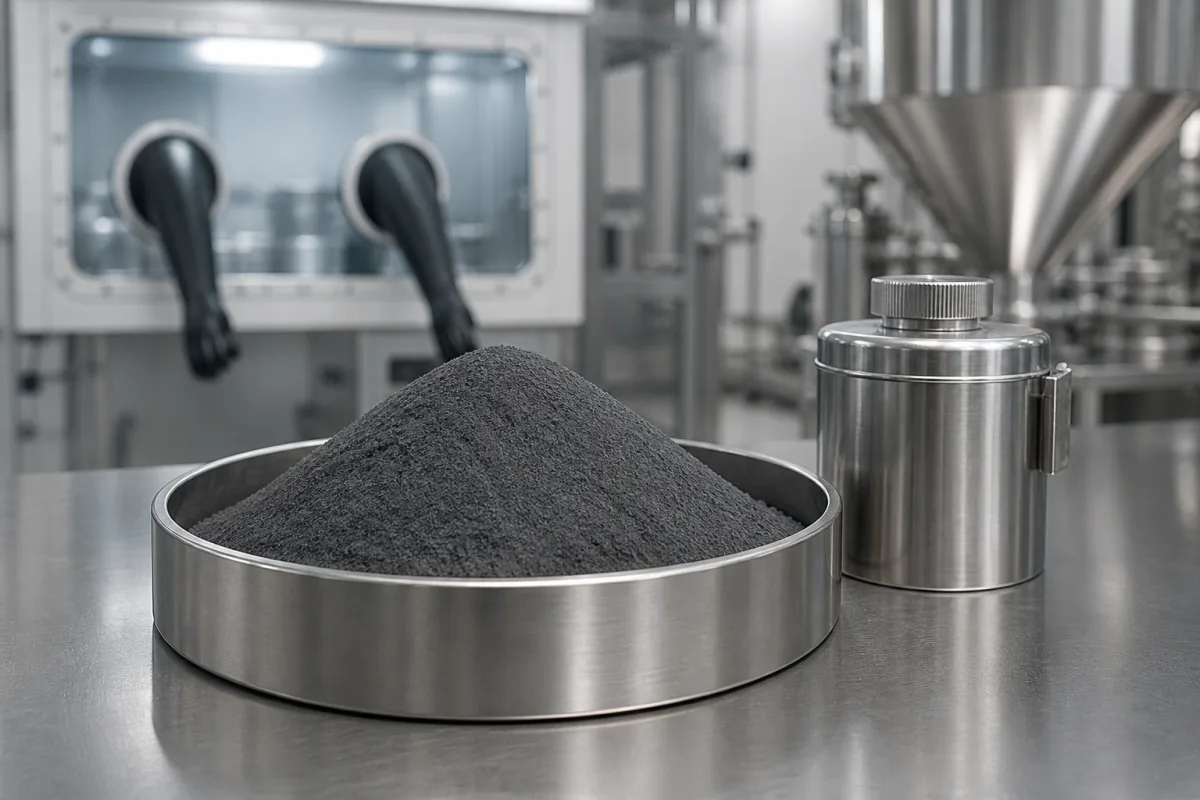
Ultra-fine refractory metal silicide powder for high-temperature industrial applications.
Product Specifications

Technical details and manufacturing context for High-Purity Molybdenum Disilicide Powder

Definition
High-purity molybdenum disilicide (MoSi2) powder is a specialized refractory material produced through advanced metallurgical processes. This semi-finished industrial substance serves as a critical raw material for manufacturing heating elements, high-temperature structural components, and oxidation-resistant coatings. In B2B supply chains, it's essential for aerospace, semiconductor processing, and industrial furnace applications where extreme thermal stability above 1600°C is required. The powder form enables precise formulation control for composite materials and advanced ceramics production.
Working Principle
MoSi2 forms a protective silica layer at high temperatures that prevents further oxidation, maintaining structural integrity through repeated thermal cycling.
Common Materials
Molybdenum, Silicon
Technical Parameters
  • Average particle size distribution (μm) Customizable
  • Minimum purity level (%) Customizable
Components / BOM
  • Molybdenum Element
    Provides high-temperature strength and thermal conductivity
    Material: Refractory metal
  • Silicon Element
    Forms protective silica layer during oxidation
    Material: Metalloid
  • Process Additives Optional
    Controls particle morphology during production
    Material: Various chemical agents
Engineering Reasoning
1600-1900°C in inert atmosphere, particle size 1-10 μm, purity 99.9-99.99% MoSi₂
Oxidation above 1700°C in air forms volatile MoO₃ and SiO₂, catastrophic embrittlement at 5-10 ppm oxygen partial pressure
Design Rationale: Pest oxidation phenomenon: oxygen diffusion along grain boundaries forms low-density oxides causing 300-400% volume expansion and intergranular fracture
Risk Mitigation (FMEA)
Trigger Moisture adsorption >0.1 wt% during storage
Mode: Hydrogen evolution and particle explosion during heating to 500-800°C
Strategy: Vacuum-sealed packaging with <10 ppm H₂O, controlled atmosphere glove box handling
Trigger Localized heating >2100°C during sintering
Mode: Silicon sublimation leaving porous molybdenum-rich phase with 60% density loss
Strategy: Multi-zone furnace with ±5°C gradient control, boron nitride diffusion barriers

Industry Taxonomies & Aliases

Commonly used trade names and technical identifiers for High-Purity Molybdenum Disilicide Powder.

Industrial Ecosystem & Supply Chain DNA

Complementary Systems
Downstream Applications
Specialized Tooling

Application Fit & Sizing Matrix

Operational Limits
pressure: Atmospheric to 10 MPa (100 bar) in processing equipment
other spec: Particle size: 0.5-10 μm typical, purity: >99.5%, slurry concentration: 20-60 wt% in aqueous/organic media
temperature: Up to 1700°C in oxidizing atmospheres, 1900°C in inert/reducing atmospheres
Media Compatibility
✓ High-temperature furnace heating elements ✓ Oxidation-resistant coatings for carbon composites ✓ Ceramic matrix composite reinforcement
Unsuitable: Fluorine-containing atmospheres or hydrofluoric acid environments
Sizing Data Required
  • Required maximum service temperature (°C)
  • Atmosphere type (oxidizing/inert/reducing)
  • Target particle size distribution (D50/D90 in μm)

Reliability & Engineering Risk Analysis

Failure Mode & Root Cause
Oxidation-induced degradation
Cause: Exposure to oxidizing atmospheres above 1700°C causes formation of silica glass layer and molybdenum oxide volatilization, leading to material loss and structural weakening.
Thermal shock fracture
Cause: Rapid temperature cycling or uneven heating creates internal stresses exceeding the material's fracture toughness, resulting in crack propagation and catastrophic failure.
Maintenance Indicators
  • Visible color change from metallic gray to white/yellow surface discoloration indicating oxidation
  • Audible popping or cracking sounds during heating/cooling cycles signaling thermal stress fractures
Engineering Tips
  • Maintain controlled atmosphere (argon/nitrogen) during high-temperature operations to prevent oxidation above 1200°C
  • Implement gradual heating/cooling ramps (≤100°C/min) and ensure uniform temperature distribution to minimize thermal gradients

Compliance & Manufacturing Standards

Reference Standards
ASTM B386-03(2018) Standard Specification for Molybdenum and Molybdenum Alloy Plate, Sheet, Strip, Foil, and Wire ISO 9001:2015 Quality management systems - Requirements DIN EN ISO 9001:2015 Quality management systems - Requirements
Manufacturing Precision
  • Particle Size Distribution: D50 +/- 5%
  • Chemical Purity: MoSi2 content >99.5%
Quality Inspection
  • X-Ray Diffraction (XRD) for Phase Purity Analysis
  • Inductively Coupled Plasma Optical Emission Spectrometry (ICP-OES) for Elemental Impurity Analysis

Factories Producing High-Purity Molybdenum Disilicide Powder

Verified manufacturers with capability to produce this product in China

✓ 98% Supplier Capability Match Found

P Project Engineer from Singapore Jan 22, 2026
★★★★★
"The High-Purity Molybdenum Disilicide Powder we sourced perfectly fits our Basic Metal Manufacturing production line requirements."
Technical Specifications Verified
S Sourcing Manager from Germany Jan 19, 2026
★★★★★
"Found 39+ suppliers for High-Purity Molybdenum Disilicide Powder on CNFX, but this spec remains the most cost-effective."
Technical Specifications Verified
P Procurement Specialist from Brazil Jan 16, 2026
★★★★★
"The technical documentation for this High-Purity Molybdenum Disilicide Powder is very thorough, especially regarding Particle Size D50 (μm)."
Technical Specifications Verified
Verification Protocol

“Feedback is collected from verified sourcing managers during RFQ (Request for Quote) and factory evaluation processes on CNFX. These reports represent historical performance data and technical audit summaries from our B2B manufacturing network.”

18 sourcing managers are analyzing this specification now. Last inquiry for High-Purity Molybdenum Disilicide Powder from Poland (1h ago).

Supply Chain Commonly Integrated Components

Infrared Pyrometer

A non-contact temperature measurement device that detects infrared radiation emitted by objects to determine their surface temperature.

Explore Specs →
Signal Processor

Electronic device that conditions, amplifies, filters, and converts raw sensor signals into standardized outputs for temperature measurement systems

Explore Specs →
Purge Air System

A system that provides controlled airflow to clear optical paths and protect sensors in molten metal temperature measurement applications.

Explore Specs →
Degassing Chamber

A specialized vessel within a molten metal degassing system where dissolved gases are removed from molten metal through controlled processes.

Explore Specs →

Frequently Asked Questions

What are the primary applications of high-purity molybdenum disilicide powder in metal production?

This powder is used in high-temperature industrial applications including refractory linings, heating elements, and protective coatings for metal processing equipment, offering exceptional thermal stability and oxidation resistance.

How does particle size affect the performance of molybdenum disilicide powder?

The D50 particle size specification ensures consistent sintering behavior, improved packing density, and enhanced surface area for better reactivity in high-temperature applications, directly impacting final product quality.

What makes this molybdenum disilicide powder suitable for refractory applications?

With high chemical purity, low oxygen content, and a melting point exceeding 2000°C, this powder maintains structural integrity under extreme thermal conditions, making it ideal for demanding metal production environments.

Can I contact factories directly on CNFX?

CNFX is an open directory, not a transaction platform. Each factory profile provides direct contact information and production details to help you initiate direct inquiries with Chinese suppliers.

Get Quote for High-Purity Molybdenum Disilicide Powder

Request technical pricing, lead times, or customized specifications for High-Purity Molybdenum Disilicide Powder directly from verified manufacturing units.

Your business information is encrypted and only shared with verified High-Purity Molybdenum Disilicide Powder suppliers.

Thank you! Your message has been sent. We'll respond within 1–3 business days.

Need to Manufacture High-Purity Molybdenum Disilicide Powder?

Connect with verified factories specializing in this product category

Add Your Factory Contact Us
Previous Product
High-Purity Magnesium Alloy Billet
Next Product
High-Purity Zinc Anode Slab