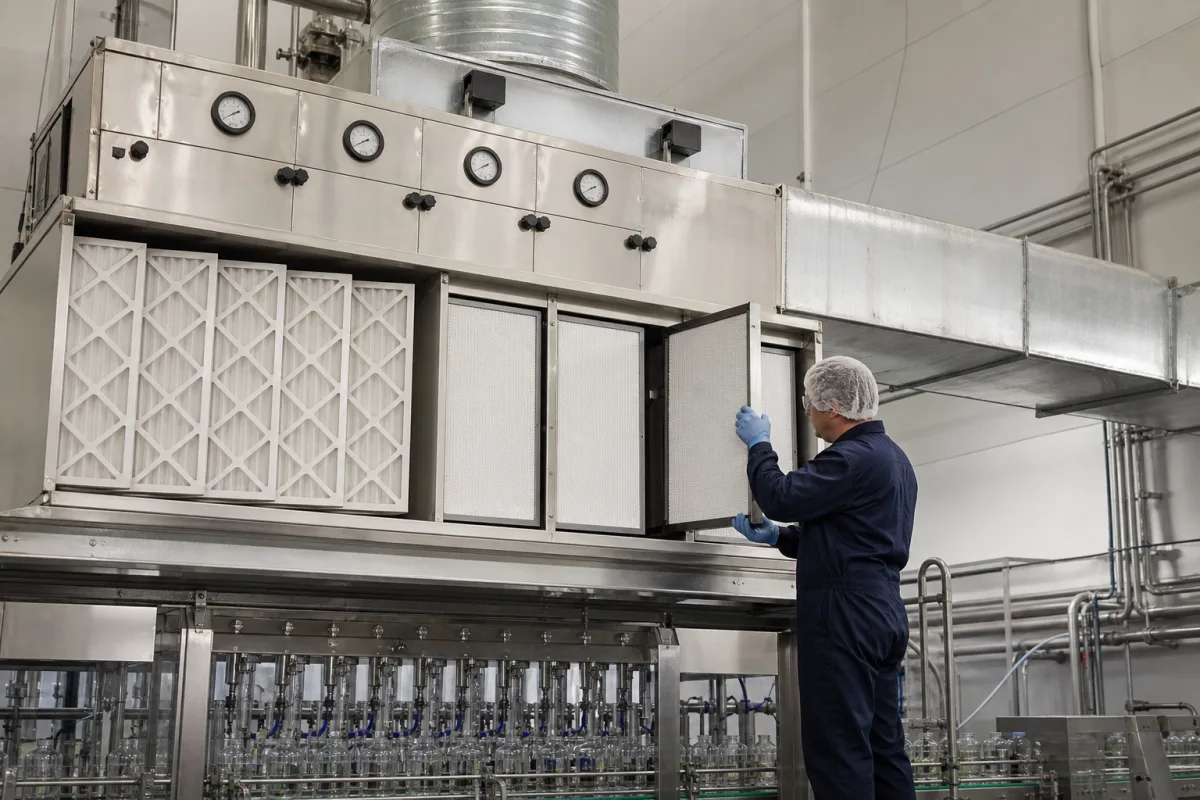
HEPA filtration unit for aseptic filling and sterilisation areas
Clean air over filling and sterilisation · H13 vs H14 class, leak test vs efficiency test, 0.01% leak criterion, airflow velocity over the critical zone
A HEPA filtration unit supplies particle-free air to a critical zone, such as the filler and capper of an aseptic beverage or pharmaceutical line or a sterilisation tunnel: a fan draws air through pre-filters and then high-efficiency particulate air (HEPA) filters sealed in a housing, delivering it downward as unidirectional flow. Ask three things first: which filter class (for example H13 or H14) the unit uses, how the installed filters will be leak-tested at installation and in service, and what air velocity and uniformity the unit delivers over the critical zone.
HEPA filter units, housings and terminal filters supplying clean air to filling, capping, sterilisation and other critical zones. Pre-filters on their own, cleanroom construction, process gas sterile filters and complete isolators are outside this page.
CNFX editorial research · Sources checked October 12, 2026 · 4 sources
APC Filtration's comparison chart lists the EN 1822 classes E10 85%, E11 95%, E12 99.5%, H13 99.95% and H14 99.995%, alongside IEST filter types rated at 99.97% or 99.99% at 0.3 µm. [3] The FDA's 2004 guidance on sterile drugs produced by aseptic processing states that an intact HEPA filter should retain at least 99.97% of particulates greater than 0.3 µm, and that an efficiency test determines the filter's rating. [1]
STJH lists separator-type HEPA filters in H13, H14 or custom grades with glass-fibre media, aluminium foil separators, galvanised, aluminium or stainless frames, and polyurethane or silicone sealant with EVA, neoprene or silicone gaskets, noting that initial and final resistance must be selected for airflow, size and system design. [4]
Editorial calculation: at the class values, H13 lets through 0.05% and H14 0.005% of the test particles, so an H14 filter passes one-tenth of the particles an H13 filter passes. [3] Ask which standard and test basis the supplier's class refers to, and for each filter's individual test record.
Give the supplier the zone served (filler, capper, sterilisation tunnel), area and height, required air velocity and uniformity, cleanliness grade, filter class, pre-filter stages, fan duty and noise, housing and frame materials, sealing type (gel or gasket), access for leak scanning and filter change, cleaning and sanitising agents used, temperature and humidity, and documents required.
02
Plan leak testing and airflow over the critical zone
The FDA guidance recommends HEPA leak testing at installation to detect breaches around sealing gaskets, through frames or through the media, and at suitable intervals afterward, for example twice a year for the aseptic processing room, with a scan of the whole filter face and frame about one to two inches from the face. A single probe reading equal to 0.01% of the upstream challenge is considered a significant leak calling for replacement or local repair. It distinguishes this leak test, using a polydispersed aerosol such as DOP or PAO with enough particles near 0.3 µm, from the efficiency test. [1]
For airflow, the FDA guidance notes for HEPA-filtered air in critical areas that "a velocity of 0.45 meters/second (90 feet per minute) has generally been established, with a range of plus or minus 20 percent around the setpoint", and that higher velocities may suit operations generating more particles. EU GMP Annex 1 (2022) gives a guidance value of 0.36–0.54 m/s for unidirectional airflow at the working position, correlated with airflow visualisation, and requires at least biannual integrity tests for HEPA filters supplying depyrogenation tunnels. [1][2]
Editorial calculation: at 0.45 m/s, a filter face of 1.2 × 0.6 m (an assumed module size) passes 0.45 × 0.72 = 0.324 m³/s, about 1,170 m³/h; a unit covering 2.4 × 1.2 m over a filler would need about 4,670 m³/h, plus margin for filter loading. [1] These guidance documents are written for pharmaceutical aseptic processing; agree the applicable requirements for your beverage line.
03
Compare what suppliers offer
Suppliers linked to this page list HEPA filters and HEPA filter units; each card links to the page reviewed.
Listings include separator-type HEPA filters, HEPA supply boxes and fan filter units for cleanrooms; ask each for filter class and individual test records, resistance at rated airflow, and how leak scanning is done on site.
04
Trace the unit parts
This is a functional reference built from the sources cited; it is not one maker's specification.
Fill the specification fields with values for your zone
A HEPA filtration unit quotation needs values for your critical zone. The table explains each field, gives published values where a reviewed source states them, and says what to obtain from the supplier.
Field
What it means and published values
Ask the supplier for
Filtration efficiency (%)
H13 99.95%, H14 99.995%; ≥99.97% at 0.3 µm. [3][1]
Explore company information and manufacturing capabilities, then discuss the scope of your project with a relevant supplier.
Share this page
Compiled and source-reviewed by the CNFX editorial team.
Published product pages show what a company offers, not tested performance. Confirm the legal seller, factory and scope for your order. How we source and review
· Page last updated 13 October 2026
Buyer questions
What is the difference between H13 and H14 HEPA filters?
APC's class chart lists H13 at 99.95% and H14 at 99.995% efficiency under EN 1822. [3]
What counts as a HEPA filter leak?
The FDA aseptic guidance treats a single probe reading of 0.01% of the upstream challenge as a significant leak. [1]
What air velocity should a HEPA unit deliver over a filler?
The FDA guidance cites 0.45 m/s ±20%; EU GMP Annex 1 gives 0.36–0.54 m/s as a guidance value at the working position. [1][2]
Sources and what still needs a direct check
Sources checked 2026-10-12. The FDA guidance and EU GMP Annex 1 are regulators' guidance for sterile pharmaceutical manufacture; APC and STJH are filter makers describing classes and products.