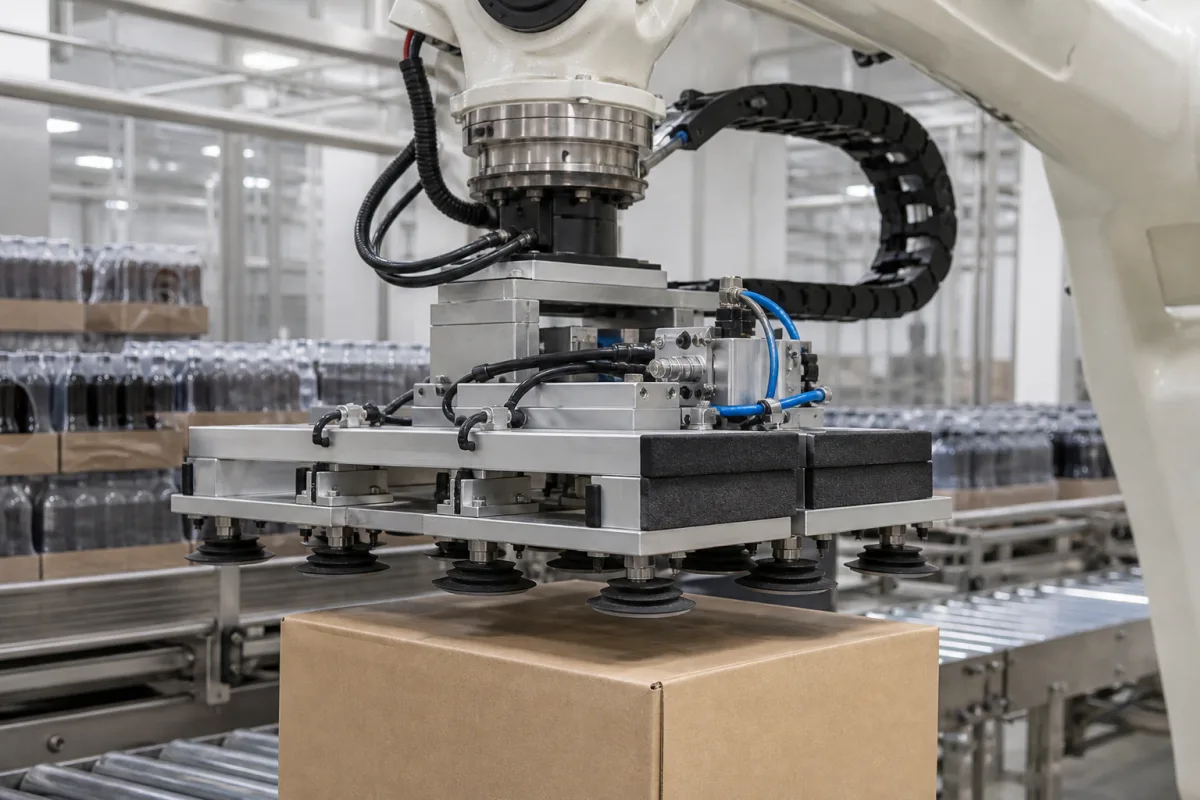
Vacuum gripper end-effector for palletizing beverage cases and cartons: leaky corrugated board, part-covered suction zones and the air flow the gripper must supply
The vacuum end-effector that lifts beverage cases and cartons on a palletizing robot · −300 to −450 mbar on unprinted corrugated board against −500 to −750 mbar on printed board, check valves or flow restrictors for cells the box does not cover, and an ejector whose flow drops from 7.33 Nl/s open to 0.21 Nl/s at −80 kPa
A carton is a leaky workpiece. Air passes through unprinted corrugated board, around the flutes at the edges and through any suction cells the box does not cover, so a palletizing gripper is designed around air flow as much as around lifting force. The questions are what vacuum the board allows, how uncovered cells are shut off, and whether the vacuum source can keep up with the leakage.
Vacuum end-effectors for robot and gantry palletizing of beverage cases, shrink-wrapped trays and cartons: foam area grippers and multi-cup tools, their zone valves, check valves and flow restrictors, and the ejector or pump that supplies them, chosen for porous and part-covered loads. Single suction cups and cup sizing are covered on the Vacuum suction cup page; compact multi-cup grippers with on-tool vacuum for machine tending on the Specialized end effector page; complete beverage palletizers, layer formation and robot selection on the Automated beverage container palletizing system page; block distributors with per-cup check valves on the Vacuum manifold (block distributor) for multi-cup vacuum grippers page.
CNFX editorial research · Sources checked October 13, 2026 · 3 sources
Printed or unprinted board: −300 to −450 mbar with a high-flow generator, or −500 to −750 mbar with a high-vacuum one
Schmalz's selection guide for its ecoPump SEP ejector modules starts from the workpiece's vacuum operating range. It gives −300 to −450 mbar for cardboard boxes that are not printed and −500 to −750 mbar for printed boxes, assigning the high-flow (HF) version to the first and the high-vacuum (HV) version to the second; the same guide puts plastic bags at −200 to −400 mbar and thermoformed trays at −300 to −400 mbar. [1]
The guide classes cardboard, non-rigid bags and particle board as porous workpieces needing the HF version with its high suction flow rate, and chooses a two-stage nozzle when the generator is within 500 mm of the suction pads and a three-stage nozzle when long hoses add air volume. Its pad-by-pad sizing tables are marked as layouts to be confirmed by test. [1]
Load (Schmalz guide)
Vacuum operating range
Generator characteristic
Cardboard box, not printed
−300 to −450 mbar
High flow (HF)
Cardboard box, printed
−500 to −750 mbar
High vacuum (HV)
Blister pack / thermoformed tray
−300 to −400 mbar
High flow (HF)
Plastic bag
−200 to −400 mbar
High flow (HF)
Send sample cases, printed and unprinted, with the heaviest filled weight; ask for a suction test on them and for the vacuum level the gripper actually reaches on each.
02
When the case does not cover every cell: foam area grippers with check valves, flow restrictors and 66 to 197 suction cells
Schmalz's FXP area gripping system, a universal gripper with an integrated multi-stage ejector for palletizing and depalletizing goods of varying size, uses 130 mm wide bodies from 442 to 1,432 mm long with sealing foam or suction cups. Listed versions with 20 mm open foam run from 66 suction cells at 442 mm, 99 at 640 mm and 132 at 838 mm to 197 at 1,234 mm. Each cell is fitted either with check valves (SVK), which Schmalz recommends for porous workpieces, or with flow resistors (SW) for smooth surfaces and swivelling up to 45°. Schmalz lists the FXP as a phase-out item with the FA-X/FA-M as its alternative. [2]
Piab's Kenos KCS foam gripper, 110 × 110 mm with 30 mm EPDM foam, takes the flow-restrictor route: a 0.6 mm flow reduction lets it lift sealed or leaking objects of different sizes, and Piab states it keeps enough vacuum to lift the object even when the whole foam area is not covered. [3]
Give the smallest and largest case footprints and the pick patterns (one case, a row, a layer); ask which valve type is fitted per cell or zone and how the gripper behaves when a case covers only part of it.
03
How much air the gripper has to move: an ejector curve from 7.33 Nl/s open to 0.21 Nl/s at −80 kPa
Piab's data sheet for the KCS, with one COAX SX ejector cartridge, shows how quickly suction flow falls as vacuum rises: 7.33 Nl/s at 0 kPa, 3.60 Nl/s at −30 kPa, 2.16 Nl/s at −40 kPa, 1.00 Nl/s at −60 kPa and 0.21 Nl/s at −80 kPa, with a maximum of 26.6 inHg, for an air consumption of 4.68 scfm. [3]
Editorial calculation: 7.33 Nl/s × 60 ≈ 440 Nl/min with the foam open, and 2.16 Nl/s ≈ 130 Nl/min at −40 kPa, inside the −300 to −450 mbar band Schmalz gives for unprinted boxes. Whatever leaks through the board and uncovered cells at the working vacuum has to stay below that flow, or the vacuum falls toward the open-flow end of the curve. [3][1]
Ask for the vacuum generator's flow curve, not only its maximum vacuum or open flow, and for the leakage measured on your cases at the working vacuum.
04
What to send for a carton palletizing vacuum gripper
Paste it into your enquiry below or into an email to a maker, then replace every bracket.
Cases: [footprint range; height; filled weight; printed or unprinted board; shrink film]
Picks: [single case, row or layer; interlayer sheets]
Gripper: [foam area or multi-cup; width and length; zones]
Valves: [check valves or flow restrictors per cell; zone switching]
Vacuum: [ejector or pump; flow curve; working vacuum on your board]
Robot: [flange; payload left for the gripper and load]
Explore company information and manufacturing capabilities, then discuss the scope of your project with a relevant supplier.
Share this page
Compiled and source-reviewed by the CNFX editorial team.
Each manufacturer above links to the page on that company's own website where the product is listed, with the date we checked it. How we source and review
· Page last updated 13 October 2026
Buyer questions
What vacuum does a cardboard case allow?
Schmalz gives −300 to −450 mbar for unprinted cardboard boxes and −500 to −750 mbar for printed ones, with high-flow and high-vacuum generators respectively. [1]
How does a foam gripper hold a box that covers only part of it?
Each suction cell has a check valve or flow resistor; Schmalz recommends check valves for porous loads, and Piab's KCS uses a 0.6 mm flow restrictor to hold vacuum when the foam is not fully covered. [2][3]
Why does the vacuum generator's flow curve matter?
Flow falls as vacuum rises; in Piab's KCS data it drops from 7.33 Nl/s open to 2.16 Nl/s at −40 kPa, so board leakage at the working vacuum must stay below that. [3]
Sources and what still needs a direct check
Sources checked 2026-10-13. Vacuum ranges for boxes and generator choice come from Schmalz's ecoPump selection guide; area gripper sizes and valve types from Schmalz's FXP product page; flow restriction and the ejector flow curve from Piab's Kenos KCS data sheet.