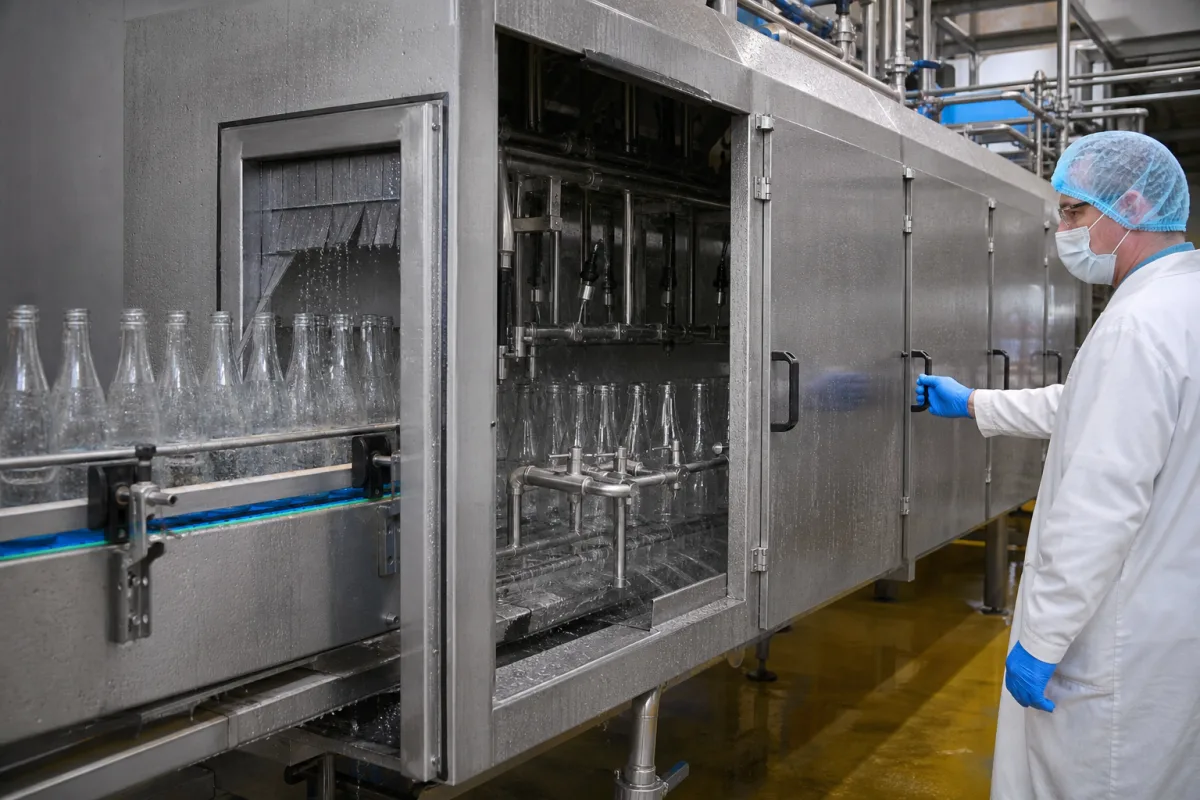
High-temperature rinse chamber of a returnable glass bottle washer: the 65–70 °C spray section after the caustic bath and the cooling rinses behind it
Returnable glass bottle washing · the hot-water spray section after the caustic soak, cascaded cooling rinses, final fresh or RO water, and the caustic film each bottle carries
In a soaker-type washer for returnable glass bottles, the bottles leave the hot caustic bath coated in lye. The high-temperature rinse chamber is the first water section they enter: an enclosed zone where sprays of hot water, 65–70 °C in one published design, start washing off the lye film while the bottle is still close to the caustic temperature. Behind it come cascaded rinse sections that cool the bottles step by step while the water runs counter to them, and a last spray of fresh or reverse-osmosis water. What a buyer specifies is the zone temperatures, the spray arrangement, how rinse water is reused, and how much caustic leaves on each bottle.
Hot-water spray and rinse sections of soaker-type washers for returnable glass bottles and other refillable beverage containers, downstream of the caustic bath: zone temperatures, fixed and rotating sprays, counter-current reuse of rinse water, final fresh or RO water rinse, and caustic carry-over. Chemical (hydrogen peroxide or peracetic acid) sterilisers for PET bottles and preforms are covered on the Beverage container sterilization system page; injection nozzles on inverted-bottle carousel rinsers on the Beverage bottle rinsing nozzle page; rotary rinsers for new bottles on the High-speed rotary bottle rinsing machine page; cabinet washers for filler change parts on the Clean-out-of-place (COP) cabinet washer page; and tunnel pasteurisers for filled bottles and cans, including their pre-cooling and final cooling zones, on the Tunnel sterilizer (tunnel pasteurizer) and Cooling section of a tunnel pasteurizer pages; those treat filled, closed containers, while this page covers empty returned bottles being washed.
CNFX editorial research · Sources checked October 13, 2026 · 3 sources
From a 70–85 °C caustic soak to 65–70 °C hot sprays and cascaded rinses at 20–65 °C
CVH Industries sets out the treatment cycle of its returnable glass bottle washer zone by zone. After two pre-wettings, a 35 °C pre-soak and a 50 °C rinse with overflow water from the spray section, the bottles soak in a main caustic bath at 70–85 °C and pass two-stage label removal. They then enter a closed section that keeps leachate out of the rest of the washer, where they receive a splash and a rinse of 65–70 °C water from fixed showers. [1]
Three cascaded sections follow for spraying, rinsing and cooling: six sprays from rotating showers, four from fixed showers and three rinses from fixed showers, all with water at 20–65 °C. The bottles finish with two sprays of RO water from rotary showers and one from fixed showers, through 2.5 mm nozzles, before a dripping zone and unloading. [1]
The caustic temperature is not the same in every source. A TU Delft MSc thesis, written with Heineken, describes beer bottle washers with caustic soda at 1.5–2% and between 65 and 70 °C, followed by pre-rinse, caustic bath, warm and cold water baths and a final rinse. [3] Editorial note: the hot rinse chamber is set against whichever caustic temperature the washer runs; ask the supplier for the temperature drop between the last caustic bath and the first hot spray, and between each later rinse section.
Editorial calculation: at CVH's figures, a bottle leaving an 85 °C bath into 65 °C water falls by up to 20 °C at the first step; going from a 70 °C bath to 70 °C water, by none. The later cascade then has to take it from 65 °C to 20 °C across three sections. [1]
Ask for every zone's set temperature and tolerance, how many sprays are rotating or fixed in each, nozzle size, and what the final rinse water is (fresh, softened or RO).
02
Running rinse water against the bottle flow, from the final rinse back to the pre-rinse
A 1977 US patent by Grover C. Evans, for washing returnable soft-drink syrup containers, sprays containers through pre-wash, wash, pre-rinse, primary rinse and final rinse zones. Fresh water at 50–55 °F is used only in the final rinse; it is collected with the primary-rinse liquid in a rinse reservoir, reused in the primary rinse at around 75 °F, then used again in the pre-wash and pre-rinse zones before draining, and also feeds make-up to the caustic sanitising reservoir, which is held near 180 °F. [2]
Editorial calculation: 180 °F is about 82 °C, the pre-rinse's 80 °F about 27 °C, the primary rinse's 75 °F about 24 °C, and the fresh water's 50–55 °F about 10–13 °C. [2]
The TU Delft model of a brewery washer in Valencia, which cleans 92,000 bottles per hour, makes the same kind of loop: the effluent from the second rinse goes straight back to the last caustic bath, and 25 m³ of water from the last three rinses is reused continuously in the pre-rinse. Rinse water pressure there was 1.4 to 1.6 bar; the flow was not measured and was assumed at 40 mL per bottle, 3.68 m³/h for the last four rinses. [3] CVH's washer likewise uses overflow from its spray section for the 50 °C rinse at the inlet. [1]
Editorial calculation: 40 mL × 92,000 bottles per hour = 3,680 L/h, matching the 3.68 m³/h in the thesis. [3]
03
10 mL of caustic film per bottle: what the hot rinse has to wash away
The thesis defines carry-over as the thin layer of solution that clings to bottles and the conveying belt when they leave a bath. In the Valencia model it is assumed at 10 mL per bottle, with caustic soda at 1.5–2% (15–20 g NaOH per litre) in three caustic baths holding 48.08 m³, and small water baths of 1.44, 6.74 and 1.57 m³ after them. [3]
In its scenario with carry-over cut to 7 mL per bottle, a 30% reduction that the author links to pocket design, caustic loss over 60 days fell by 22.5%, from 19,229.78 kg to 14,911.05 kg, and the caustic dose by 19.4%. The caustic concentration in the last rinse effluent was then 0.05 g/L. The thesis adds that carry-over is hard to control on the bottle surface itself. [3]
Editorial calculation: 10 mL × 92,000 bottles per hour is 920 L/h of film leaving the last caustic bath; at 20 g/L that is about 18.4 kg of NaOH per hour reaching the first rinse section. These are the thesis's assumed values, not a measurement. [3]
Ask how the bottle pockets drain between the caustic bath and the hot spray, what carry-over the supplier designs for, and what caustic concentration is guaranteed in the final rinse effluent.
04
Zone temperatures in three published washer designs
Paste it into your enquiry below or into an email to a maker, then replace every bracket.
Bottles: [glass type; size; bottles per hour]
Caustic bath: [concentration; temperature]
Hot rinse: [temperature; fixed and rotating sprays; nozzle size]
Cooling rinses: [number of sections; temperatures]
Final rinse: [fresh, softened or RO water; flow per bottle; pressure]
Water reuse: [counter-current routing; reuse in pre-rinse]
Carry-over: [design value per bottle; caustic limit in final rinse effluent]
Explore company information and manufacturing capabilities, then discuss the scope of your project with a relevant supplier.
Share this page
Compiled and source-reviewed by the CNFX editorial team.
Each manufacturer above links to the page on that company's own website where the product is listed, with the date we checked it. How we source and review
· Page last updated 13 October 2026
Buyer questions
How hot is the rinse after the caustic bath?
CVH's returnable glass bottle washer splashes and rinses bottles with 65–70 °C water after a 70–85 °C caustic bath, then cools them through rinses at 20–65 °C. [1]
How much caustic do bottles carry out of the bath?
A TU Delft model of a 92,000 bottle-per-hour washer assumed 10 mL per bottle; cutting it to 7 mL reduced caustic loss by 22.5% over 60 days. [3]
Is fresh water used in every rinse?
No. In Evans's patent fresh water goes only to the final rinse and is then reused in the primary rinse, pre-wash and pre-rinse. [2]
How much rinse water does a bottle get?
The Valencia model assumed 40 mL per bottle for the last four rinses, 3.68 m³/h at 92,000 bottles per hour. [3]
Sources and what still needs a direct check
Sources checked 2026-10-13. A bottle washer maker's published treatment cycle (CVH Industries), a 1977 US patent on rinse-water reuse in a container washer (Grover C. Evans), and a 2022 TU Delft MSc thesis, supervised with Heineken, that models water and caustic flows in brewery bottle washers.