Industry-Verified Manufacturing Data (2026)

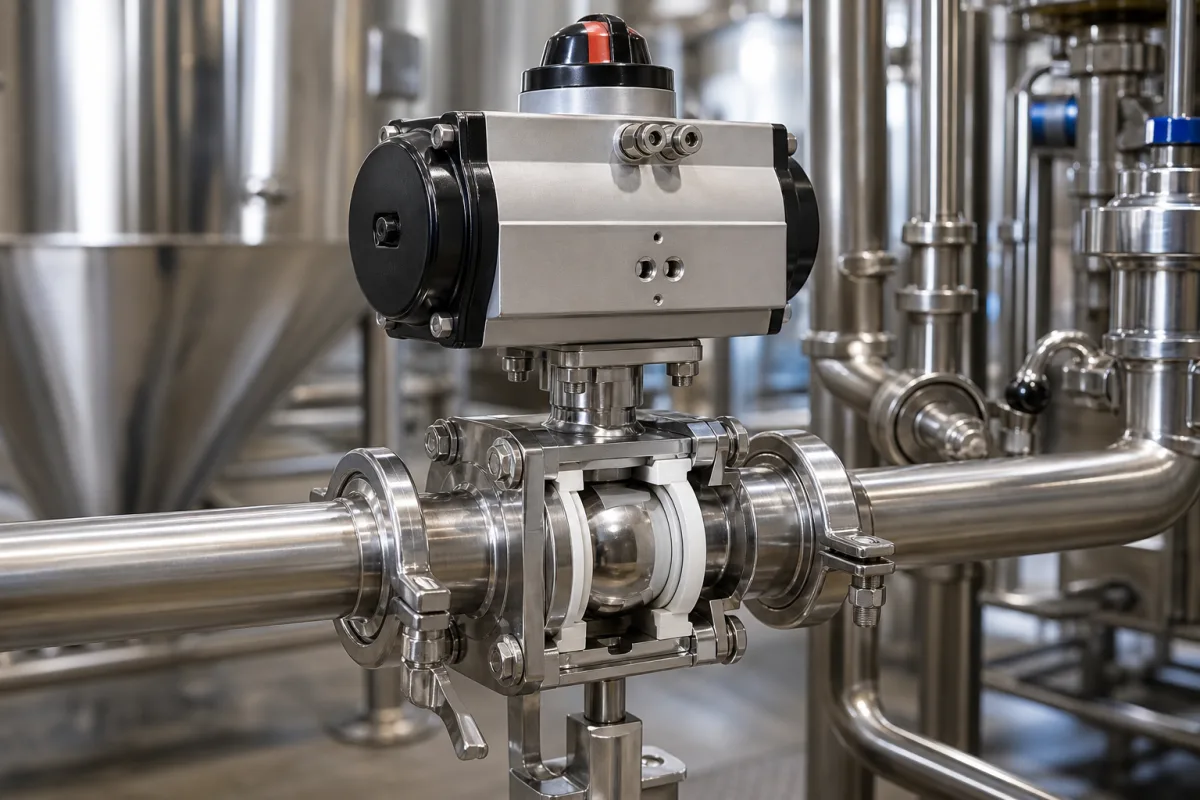
Sanitary Ball Valve Assembly

Based on aggregated insights from multiple verified factory profiles within the CNFX directory, the standard Sanitary Ball Valve Assembly used in the Beverage Manufacturing sector typically supports operational capacities ranging from standard industrial configurations to heavy-duty production requirements.

Technical Definition & Core Assembly

A canonical Sanitary Ball Valve Assembly is characterized by the integration of Valve Body and Ball. In industrial production environments, manufacturers listed on CNFX commonly emphasize 316L Stainless Steel construction to support stable, high-cycle operation across diverse manufacturing scenarios.

Hygienic ball valve assembly for precise flow control in beverage processing lines
Product Specifications

Technical details and manufacturing context for Sanitary Ball Valve Assembly

Definition
A sanitary ball valve assembly is a critical flow control component designed specifically for alcoholic beverage manufacturing environments. It provides reliable on/off and throttling control for liquids like wort, wine must, spirits, and cleaning solutions while maintaining strict hygienic standards. The assembly features polished surfaces, crevice-free design, and quick-disconnect capabilities to prevent bacterial growth and facilitate cleaning. It integrates seamlessly into automated processing systems for precise batch control and process optimization.
Working Principle
A spherical ball with a through-hole rotates 90 degrees within the valve body to open or close flow; when aligned with pipeline, fluid passes through; when perpendicular, flow is blocked completely.
Common Materials
316L Stainless Steel, PTFE (Polytetrafluoroethylene)
Technical Parameters
  • Nominal pipe size for connection (inches) Per Request
  • Maximum working pressure rating (PSI) Per Request
Components / BOM
  • Valve Body
    Main housing containing fluid path and mounting interfaces
    Material: 316L Stainless Steel
  • Ball
    Rotating spherical element with through-hole for flow control
    Material: 316L Stainless Steel
  • Seat Seals
    Provide leak-tight seal between ball and body
    Material: PTFE
  • Stem
    Transmits rotational force from actuator to ball
    Material: 316L Stainless Steel
  • Actuator Interface Optional
    Mounting point for manual handle or automated actuator
    Material: 316L Stainless Steel
Engineering Reasoning
0-16 bar at 0-120°C
Ball seat deformation at 18 bar differential pressure or 140°C
Design Rationale: Polytetrafluoroethylene seat material exceeds glass transition temperature (130°C) or yield strength (15 MPa)
Risk Mitigation (FMEA)
Trigger Particulate contamination exceeding 50 μm in beverage stream
Mode: Ball surface scoring leading to 0.1 mm clearance and 5% leakage
Strategy: Install 10 μm stainless steel duplex filter upstream with differential pressure monitoring
Trigger Cyclic thermal stress from 20-90°C cleaning-in-place cycles at 15-minute intervals
Mode: Stem seal fatigue failure at 10,000 cycles
Strategy: Implement Kalrez perfluoroelastomer seals with 100,000-cycle fatigue life at 0.5 mm compression

Industry Taxonomies & Aliases

Commonly used trade names and technical identifiers for Sanitary Ball Valve Assembly.

Industrial Ecosystem & Supply Chain DNA

Complementary Systems
Downstream Applications
Specialized Tooling

Application Fit & Sizing Matrix

Operational Limits
pressure: Up to 10 bar (145 psi)
flow rate: Cv values from 0.5 to 50 (depending on valve size)
temperature: -10°C to 120°C
slurry concentration: Not recommended for abrasive slurries >5% solids by weight
Media Compatibility
✓ Carbonated beverages ✓ Dairy products ✓ Pharmaceutical-grade water
Unsuitable: Highly corrosive chemical cleaning agents (e.g., concentrated acids)
Sizing Data Required
  • Required flow rate (L/min or GPM)
  • Line pressure (bar or psi)
  • Pipe diameter (inches or mm)

Reliability & Engineering Risk Analysis

Failure Mode & Root Cause
Seal degradation and leakage
Cause: Chemical incompatibility with process media, thermal cycling, or improper installation torque causing seal compression set or extrusion
Ball surface corrosion and galling
Cause: Electrochemical corrosion from chloride-containing fluids, lack of proper passivation on stainless steel components, or abrasive particles in media causing surface damage
Maintenance Indicators
  • Visible weeping or dripping at valve stem or body seals during operation
  • Increased operating torque or sticking during actuation, often accompanied by audible grinding or scraping sounds
Engineering Tips
  • Implement regular cleaning and passivation cycles for stainless steel components using nitric acid solutions to maintain corrosion resistance
  • Establish proper installation torque procedures and use calibrated torque wrenches to prevent seal damage while ensuring adequate compression

Compliance & Manufacturing Standards

Reference Standards
ISO 5211:2017 (Industrial valves - Part-turn actuator attachments) ANSI/ASME B16.34:2020 (Valves - Flanged, Threaded, and Welding End) DIN 11850-2:2009 (Fittings in stainless steel tube - Part 2: Fittings for welding)
Manufacturing Precision
  • Bore Diameter: +/-0.05mm
  • Surface Finish: Ra ≤ 0.8μm
Quality Inspection
  • Pressure Test (Hydrostatic/Pneumatic)
  • Material Verification (PMI - Positive Material Identification)

Factories Producing Sanitary Ball Valve Assembly

Verified manufacturers with capability to produce this product in China

✓ 93% Supplier Capability Match Found

P Procurement Specialist from Germany Feb 12, 2026
★★★★★
"Standard OEM quality for Beverage Manufacturing applications. The Sanitary Ball Valve Assembly arrived with full certification."
Technical Specifications Verified
T Technical Director from Brazil Feb 09, 2026
★★★★★
"Great transparency on the Sanitary Ball Valve Assembly components. Essential for our Beverage Manufacturing supply chain."
Technical Specifications Verified
P Project Engineer from Canada Feb 06, 2026
★★★★★
"The Sanitary Ball Valve Assembly we sourced perfectly fits our Beverage Manufacturing production line requirements."
Technical Specifications Verified
Verification Protocol

“Feedback is collected from verified sourcing managers during RFQ (Request for Quote) and factory evaluation processes on CNFX. These reports represent historical performance data and technical audit summaries from our B2B manufacturing network.”

13 sourcing managers are analyzing this specification now. Last inquiry for Sanitary Ball Valve Assembly from Turkey (14m ago).

Supply Chain Commonly Integrated Components

Sanitary Flow Meter

A precision instrument designed to measure the volumetric or mass flow rate of liquids in hygienic processing environments, featuring smooth surfaces and cleanable designs to prevent contamination.

Explore Specs →
Ingredient Inlet Valve Manifold

A multi-port valve assembly that controls and directs the flow of liquid ingredients into an automated beverage blending system.

Explore Specs →
In-line Mixer/Static Mixer

A stationary mixing device installed directly in a pipeline that blends beverage ingredients through geometric flow manipulation without moving parts.

Explore Specs →
Human-Machine Interface (HMI)

A hardware and software interface that allows human operators to monitor, control, and interact with the automated beverage blending system.

Explore Specs →

Frequently Asked Questions

Why is 316L stainless steel preferred for alcoholic beverage valve assemblies?

316L stainless steel offers superior corrosion resistance against acidic and alcoholic substances, meets food-grade hygiene standards, and provides durability for frequent cleaning cycles in beverage production.

How does the PTFE material in seat seals benefit beverage processing applications?

PTFE (Polytetrafluoroethylene) provides excellent chemical resistance against alcoholic beverages, prevents flavor contamination, offers low friction for smooth operation, and maintains seal integrity across the specified temperature range.

What makes this ball valve assembly suitable for hygienic beverage processing lines?

This assembly features a sanitary surface finish (Ra rating) to prevent bacterial growth, crevice-free design for easy cleaning, food-grade materials, and precise flow control essential for maintaining beverage quality and consistency.

Can I contact factories directly on CNFX?

CNFX is an open directory, not a transaction platform. Each factory profile provides direct contact information and production details to help you initiate direct inquiries with Chinese suppliers.

Get Quote for Sanitary Ball Valve Assembly

Request technical pricing, lead times, or customized specifications for Sanitary Ball Valve Assembly directly from verified manufacturing units.

Your business information is encrypted and only shared with verified Sanitary Ball Valve Assembly suppliers.

Thank you! Your message has been sent. We'll respond within 1–3 business days.

Need to Manufacture Sanitary Ball Valve Assembly?

Connect with verified factories specializing in this product category

Add Your Factory Contact Us
Previous Product
Rotating Lobe Assembly
Next Product
Sanitary Centrifugal Pump