Structured Manufacturing Data (2026)

Ammonia Synthesis Catalyst Bed Support Grid

Based on aggregated insights from structured factory profiles within the CNFX directory, the standard Ammonia Synthesis Catalyst Bed Support Grid used in the Chemical Manufacturing sector typically supports operational capacities ranging from standard industrial configurations to heavy-duty production requirements.

Technical Definition & Core Assembly

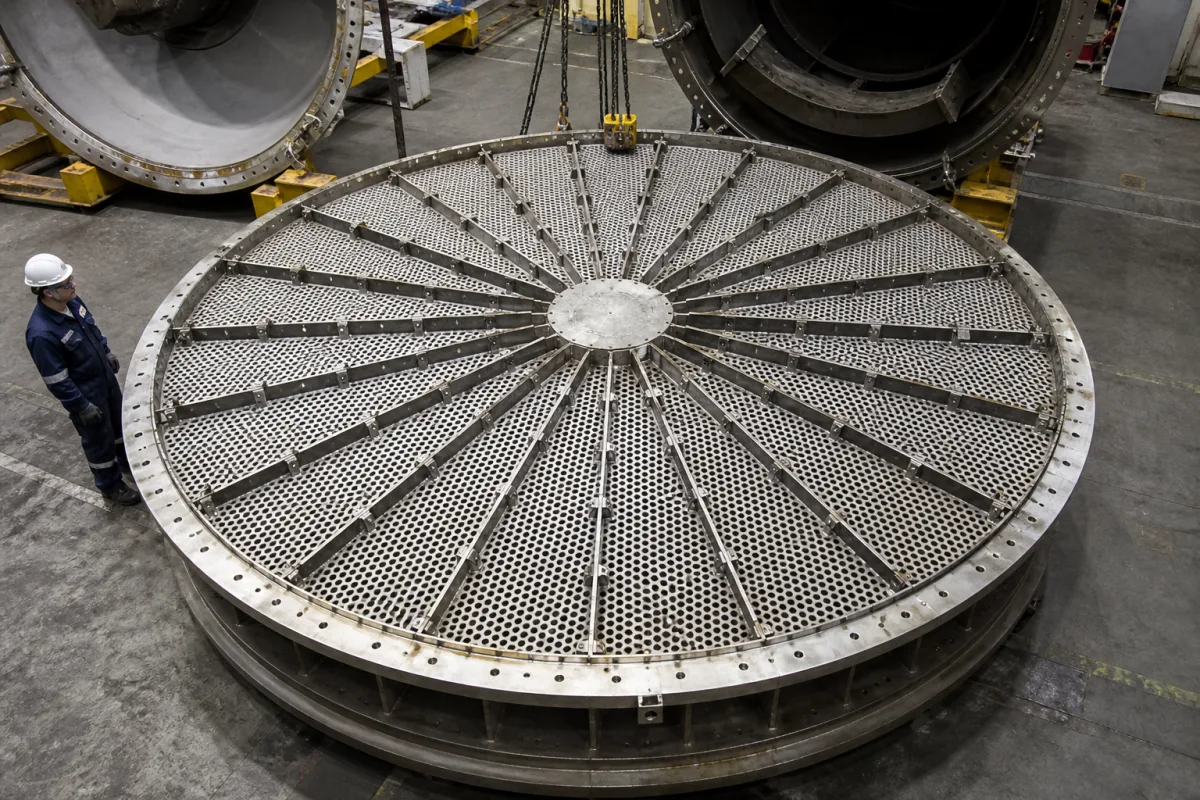
A canonical Ammonia Synthesis Catalyst Bed Support Grid is characterized by the integration of Support ring and Cross bars. In industrial production environments, manufacturers listed on CNFX commonly emphasize Stainless Steel 316L construction to support stable, high-cycle operation across diverse manufacturing scenarios.

Structural grid supporting catalyst beds in ammonia synthesis converters.

Product Specifications

Technical details and manufacturing context for Ammonia Synthesis Catalyst Bed Support Grid

Definition
A critical structural component installed within ammonia synthesis converters to support catalyst beds while allowing uniform gas flow distribution. This grid prevents catalyst particle migration and bed compaction under high-pressure, high-temperature operating conditions. It ensures optimal contact between synthesis gas and catalyst particles for efficient ammonia production. The component is essential for maintaining reactor performance and preventing pressure drop issues in fertilizer manufacturing plants.
Working Principle
Provides mechanical support for catalyst particles while maintaining open flow channels for reactant gases to pass through the catalyst bed uniformly.
Common Materials
Stainless Steel 316L, Inconel 625
Technical Parameters
  • Grid opening size for optimal gas flow (mm) Per Request
  • Maximum allowable working pressure (MPa) Per Request
Components / BOM
  • Support ring Part
    Outer structural ring for mounting in reactor
    Material: Stainless Steel 316L
  • Cross bars Part
    Primary load-bearing structural elements
    Material: Stainless Steel 316L
  • Retainer mesh Optional Part
    Fine mesh layer for catalyst particle retention
    Material: Inconel 625 wire mesh
  • Mounting brackets Part
    Attachment points for reactor wall mounting
    Material: Stainless Steel 316L

Industry Taxonomies & Aliases

Commonly used trade names and technical identifiers for Ammonia Synthesis Catalyst Bed Support Grid.

Industrial Ecosystem & Supply Chain Structure

Complementary Systems
Downstream Applications
Specialized Tooling

Application Fit & Sizing Matrix

Operational Limits
pressure: Up to 300 bar (typical ammonia converter design pressure)
flow rate: Dependent on converter design, typically 0.5-2.0 m/s gas velocity
temperature: 400-550°C (typical ammonia synthesis operating range)
mechanical load: Must support catalyst bed weight + pressure drop forces
Media Compatibility
✓ Hydrogen-nitrogen synthesis gas mixtures ✓ Ammonia-rich process streams ✓ Inert gas purging environments
Unsuitable: Chloride-containing streams (risk of stress corrosion cracking)
Sizing Data Required
  • Catalyst bed diameter and height
  • Maximum expected pressure drop across bed
  • Operating temperature and thermal expansion requirements

Reliability & Engineering Risk Analysis

Failure Mode & Root Cause
Thermal fatigue cracking
Cause: Cyclic temperature variations during startup/shutdown or process upsets causing differential expansion/contraction stresses in the grid material, leading to crack initiation and propagation, especially at weld joints or stress concentration points.
Corrosion-induced weakening
Cause: Exposure to ammonia synthesis gas containing trace contaminants (e.g., chlorides, sulfides) or moisture ingress, leading to localized pitting, stress corrosion cracking, or general material degradation that compromises structural integrity and load-bearing capacity.
Maintenance Indicators
  • Visible catalyst leakage through the grid during shutdown inspections, indicating potential grid perforation or failure.
  • Abnormal pressure drop increase across the catalyst bed during operation, suggesting grid deformation, blockage, or structural compromise affecting flow distribution.
Engineering Tips
  • Implement strict thermal ramp rate controls during reactor startups and shutdowns to minimize thermal stress cycles on the grid, and use finite element analysis (FEA) during design to optimize grid geometry for stress distribution.
  • Enhance material selection with corrosion-resistant alloys (e.g., high-nickel alloys) and apply protective coatings if feasible, coupled with rigorous gas purification to remove contaminants and moisture before the synthesis loop.

Compliance & Manufacturing Standards

Reference Standards
ISO 9001:2015 - Quality Management Systems ASME B31.3 - Process Piping ASTM A240/A240M - Chromium and Chromium-Nickel Stainless Steel Plate, Sheet, and Strip
Manufacturing Precision
  • Flatness: ≤0.1mm per 100mm
  • Hole Diameter: +0.05mm/-0.00mm
Quality Inspection
  • Dye Penetrant Testing (PT)
  • Dimensional Verification with CMM

Factories Producing Ammonia Synthesis Catalyst Bed Support Grid

Manufacturer profiles with relevant production capability in China

Manufacturer listings support early research and capability understanding. They are not certification, ranking, or transaction guarantees.

Technical documentation
4/5
Manufacturing capability
4/5
Inspection readiness
5/5
Supplier transparency
3/5

These scores are example evaluation dimensions, not real customer ratings, country-specific buyer feedback, or live inquiry activity.

Supply Chain Commonly Integrated Components

Process Analytics

Real-time monitoring and analysis system for pharmaceutical manufacturing processes

Explore Specs →
Dust Containment System

A safety and environmental control system designed to capture, contain, and prevent the escape of airborne pharmaceutical powder particles during blending operations.

Explore Specs →
Feed Tank & Pump

A combined unit consisting of a storage tank and pump for feeding solvent into an automated recovery and purification system.

Explore Specs →
Pre-Filtration Unit

A filtration component that removes coarse particulates and contaminants from solvents prior to main purification processes

Explore Specs →

Frequently Asked Questions

What materials are used in ammonia synthesis catalyst bed support grids and why?

Our support grids are manufactured from Stainless Steel 316L and Inconel 625 for exceptional corrosion resistance and high-temperature stability in ammonia synthesis environments, ensuring long-term durability and minimal contamination.

How does the support grid design affect ammonia production efficiency?

The grid's optimized open area percentage and pressure drop specifications maintain proper gas flow distribution while securely retaining catalyst particles, preventing channeling and maximizing conversion rates in synthesis converters.

What specifications should I consider when selecting a catalyst bed support grid?

Key specifications include catalyst particle retention size, grid diameter/thickness, maximum temperature rating (typically 500-600°C), open area percentage (usually 30-50%), and pressure drop to ensure compatibility with your converter design and operating conditions.

Can I contact factories directly on CNFX?

CNFX is an open directory, not a transaction platform. Each factory profile provides direct contact information and production details to help you initiate direct inquiries with Chinese suppliers.

Data Basis

CNFX manufacturer profiles, technical classification, publicly available product information, and ongoing plausibility checks.

Preliminary Technical Classification
This page supports structured research, RFQ preparation, and supplier evaluation. It does not replace buyer-led supplier qualification, standards review, or technical approval.

Request Manufacturing Insight for Ammonia Synthesis Catalyst Bed Support Grid

Ask for use case, specification boundaries, supplier type, and RFQ preparation information for Ammonia Synthesis Catalyst Bed Support Grid.

Your business information is used only to process this request.

Thank you! Your message has been sent. We'll respond within 1–3 business days.

Need to Manufacture Ammonia Synthesis Catalyst Bed Support Grid?

Compare manufacturer profiles with relevant product and process capability.

Create Manufacturer Profile Contact Us
Previous Product
Ammonia Oxidation Reactor
Next Product
Analytical Sensor Array