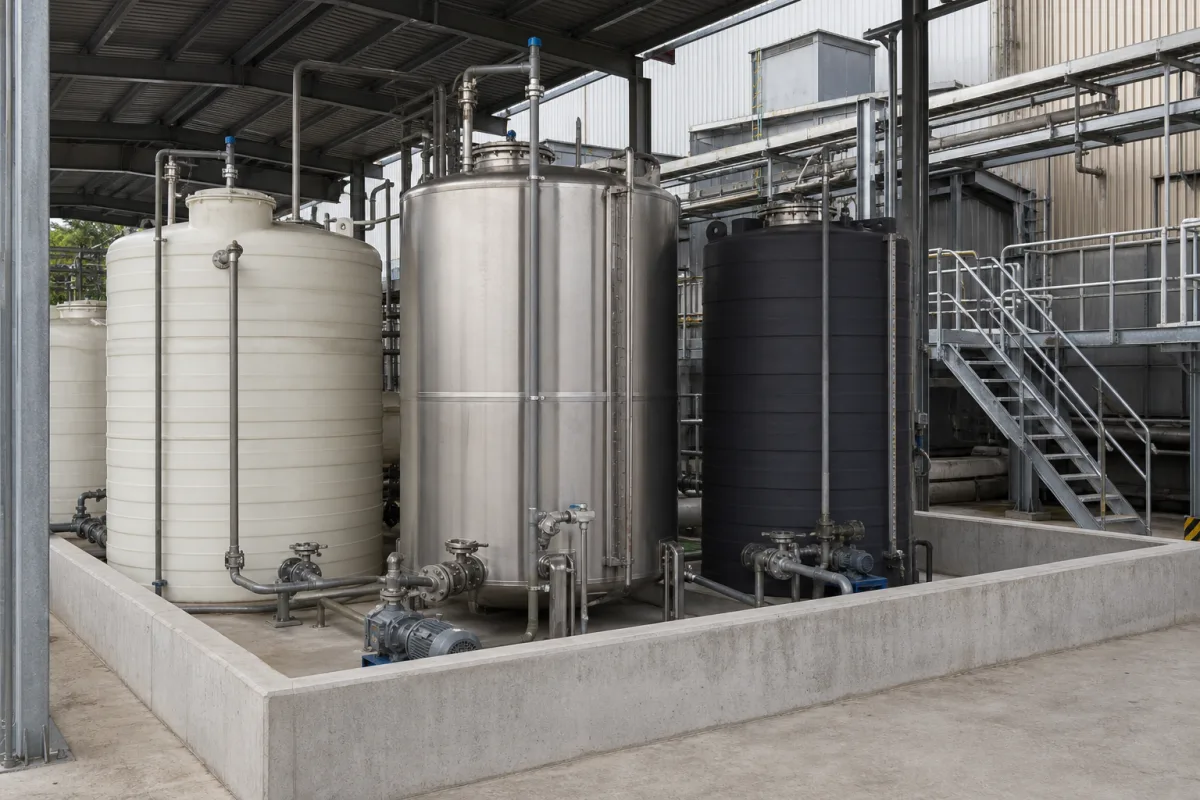
Chemical storage tanks and their fill points: keeping each bulk delivery going into the right tank
Chemical storage tanks at the point of delivery · Fill connections for different chemicals 18 in. apart and alike, an unlocked line, sulfuric acid into a hypochlorite tank and a chlorine cloud; unique fittings, labels, locks, a person present, checklists and shutdown interlocks at the tank farm
This page covers chemical storage tanks in a tank farm from the side where chemicals arrive: the fill lines, connections, locks, labels and controls through which tanker trucks and railcars unload into each tank. Ask three things first: whether a delivery hose for one chemical can physically be connected to another chemical's tank, who checks the connection and how before flow starts, and what stops the transfer quickly if it goes into the wrong tank or a hose fails.
Bulk chemical storage tanks in multi-chemical tank farms, viewed through their fill points, unloading connections, labelling, locking and transfer shutdown. Tank materials, specific gravity ratings and bunds for corrosive reagents are covered on the Reagent storage tank page, atmospheric storage tanks as a whole on the Storage tank page, and product buffer tanks on the Liquid storage tank page. Tank trucks, railcars and pipeline transfer systems are outside this page.
CNFX editorial research · Sources checked October 12, 2026 · 3 sources
What happened at MGPI: two similar, unlabelled fill lines 18 in. apart and one left unlocked
The US Chemical Safety Board's case study of the 21 October 2016 release at MGPI Processing in Atchison, Kansas, found that a facility employee escorted the sulfuric acid tanker driver to the locked loading dock and unlocked the gate and the sulfuric acid fill line, unaware that the sodium hypochlorite fill line was also unlocked; the two lines were only 18 in. apart, looked similar and were not clearly marked, and the driver connected his sulfuric acid hose to the hypochlorite line. Thousands of gallons of acid entered the hypochlorite tank, producing a dense green cloud containing chlorine that drifted over the town; over 140 workers and members of the public went to hospital and thousands of residents were told to shelter in place or evacuate. [1]
The CSB's 11 key lessons include evaluating unloading equipment and processes with human factors in mind, installing alarms and interlocks in the process control system that can shut down chemical transfer in an emergency, and having facilities and their chemical distributors carry out a joint risk assessment and agree unloading procedures with clearly defined responsibilities. [1] AIChE's Process Safety Beacon adds that one MGPI employee and five members of the public were hospitalised, and lists the contributing factors as poor labelling of connection points, a weak system for telling the driver the correct connection, the operator not verifying the connection before transfer, and errors in an unloading procedure that operators understood poorly. [2]
Editorial calculation: 18 in. is about 0.46 m, less than an arm's length, which is why distance alone does not separate fill points for incompatible chemicals.
Give the tank and piping supplier the list of chemicals stored, their incompatibilities, delivery modes (truck, railcar, IBC), the fill point layout, the connection types wanted, the level and overfill instruments, and how transfers will be stopped remotely.
02
Fill points that only accept the right hose, a person present and a written check before flow
AIChE's Beacon notes that some companies fit unique fittings on load and unload piping so that only the correct material's hose can be connected; that manual loading and unloading needs detailed procedures and well-marked piping and connection points; that procedures should require facility personnel to be physically present during deliveries, with personnel and driver verifying the connection by written checklist, piping diagram or walk-down before discharge; that where drivers unload, the distributor and the facility share responsibility; and that hazard analyses should ask what happens if the hose is connected to the wrong tank, using a compatibility tool such as CRW4. [2]
EPA's settlement with Roberts Chemical in Attleboro, Massachusetts, a repackager supplied by tanker truck and railcar through dedicated unloading stations into aboveground tanks, followed a spill of about 5,000 gallons of sulfuric acid from a ruptured transfer hose during railcar unloading; EPA's lesson was that companies transferring extremely hazardous chemicals need excellent hose maintenance programs and clearly labelled, safely stored and moved chemicals. [3] Editorial calculation: 5,000 US gallons is about 18.9 m³ of acid released at the unloading station, a volume to check against the containment there as well as at the tanks.
03
Send the chemicals, deliveries and fill point layout together
Paste it into your enquiry below or into an email to a maker, then replace every bracket.
3 companies list this product among what they make. Company figures are quoted from each
company's own website; every card states where the relationship came from.
Hebei Yongchang Composite Material Technology Co., Ltd.
Manufacturing site to be confirmed for the order
Lists GRP/FRP storage tanks, vertical and underground, with GRP pipe and fittings.
Explore company information and manufacturing capabilities, then discuss the scope of your project with a relevant supplier.
Share this page
Compiled and source-reviewed by the CNFX editorial team.
Each manufacturer above links to the page on that company's own website where the product is listed, with the date we checked it. How we source and review
· Page last updated 13 October 2026
Buyer questions
How do wrong-tank deliveries happen at chemical tank farms?
At MGPI in 2016, the CSB found two similar, poorly marked fill lines 18 in. apart, with the wrong one unlocked, so sulfuric acid went into a sodium hypochlorite tank. [1]
How can fill points prevent connecting the wrong chemical?
AIChE's Beacon cites unique fittings that accept only the correct hose, clear labels, a facility person present and written checks before discharge. [2]
What should stop a chemical transfer that goes wrong?
The CSB recommends alarms and interlocks in the process control system that can shut down chemical transfer in an emergency. [1]
Sources and what still needs a direct check
Sources checked 2026-10-12. The US Chemical Safety Board and AIChE's CCPS describe the MGPI incident and its lessons; EPA describes an unloading hose failure; suppliers list their tanks.