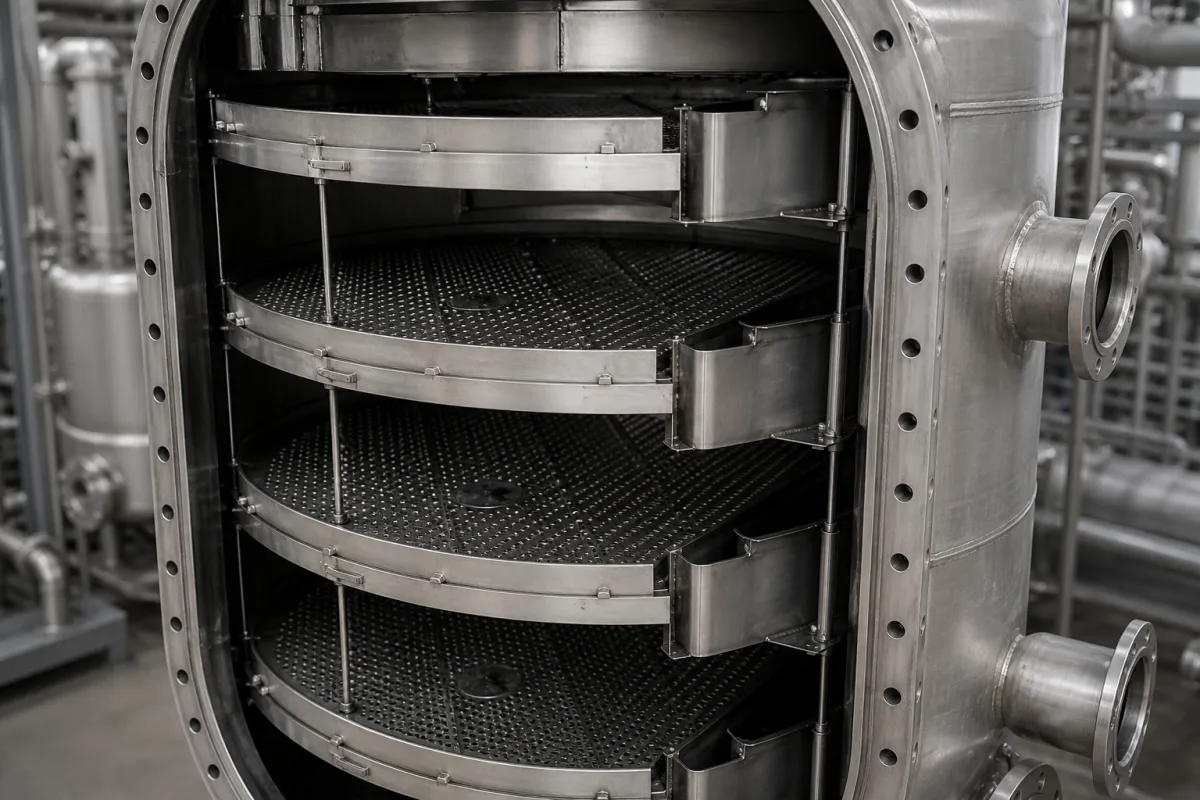
Column internals · Sieve vs valve trays, jet flooding and weeping limits, turndown, structured packing pressure drop per stage, tray specification data
Distillation trays and packings are the internals of a column that bring rising vapour into contact with falling liquid: trays do it stage by stage on perforated or valved decks with weirs and downcomers, packings do it continuously over a large wetted surface. Ask three things first: what vapour and liquid loads, including the minimum, the internals must handle without flooding or weeping; how much pressure drop per stage the process can accept, which can favour packing under vacuum; and which tray or packing type, material and mechanical design suit the service and the existing column.
Trays (sieve, valve, bubble cap and high-capacity designs), structured and random packings, and associated column internals for distillation and absorption. Complete columns, demisters as stand-alone items, reactor internals and process simulation services are outside this page.
CNFX editorial research · Sources checked October 12, 2026 · 4 sources
Set the operating window between flooding and weeping
Koch-Glitsch engineers, writing in Hydrocarbon Engineering (September 2025), define the upper limit of efficient tray operation as jet flooding, where a large share of the liquid is entrained to the tray above until the column fills with liquid, and the lower limit as weeping, where liquid falls through the deck openings to the tray below; weeping at the tray inlet is the worst type because the liquid misses contact on two tray levels. [1]
The same article explains that a sieve hole has no feature to direct vapour or prevent weeping, a movable T valve adds a cage and cap that closes at low vapour rates, and floating valves with a shaped cap and extruded hole direct vapour downward and resist weeping. In Koch-Glitsch's air/water data the sieve tray had the lowest capacity and narrowest operating range, the floating valve tray about 35% more capacity than the T valve tray, and double its turndown. [1]
In its deisobutaniser comparison, 0.5 in sieve trays needed a 14 ft 6 in column 200 ft high at 24 in tray spacing with a 60% minimum load; floating valve trays allowed either a 12 ft 0 in diameter at the same height (15% minimum load, about 30% vessel weight saving) or a 140 ft height at 16 in spacing (20% minimum load, about 26% saving). [1] Editorial calculation: reducing diameter from 14.5 ft to 12 ft cuts column cross-section by about 32%.
Give the supplier the vapour and liquid flow rates, densities, viscosities and surface tension at the limiting sections (or simulation tray-to-tray output), the operating range required, foaming tendency and fouling, operating pressure and temperature, maximum pressure drop per tray, tower inside diameter, tray spacing, manhole size, materials, and whether the tower is new or existing with its attachment drawings.
02
Weigh pressure drop per stage: trays or packing
Sulzer gives its Mellapak structured packing a pressure drop of 0.3–1.0 mbar per theoretical stage and about 2 mbar/m at 70–80% of flooding, a minimum liquid load of about 0.2 m³/m²h and a maximum of more than 200 m³/m²h, and lists vacuum to moderate pressure as preferred applications, including increasing the capacity of existing tray and packed columns. It states that MellapakPlus, with corrugations turned vertical at the sheet ends, can be used from 1 mbar vacuum to high pressure and gives up to 50% higher capacity at the same number of theoretical stages per metre. [3]
Koch-Glitsch's tray specification sheet asks for the maximum pressure drop per tray (mbar) together with operating pressure, tray spacing and number of liquid passes, so the allowable pressure drop is a design input for trays as well. [2] Editorial calculation: a separation needing 40 theoretical stages would see about 12–40 mbar across Mellapak at Sulzer's 0.3–1.0 mbar per stage; at a top pressure of 50 mbar that is a large share of the absolute pressure, which is why low pressure drop is a design priority in vacuum columns. [3]
Editorial note: packings and trays need different auxiliaries — liquid distributors, collectors, bed supports and limiters for packing; downcomers, weirs, support rings and hardware for trays — so compare complete internals packages, not deck or packing elements alone.
For random packing, RVT Process Equipment's Hiflow ring page tabulates bed weight and void fraction by size and material: in polypropylene, 77 kg/m³ and 91% void for size 15-7 down to 27 kg/m³ and 97% for size 90-7; in stainless steel 1.4301 (AISI 304), 298 kg/m³ and 96% for size 25-4, 210 kg/m³ and 97% for 40-4, and 148 kg/m³ and 98% for 50-4; and in porcelain, 693 kg/m³ and 71% for 20-4 to 466 kg/m³ and 81% for 50-6. RVT says the lattice shape gives high mechanical stability with very high void fraction and low weight, allowing tall packed beds without intermediate supports, with low pressure drop and low sensitivity to fouling. [4] Editorial calculation: a 3 m bed of 50 mm stainless rings in a 2.0 m column (3.14 m²) holds about 9.4 m³ and weighs about 1,390 kg (148 kg/m³), against about 4,390 kg for 50 mm porcelain at 466 kg/m³; void fraction and bed weight belong on the packing quotation with the specific surface area. [4]
03
Compare what suppliers offer
Suppliers linked to this page list distillation trays and packings; each card links to the page reviewed.
Listings include valve, bubble cap and sieve trays, structured and random packings and column internals such as distributors and supports; ask each for hydraulic rating at your loads, turndown, pressure drop and mechanical design.
04
Trace the internals
This is a functional reference built from the sources cited; it is not one maker's specification.
Part
Role
Fix in the order
Tray deck and valves
Vapour–liquid contact; sets capacity and turndown. [1]
Fill the specification fields with values for your column
A trays or packing quotation needs values for your column. The table explains each field, gives published values where a reviewed source states them, and says what to obtain from the supplier.
Sets capacity and pressure drop; e.g. 71–98% for one random ring by material and size. [4]
Value.
06
Send the loads, pressure and column data together
Paste it into your enquiry below or into an email to a maker, then replace every bracket.
Loads: [vapour and liquid rates, densities, viscosity, surface tension at limiting sections]
Range: [minimum and maximum load; turndown]
Pressure: [operating pressure; maximum pressure drop per tray or stage]
Service: [foaming; fouling; corrosion]
Column: [inside diameter; tray spacing or bed height; manhole; new or existing]
Mechanical: [materials; deck thickness; support rings; welding allowed]
Documents: [hydraulic rating; drawings]
Explore company information and manufacturing capabilities, then discuss the scope of your project with a relevant supplier.
Share this page
Compiled and source-reviewed by the CNFX editorial team.
Published product pages show what a company offers, not tested performance. Confirm the legal seller, factory and scope for your order. How we source and review
· Page last updated 13 October 2026
Buyer questions
What limits the operating range of a distillation tray?
Koch-Glitsch defines jet flooding (entrainment to the tray above) as the upper limit and weeping (liquid falling through deck openings) as the lower limit. [1]
Are valve trays better than sieve trays?
In Koch-Glitsch's data, sieve trays had the lowest capacity and narrowest range; its floating valves showed about 35% more capacity than T valves and double the turndown. [1]
What pressure drop does structured packing have?
Sulzer gives Mellapak 0.3–1.0 mbar per theoretical stage and about 2 mbar/m at 70–80% of flooding. [3]
What void fraction do random column packings have?
One maker's ring packing lists 91–97% void in polypropylene, 96–98% in stainless steel and 71–81% in porcelain, with bed weights from 27 to 693 kg/m³. [4]
Sources and what still needs a direct check
Sources checked 2026-10-12. Koch-Glitsch and Sulzer are column internals makers describing their own products; their figures are for those designs and test systems.