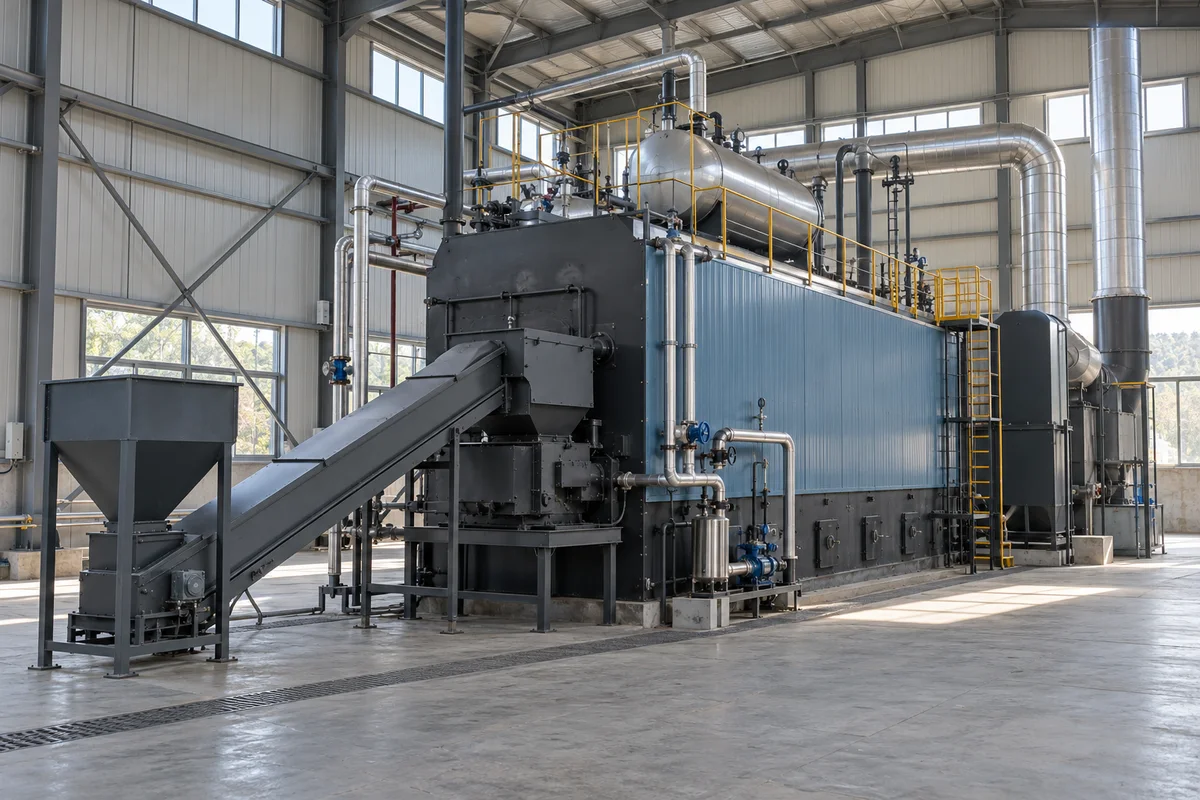
A biomass steam boiler has two linked duties: burn the delivered fuel reliably, and transfer enough heat into water to supply steam at the required pressure and temperature. Follow both circuits before comparing a tonnes-per-hour figure. Use the rating, fuel and component information to define a complete supply package.
This industrial-boiler entry focuses on biomass-fired steam plant. SEAI’s 2019 guide mainly covers 50 kW–5 MW non-domestic hot-water systems; its fuel and combustion explanations are used here, not as approval of the much larger DHB steam plant. The scene is generic; the companies below include complete-boiler, clean-steam and auxiliary-component suppliers.
CNFX editorial research · Sources checked October 10, 2026 · 8 sources
Convert the nameplate rating into your steam output
Spirax Sarco defines a “from and at 100°C” rating as evaporation from water at 100°C into steam at atmospheric pressure: 2,257 kJ of heat per kilogram. To convert that rating, use the steam enthalpy at the required condition minus the feedwater enthalpy. The comparison assumes the same useful heat transfer into the water; it does not establish how a different fuel or combustion efficiency changes the available heat [1].
Find the heat per kg at your conditions
Steam enthalpy at your pressure minus feedwater enthalpy, from steam tables.
Apply the factor
Spirax Sarco’s example uses 15 bar g steam and 68°C feedwater: 2,794 − 284.9 = 2,509.1 kJ/kg. A 2,000 kg/h from-and-at rating then gives 2,000 × 2,257 ÷ 2,509.1 ≈ 1,800 kg/h at those conditions [1].
Convert kW ratings the same way
For a 3,000 kW useful boiler-output rating at 10 bar g with 50°C feedwater, the source uses 2,781.33 − 209.438 = 2,571.892 kJ/kg. Output is 3,000 × 3,600 ÷ 2,571.892 ≈ 4,199 kg/h. A fuel-input rating would first need the appropriate efficiency and boundary; the same number cannot be inserted as useful output [1].
State your conditions in the RFQ
Ask for guaranteed output at your pressure and feedwater temperature, with your fuel.
Both worked examples are the source’s stated conditions, not DHB guarantees. Saturated steam temperature follows pressure; a superheated outlet needs a separately specified temperature and enthalpy. Spirax Sarco describes the extra superheater heat exchanger used after evaporation [1][6].
02
Follow the fuel path and the pressure-water circuit
Fuel is moved from storage into the combustion system. A grate advances the burning bed while primary and secondary air support combustion; a fluidised-bed furnace works differently. The hot gases heat the pressure-water circuit and pass through any specified heat-recovery and gas-cleaning equipment. In a water-tube boiler, water and steam are inside the tubes; a drum design separates steam from circulating water. A fire-tube boiler reverses that arrangement, with hot gases in tubes surrounded by water. Boiler geometry and circulation must therefore be identified before ordering parts [2][5][8].
Functional assembly / BOM reference
What it does
Material and configuration boundary
Drum, headers and pressure circuit
Contain the water/steam; a drum arrangement separates steam and returns water through its circulation circuit [5].
The pressure-part grade, thickness, weld record and design code are model documents. No verified grade or manufacturing quantity is published here.
Furnace, grate and refractory
Receive and burn fuel; stepped moving grates move it through drying and combustion zones. Refractory stores and radiates heat into wet fuel [2].
Moving, chain and fluidised-bed arrangements are distinct. Grate alloy and refractory specification remain unverified.
Fuel feed and storage discharge
Augers move fuel along a screw; ram feeds handle a different range of particle size and moisture. Feed design is part of the fuel specification [2].
No universal feed mechanism, conveyor size or material grade is established for the DHB families.
Combustion-air and draught equipment
Supply combustion air; induced draught and the flue system control the gas path and furnace pressure [2].
Fan duty, dust, gas temperature and pressure must match the selected furnace. Not proof that a listed fan is a compatible spare.
Water walls and convection heating surfaces
Membrane panels absorb radiant heat; downstream tube banks recover heat from hot gases in a water-tube design [5].
Tube grade, wall thickness and corrosion allowance must be documented for the selected pressure design.
Superheater, when specified
Adds heat to saturated steam to obtain the required superheated temperature [6].
Required by the specified steam state, not fitted to every boiler. No alloy or temperature guarantee is inferred.
Economiser and any air preheater
An economiser transfers remaining flue-gas heat into feedwater. DHB’s vibrating-grate parameter block also lists an air preheater [6][3].
Heat-recovery scope and corrosion limits need the actual design. An economiser is not automatically included in every offer.
Feedwater treatment, pump and check valve
Condition and replenish boiler water; the check valve prevents return flow from the boiler into the feed line [8][7].
Treatment depends on raw water and boiler duty; stainless pumps and valves are not established as universal construction.
Control system and protective instruments
Control water level and firing; level alarms, pressure indication and relief devices protect against abnormal conditions [8][7].
A control panel alone does not establish the safety architecture, unattended-operation permission or certified protection.
Steam outlet and blowdown fittings
The steam stop valve isolates the boiler outlet. TDS blowdown removes dissolved-solids-rich water; bottom blowdown removes settled sediment [7].
Valve class, relief sizing and operating procedures belong to the issued plant design and instructions.
Ash removal, flue cleaning and stack
Remove bottom ash and entrained particles, then carry combustion products out through the designed flue system [2].
A cyclone, bag filter or other abatement is selected for the fuel and emission duty; it is not a universal included package.
This is a functional plant breakdown, not a manufacturer’s parts list with quantities or certified materials. A gas/oil fuel-air burner and a biomass grate perform different combustion duties; a biomass plant may have a separate ignition burner, whose scope must be stated. Water is the working fluid rather than a purchased assembly; its chemistry and circulation remain essential [2][8].
03
Specify the fuel as carefully as the boiler
SEAI's guide sets out the fuel properties that decide biomass boiler performance [2].
Write moisture ranges into the contract
SEAI advises that biomass fuel specifications should always include an acceptable moisture range [2]. Give the boiler maker the range you will actually receive across seasons, not the average.
Calorific value
SEAI: "Biomass fuel CVs are normally expressed in net terms as MJ/kg or kWh/tonne"; check whether it is net or gross and at what moisture [2]
Moisture content
Percentage of the fuel's weight; higher moisture lowers CV. SEAI: "In general, wood pellets should have a MC of less than 10%. Wood chip and logs can be purchased at a wide range of MC" [2]
Bulk and energy density
Energy density = CV × bulk density; it sets storage size, delivery frequency and annual tonnage [2]
Particle size
Boiler makers specify acceptable sizes; oversize or fines cause feed blockages and bridging [2]
Ash content
Percentage of dry mass; more ash from high-ash fuels, poor combustion, contamination and bark [2]
Chlorides and ash fusion
SEAI explains that straw can contain high chlorides and silica; these can promote low-melting slag that binds to the grate or damages ash handling. Fuel composition and ash behaviour belong in the selected furnace’s fuel envelope [2].
04
Choose the combustion system for fuel and load
SEAI describes the following designs in its 2019 non-domestic heating guide. These ranges illustrate that guide’s technology discussion; they are not capacities or fuel limits for the DHB chain-grate and vibrating-grate steam units [2].
Type
Fuel moisture
Size range
Response
Moving (stepped) grate
Designs described can accept moisture up to 55%; not every moving grate has that limit [2]
Ratio of maximum to minimum efficient or controllable output; 2:1 means operation down to 50%. Biomass boilers have lower turndown than gas or oil boilers [2]
Responsiveness
Fuel already on the grate can keep burning after demand falls, and refractory stores heat. SEAI discusses control, thermal storage and conventional top-up plant for its hot-water systems. For steam plant, load-following capacity and any steam accumulator need their own engineered design [2].
Emissions
Fuel nitrogen, combustion conditions and abatement determine emissions. SEAI describes particulates and NOx controls; its guide is not an emission permit. Specify the project jurisdiction, dry/wet gas basis, reference oxygen and the duty at which any guarantee is tested [2].
Space
Larger boiler, fuel store and delivery access than oil or gas plant [2]
05
Compare offers on published parameters
DHB’s current biomass page lists the fuel-specific families below. Its separate Parameters tab describes a high-temperature, ultra-high-pressure vibrating-grate plant; those figures are not attached to every wood, rice-husk or palm-husk boiler [3].
Ask for guarantees on your fuel
Compare guaranteed steam output and condition, efficiency basis, fuel envelope and emission duty on the same offered configuration. The DHB page’s >90% efficiency has no published net/gross basis or test report here [3].
The vibrating-grate parameter block lists 120–145 t/h, main steam pressure 13.7 MPa, main steam temperature 540°C, feedwater 230°C, hot air 194°C, exhaust gas 130°C, thermal efficiency >90%, L×W×H 37×27×29 m and weight 2,030 t. This is the manufacturer’s published design data, not an independently verified project result [3].
Efficiency basis
Ask whether efficiency is on net or gross calorific value, at what load and fuel moisture, and which equipment losses are inside the test boundary. ASME’s current listing is PTC 4–2013 (R2023). Its public scope allows use of the concepts for other fuels but warns that fuel variability can increase uncertainty; it does not prove a biomass offer meets a Code test or certify boiler construction [4].
06
Give each rating its operating condition and boundary
A thermal-power number alone cannot identify the required plant. Define steam output, feedwater conditions, fuel and supply scope alongside the physical and emissions data [1].
Parameter
Unit / basis
What belongs in the specification
Steam output
kg/h or t/h
Actual outlet pressure, steam state, feedwater temperature, fuel and sustained load. State whether a quoted rate is actual or from-and-at [1].
Thermal capacity
kW or MW
Identify useful heat into water/steam versus fuel input; distinguish output at rated duty from minimum stable operation [1][2].
Working pressure
bar g or MPa, explicitly stated
Separate operating pressure, design/maximum permissible pressure and relief settings. Explicitly state whether a pressure is gauge or absolute [7].
Steam temperature
°C; saturated or superheated
Saturation temperature is tied to pressure. A superheater supplies additional heat; DHB lists 540°C for its high-pressure vibrating-grate example only [6][3].
Feedwater condition
°C and specified water chemistry
The temperature affects heat per kilogram; treatment and water quality affect scaling, corrosion and carryover [1][8].
Fuel type and analysis
As-received moisture / net or gross CV / dry ash / size
A fuel name alone does not define energy supply, feedability or ash behaviour [2].
Thermal efficiency
%; stated test boundary and CV basis
Report load, fuel analysis, moisture and test method. DHB >90% is a maker figure with basis unresolved; it is not a guarantee for every offered boiler [3][4].
Water content
m³, at a defined condition
Actual contained water differs from rated output; circulation and stored thermal energy depend on design. Water content for the offered boiler is not supplied by these family listings [5].
Flue-gas temperature
°C at a named location and load
DHB lists 130°C at the exhaust for its example. Economiser cooling is constrained by condensation/corrosion and feedwater boiling, not simply “lower is better” [3][6].
NOx and particulate duty
mg/Nm³ with gas basis, reference O₂ and duty
Agree project limits and measurement conditions; no generic ≤80 mg/Nm³ guarantee or worldwide legal limit is asserted [2].
Auxiliary electrical demand
kW installed and running, defined scope
List fans, pumps, feed and ash drives and controls included in the supplied plant. Separate installed motor ratings from running electrical demand at the specified load.
Plant weight
t; dry, operating and shipment masses
DHB lists 2,030 t for the vibrating-grate plant; the weight basis and foundation loads remain unspecified [3].
Dimensions and service envelope
L×W×H, m; access and removal clearances
DHB lists 37×27×29 m. Fuel stores, delivery access, tube-cleaning clearance and ash plant extend beyond a boiler-body envelope [3][2].
The fields describe what a usable specification needs; they do not establish a single nominal capacity, pressure, emissions limit or material specification across all industrial boilers.
07
Specify the operating documents with the plant
A biomass plant has maintenance on both sides of the heat-transfer surface: fuel, clinker and ash on the combustion side; water chemistry, deposits and corrosion on the pressure side. SEAI describes bottom ash, entrained fly ash and access for tube cleaning. HSE explains how unsuitable water treatment and operation beyond design limits damage steam plant [2][8].
Fuel and ash access
Allocate working space for fuel delivery, feed inspection, ash removal and tube cleaning. A reported boiler footprint does not include all these tasks [2].
Water and protective-device records
Provide water-treatment limits, control/limiter test instructions, results against required values, operator identity and corrective actions. HSE recommends manufacturer routine tests as a minimum, with frequency adjusted where conditions require [8].
Serial-specific documentation
Retain the nameplate identity, operating limits, issued drawings, component and material records, control logic, manuals and repair/modification history. Model and serial numbers identify the relevant spare parts [7][8].
Installation and examination scope
Identify who designs the site connections, commissioning and pressure-system examination. HSE’s written examination scheme discussion is UK guidance; the destination’s applicable inspection regime must be established separately [8].
This page is not a start-up, blowdown, relief-valve adjustment or furnace-entry procedure. No cleaning interval, chemical dose, pressure-test value or unattended-operation permission is inferred from a product-category record. These belong to the issued plant instructions and competent site arrangements [8].
08
Copy this RFQ and fill in the brackets
Paste it into your enquiry below or into an email to a maker, then replace every bracket.
Product: biomass steam boiler; quantity [ ]; site/country [ ]
Steam: actual [kg/h or t/h] at [bar g or MPa, stated basis]; [saturated / superheated °C]; feedwater [°C]
Load profile: minimum/maximum [ ], ramps [ ], start-stop frequency [ ], hours/year [ ]
Fuel: origin/type [ ]; as-received moisture range [ %]; net/gross CV [MJ/kg] at [ %] moisture
Fuel handling: size/fines [mm/%], dry ash [ %], chlorine/alkali and ash behaviour [ ]; delivery/store [ ]
Combustion and scope: grate/bed [ ]; fuel feed, fans, ash extraction, economiser, superheater and abatement [ ]
Emission guarantee: project limits [ ]; dry/wet gas, reference O2, load/fuel and test method [ ]
Performance guarantee: actual steam output/state, efficiency CV basis and boundary, test method and uncertainty [ ]
Pressure system: design code/edition [ ], inspection route [ ], legal manufacturer and documents [ ]
Site: boiler/auxiliary envelope, service access, operating/foundation loads, power/water/stack connections [ ]
Handover: drawings, serial-specific component/material records, control/limiter tests, operating and maintenance manuals [ ]
Delivery and commissioning responsibilities [ ]; target date [ ]
Complete steam plant, clean-steam equipment, heaters and fans are different supply packages. Each company's published scope is shown below.
DHB Boiler
Zhangjiagang, Jiangsu (contact region; model plant to be verified), CN
DHB lists wood, rice-husk, palm-husk and fluidised-bed boiler families. Its vibrating-grate parameter block is a separate 120–145 t/h high-pressure steam design. Published efficiency, fuel suitability and project claims are manufacturer information, not a verified acceptance test.
Jinzhong’s current catalogue lists electric heating elements and stainless steam-generator/heater assemblies for appliances and commercial equipment. These listings do not establish a biomass-fired industrial steam-boiler model or the DHB plant scope.
TianSure’s PLC pure-steam generator uses purified water/WFI heated by plant steam or electric heaters, with separation and demisting. It is pharmaceutical clean-steam equipment, not a demonstrated biomass-combustion boiler. Published GMP and qualification claims have not been independently certified here.
SIMO publishes industrial centrifugal fans and explicitly lists boiler combustion-air/flue-gas applications. This is auxiliary fan supply; the current site does not establish complete steam-boiler manufacture. The working source is the www hostname.
Explore company information and manufacturing capabilities, then discuss the scope of your project with a relevant supplier.
Share this page
Compiled and source-reviewed by the CNFX editorial team.
Each manufacturer above links to the page on that company's own website where the product is listed, with the date we checked it. How we source and review
· Page last updated 13 October 2026
Buyer questions
What does a 'from and at 100 °C' boiler rating mean?
It is evaporation from 100°C water into steam at atmospheric pressure, using 2,257 kJ/kg. Spirax Sarco’s 2,000 kg/h example becomes about 1,800 kg/h at 15 bar g and 68°C feedwater for the same useful heat transfer. This is a conversion example, not a biomass-fuel performance guarantee. [1]
How wet can biomass fuel be?
SEAI’s 2019 guide describes moving-grate designs accepting moisture up to 55%, and, for underfed stokers, "Wood chip and pellet fuel can be used, usually with a MC less than 30%"; it also states "In general, wood pellets should have a MC of less than 10%". The guide mainly covers non-domestic hot-water systems. Those values do not establish the allowable fuel moisture for a particular DHB steam boiler. [2]
Why does a biomass boiler respond slowly?
Fuel already deposited on the grate continues to burn when demand falls, and refractory stores heat. The response depends on furnace design; SEAI notes relatively fast response for low-refractory underfed designs. Steam-load swings therefore require the actual offered plant’s load-following duty. [2]
What capacity are rice husk boilers?
DHB lists chain-grate rice husk boilers from 4 to 45 t/h. [3]
Does a >90% boiler efficiency figure describe the whole installation?
Only when its definition says so. DHB publishes >90% for its vibrating-grate parameter block without a net/gross calorific-value basis or test report here. Useful heat, fuel input, auxiliary electricity and other plant losses need an agreed boundary. ASME PTC 4’s public scope also highlights extra uncertainty from variable fuels. [3][4]
Sources and what still needs a direct check
Sources checked 2026-10-10. Sources checked 10 October 2026. Boiler-rating images and DHB’s parameter tab were read directly; SEAI’s 2019 guide is used within its scope. These sources do not certify an offered boiler, its pressure design or its legal manufacturer.