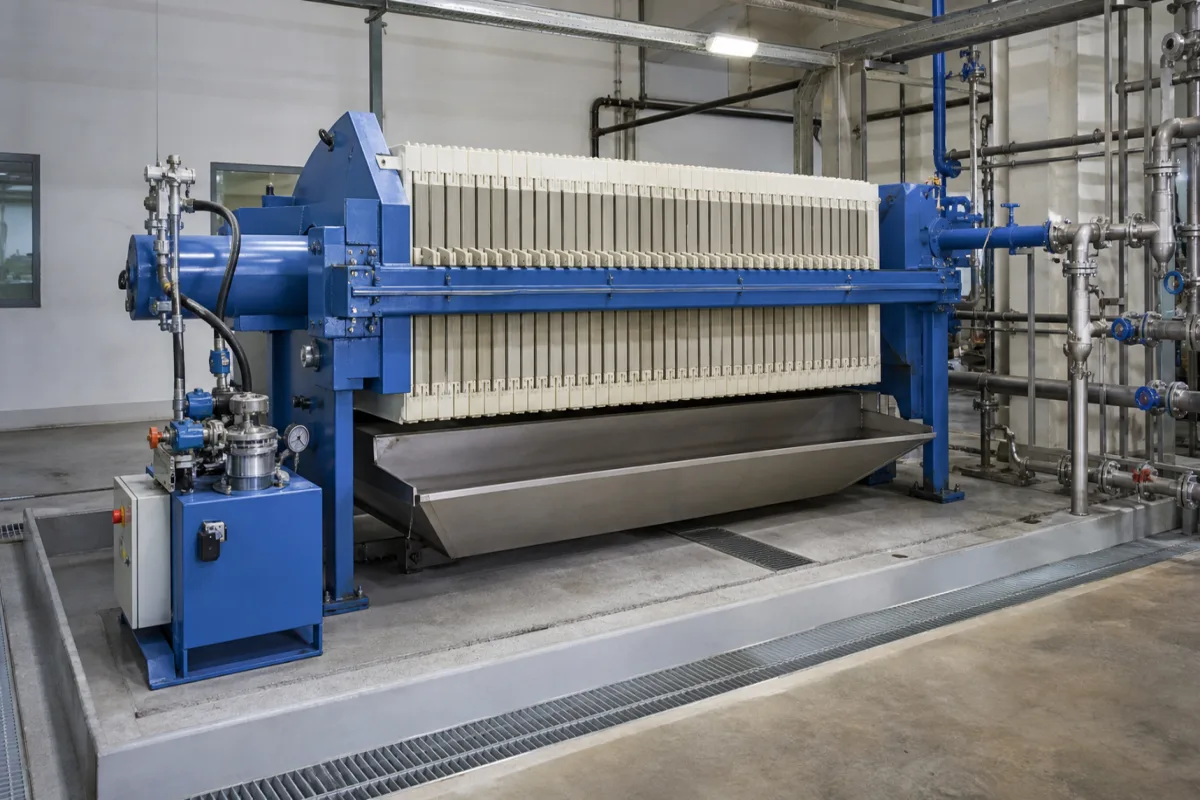
Solid–liquid separation · Cycle, pressure, cloth and cake
A plate filter press is a batch machine: plates clamped by a hydraulic cylinder fill with slurry, liquid leaves through the cloths, and the cakes drop out when the stack opens. Cycle time and cake moisture depend heavily on the slurry, so ask for tests on your material before fixing size and pressure.
Recessed-chamber, membrane and plate-and-frame filter presses for chemical, mineral, food and wastewater slurries. Belt filter presses, leaf filters, cartridge and self-cleaning filters are outside this page.
CNFX editorial research · Sources checked October 12, 2026 · 8 sources
McLanahan describes the plate filter press cycle as: clamp the plates with a hydraulic cylinder and moving plate; fill at high flow and low pressure; ramp the feed pump to the target filtration pressure and hold it until flow falls to a preset minimum; then optional core blow, cake dry and membrane squeeze; then unclamp and open the plates so the cakes fall out. Clamping pressure must withstand the feed pump pressure. [1]
ErtelAlsop adds that the first third to half of the cycle is the fast-fill stage, when "the majority of the total cake solids have been pumped into the press"; flow then tapers as the cakes thicken and bridge at the centre of each chamber. It is the pressure difference across the cloth and cake, not the pump pressure alone, that drives filtration. [3]
At the start, McLanahan limits the fill flow rate by controlling pump speed "to help reduce cloth wear around the filter plate feed hole areas". [1]
Send the supplier a slurry sample, or results of a test on it: percent solids, particle size, composition, temperature and pH. A press sized without your material is a guess.
02
Set feed pressure and the extra dewatering steps
McLanahan states that "in general, higher slurry feed pressure will result in faster dewatering rates, i.e., lower cake percent moisture", and that "today, most Filter Presses are designed for low pressure, up to 100 PSI slurry feed pressure, or high pressure, up to 225 PSI", with very high pressure presses up to 500 psi or more. Editorial conversion: 100 psi is about 6.9 bar and 225 psi about 15.5 bar. [2]
Cake moisture depends on particle size and shape, composition, feed pressure and filtration time: coarse, rounded particles dewater easily; fine, flat particles and clays hold water; organic material may be nearly impossible to dewater mechanically. The dewatering rate falls steeply late in the cycle, so filtration is stopped at an acceptable moisture. [2]
Cake dry blows compressed air through the cakes and suits porous material needing very low moisture. Membrane plates have flexible faces inflated with water or air to squeeze the cakes after filling. [1]
McLanahan states that how much higher pressure shortens filtration can only be found by testing representative material at different pressures. [1]
03
Choose chamber thickness and filter cloth
Thicker chambers hold more slurry and need longer fill and filtration time. McLanahan says filter cloths "are typically woven synthetic fabrics made from fine nylon, polypropylene or polyester filaments"; a tighter weave catches finer particles but slows filtrate flow. The cloth is chosen for dewatering, wear and cake release. [1]
ErtelAlsop explains that cloth gives surface filtration in which "most of the filtration is performed by the developed filter cake", so cloth "can be used throughout many filtration cycles without needing to be replaced"; cellulose depth media capture particles inside the sheet and are replaced when saturated, and suit polishing at lower pressure. [3]
04
Estimate cycle time and handling
McLanahan notes that the hydraulic power unit and cylinder size set how fast the press opens and closes, one to ten minutes, and that plate shifting is "typically one to five seconds per plate". It adds that "slurry feeds with high densities will typically reduce the fill and filtration times". [1]
Ask the supplier for a cycle broken into its steps for your slurry, and for automation options such as automatic plate shifting, cake discharge and cloth washing. [3][5]
05
Membrane plates, mining presses, drilling-mud and starch presses on supplier sites
Jingjin states its high-pressure PP membrane plates can be inflated to 4.0 MPa and that it weaves its own cloth; JXSC lists presses of 20–500 m² filter area and 0.24–7.96 m³ chamber volume with PP plates and Q235 frames; HL lists filter presses in drilling-fluid treatment and HMFoodTech frame presses for starch. These are suppliers' own statements. [4][5][7][8]
06
Frame, hydraulic closure, plates, cloth, feed pump and plate shifter
Clamping pressure links the closure row to the feed pump row: McLanahan says the clamp must withstand the pump pressure, and the hydraulic power unit sets the one-to-ten-minute open and close time. [1]
Part
Role
Fix in the order
Carriage (frame)
Fixed head, moving head, side bars or beam; holds the plates against internal pressure. [3]
Frame type, material, plate capacity.
Hydraulic closure
Clamps the stack against feed pressure; sets open and close time. [1]
Filter area, feed pressure, chamber volume, cycle time and target cake moisture
Cake moisture and cycle time cannot be read from a catalogue: McLanahan says the gain from higher pressure can only be found by testing representative material, so the area, cycle and moisture rows need a test on your slurry. [1]
Field
What it means and published values
Ask the supplier for
Filtration area (m²)
Total cloth area; sets capacity per cycle.
Area from tests on your slurry.
Operating pressure (bar)
McLanahan: low-pressure presses to 100 psi, high-pressure to 225 psi, very high pressure to 500 psi or more. [2]
Design feed pressure.
Chamber volume (L)
Cake held per cycle; thicker chambers fill slower. [1]
Volume and chamber depth.
Plate dimensions (mm)
Plate size sets frame size.
Plate size and count.
Cycle time (minutes)
Sum of fill, filtration, optional steps and opening. [1]
12 companies list this product among what they make. Company figures are quoted from each
company's own website; every card states where the relationship came from.
Jingjin Equipment Inc.
Manufacturing site to be confirmed for the order
Lists filter presses, PP membrane filter plates and filter cloth.
Explore company information and manufacturing capabilities, then discuss the scope of your project with a relevant supplier.
Share this page
Compiled and source-reviewed by the CNFX editorial team.
Each manufacturer above links to the page on that company's own website where the product is listed, with the date we checked it. How we source and review
· Page last updated 13 October 2026
Buyer questions
What is the cycle of a filter press?
Clamp the plates, fill at low pressure, ramp to filtration pressure until flow drops, optionally core blow, cake dry or membrane squeeze, then open and discharge the cakes. [1]
What pressure does a filter press run at?
McLanahan states that "most Filter Presses are designed for low pressure, up to 100 PSI" or "high pressure, up to 225 PSI", with very high pressure units to 500 psi or more. [2]
How can I get drier filter cake?
Higher feed pressure, longer filtration, cake dry with air or membrane squeeze can lower moisture, but material type sets the limit; test your slurry. [2][1]
Sources and what still needs a direct check
Sources checked 2026-10-12. McLanahan is a filter press manufacturer; its articles explain the cycle and cake moisture. ErtelAlsop is a filtration equipment maker explaining filter press operation. Supplier pages describe their own offers.