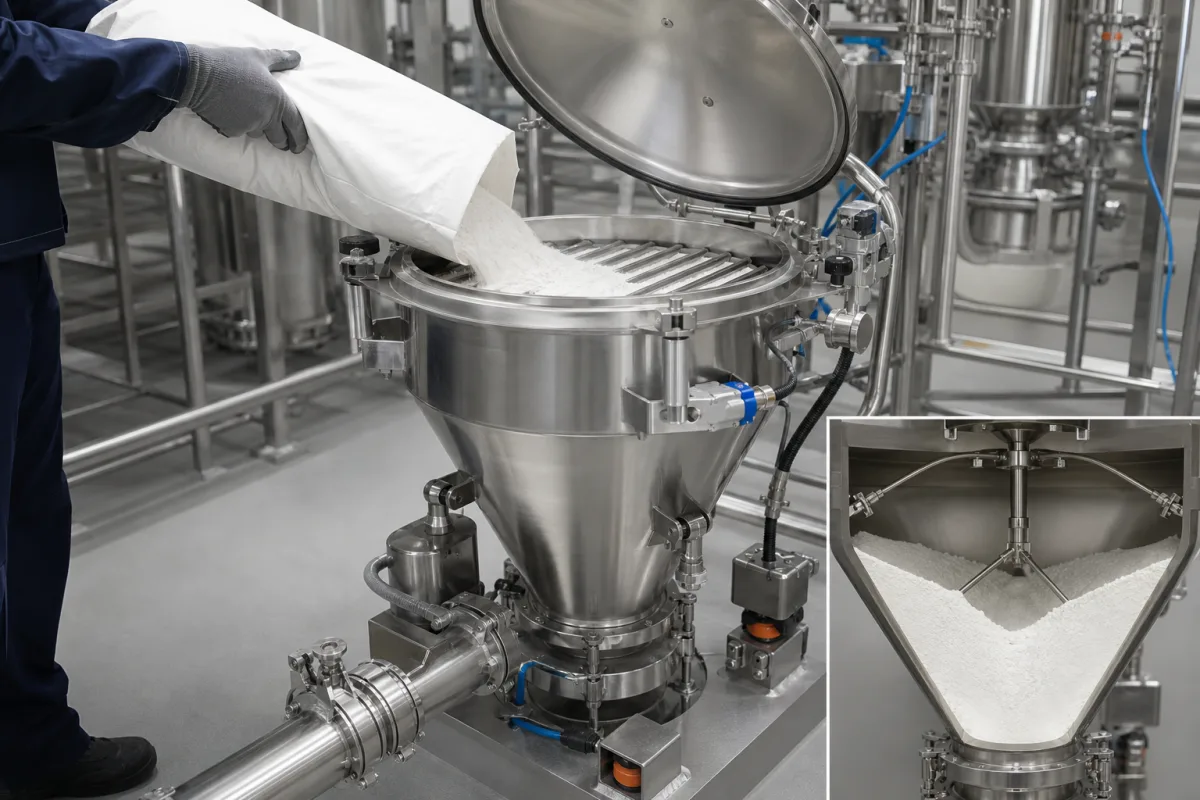
Ingredient hopper (hygienic bag-tip hopper for food and pharmaceutical ingredients, built for wet cleaning and contained feeding)
Hygienic ingredient hoppers for food and pharmaceutical lines · 3-A and cGMP finishes, CIP connections and cleaning access, product-contact Ra, 316L contact parts, glovebox and OEB 3 containment, feed adapters into vacuum conveyors
An ingredient hopper here is the hygienic version of a bag-tip hopper: the point where operators add ingredients by hand to a food or pharmaceutical process, built so that it can be wet-cleaned in place, leaves no ledges or crevices for product to collect, and keeps the ingredient sealed from the room and from other batches on its way into a vacuum conveyor. Ask three things first: which sanitary standard and surface finish the contact parts must meet, how the hopper is cleaned (CIP connections, openings, disassembly), and what containment and cross-contamination control the ingredient needs.
Hygienic bag-tip ingredient hoppers for food, nutrition and pharmaceutical plants: sanitary finishes, clean-in-place connections, polished welds, product-contact materials and finishes, glovebox and OEB containment and filtered feed into vacuum conveying. General-purpose bag dump stations sized by grate, hood airflow and filter area are covered on the Loading hopper for manual bag tipping (bag dump station) page; fluidised powder feed hoppers for coating guns are covered on the Powder feed hopper page; big-bag dischargers and silos are outside this page.
CNFX editorial research · Sources checked October 12, 2026 · 5 sources
Sanitary finish, cleaning access and containment level
Schenck Process lists the features of its hygienic bag dump station as interior and exterior finishes "to meet 3-A sanitary requirements", ferrules mounted for a clean-in-place (CIP) skid, large openings for internal CIP cleaning, a removable internal bag rest, all-stainless diaphragm bodies, 304 stainless bag cages, side-removal filter bags that meet 3-A, a 7-gauge stainless housing and hopper, and a hinged door with gas springs; it comes in filtered and non-filtered styles. [3]
Automated Flexible Conveyor's sanitary Dump Clean, reported by Powder & Bulk Solids, has stainless construction with "continuous, full penetration interior welds with a polished finish to meet cGMP requirements" so that material cannot be trapped, an integrated fan and filter that draws fine dust back inside, and can be taken apart for complete cleaning. [4] Piab pickles the product-contact zone of its 100 litre bag dump station to "≤ Ra 0.8" and states that it meets FDA and EC No. 1935/2004. [5]
Volkmann makes product-contact parts of 316L stainless steel (1.4404 or 1.4435), with glass bead blasted surfaces that can be ground or polished on request, and large bends in all hopper corners for "residue-free cleaning". For hazardous ingredients it offers a negative-pressure glovebox and a containment version rated OEB 3. [1]
Give the hopper maker the ingredients (name, bulk density, particle size, allergen or potency class), sanitary standard (3-A, cGMP, EC 1935/2004), contact material and Ra, weld finish, cleaning method (CIP connections, spray coverage, drainage, disassembly), containment level, filter type and validation, how empty bags leave the station, the conveyor or vessel it feeds, and quantity.
02
Feeding a vacuum conveyor without cross-contamination
Piab's bag dump station holds about four small bags and feeds its piFLOW vacuum conveyors through feed adapters that "maintain the optimal air ratio within the conveying line"; where cross-contamination must be prevented, the adapters can be fitted with an air inlet filter, and material passes to the conveyor through a flexible hose. [5] Volkmann states that material emptied into its RNT hopper can be vacuum conveyed "over a distance of up to 100 metres" to a mixer, reactor or filling machine, or fed by gravity to a system below, and that conveying under nitrogen needs a lockable hood and oxygen monitoring in the work area. [1]
Editorial calculation: a 25 kg bag of a powder with an assumed bulk density of 0.5 kg/L occupies about 50 L, so a 100 litre hopper buffers about two such bags and an 80 litre one about 1.6; at 0.8 kg/L a bag is about 31 L. Use your ingredient's bulk density and the conveyor's rate to size the buffer. [5][1]
03
Xianchen dust-free feeding stations
Henan Xianchen lists dust-free feeding stations for small bags and ton bags in pharmaceutical, food and chemical plants. [2] Ask for the contact material and Ra, weld finish, cleaning access and any CIP connections before treating it as a hygienic station.
04
Contact surfaces, CIP ferrules, bag rest, filter and feed adapter
In these stations the bag rest and filter bags come out, the interior welds are polished and the CIP ferrules take the cleaning liquid in.
Contact finish, materials, volume and containment for a hygienic hopper
The hygiene rows carry the published values: Ra 0.8 or better pickled contact zones on one station, 316L contact parts on another, and 3-A finishes on a third.
Field
What it means and published values
Ask the supplier for
Capacity (m³)
Examples: 100 litres; 80 litres for a small station. [5][1]
Explore company information and manufacturing capabilities, then discuss the scope of your project with a relevant supplier.
Share this page
Compiled and source-reviewed by the CNFX editorial team.
Each manufacturer above links to the page on that company's own website where the product is listed, with the date we checked it. How we source and review
· Page last updated 13 October 2026
Buyer questions
How is a hygienic ingredient hopper different from a general bag dump station?
It is built for wet cleaning and sanitary standards (3-A finishes, CIP connections, polished welds, low Ra); general stations sized by grate and dust airflow are on the Loading hopper for manual bag tipping page. [3][4]
Can the hopper be cleaned in place?
Schenck Process fits ferrules for a CIP skid and large openings for internal CIP cleaning on its hygienic bag dump station. [3]
What surface finish touches the product?
Piab pickles the product-contact zone to Ra 0.8 or better; Volkmann uses 316L that can be ground or polished. [5][1]
How is cross-contamination kept out of the conveying line?
Piab's feed adapters can carry an air inlet filter where stringent measures against cross-contamination are needed. [5]
Sources and what still needs a direct check
Sources checked 2026-10-12. Schenck Process (now Qlar) announced its hygienic bag dump station; Powder & Bulk Solids reported AFC's sanitary Dump Clean; Piab and Volkmann publish their bag dump stations; Xianchen describes its feeding station.