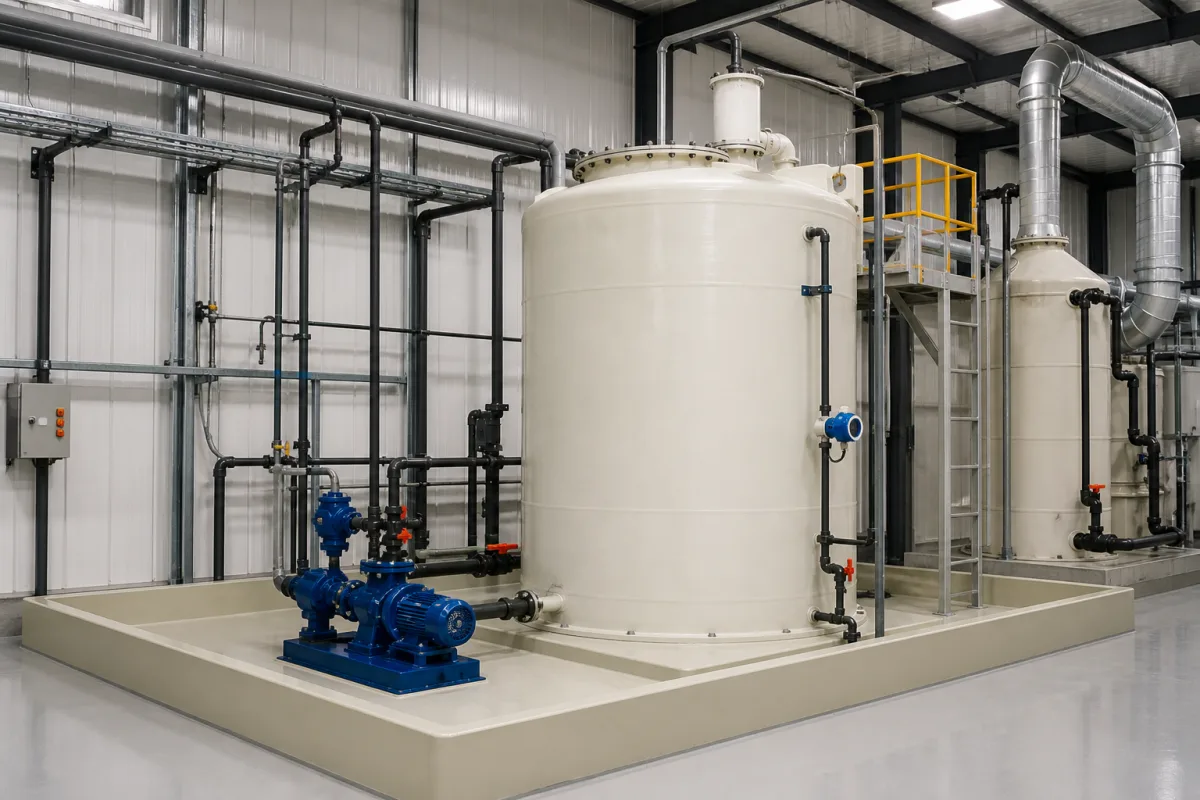
Reagent storage tank: bulk tanks for corrosive treatment and process chemicals, rated for the chemical's specific gravity and set in a bund
Bulk tanks for corrosive chemical reagents · Specific gravity rating and stored-liquid temperature behind a polyethylene tank's wall, FRP and glass-lined alternatives, and bund capacity of 110% of the largest tank or 25% of the total
This page covers bulk tanks for corrosive chemical reagents, such as acids, alkalis, hypochlorite and other oxidisers, in cross-linked polyethylene, filament-wound FRP or glass-lined steel, together with the bund they stand in. Ask three things first: which specific gravity and liquid temperature the tank wall is rated for, which material and resin the supplier proposes for your exact chemical, and how large the bund must be for all the tanks that share it.
Bulk storage tanks for corrosive chemical reagents, including acids, alkalis, hypochlorite and other oxidisers, in cross-linked polyethylene, filament-wound FRP or glass-lined steel, with their vents, fittings and secondary containment bunds. Atmospheric and low-pressure tanks for water, oil, food and liquefied gases are covered on the Storage tank page. Laboratory reagent reservoirs and bottles, and large field-erected API 650 steel tanks, are outside this page.
CNFX editorial research · Sources checked October 12, 2026 · 6 sources
Specific gravity rating and the stored liquid's temperature set a polyethylene tank's wall
Poly Processing explains that specific gravity, the chemical's density relative to water, sets the wall thickness of a polyethylene tank: a 1.9-rated tank meets ASTM guidelines for wall thickness to hold a chemical of specific gravity 1.9 or less. It offers wall ratings of 1.0, 1.35, 1.65, 1.9 and 2.2, and states that both the weight and the temperature of the chemical, meaning the liquid's own temperature rather than the room's, decide the rating; heavier chemicals, especially above 100 °F, need a thicker wall. [1]
Poly Processing designs a standard tank for a maximum of 100 °F and states that higher fill temperatures raise hoop stress; the maximum service temperature of its cross-linked polyethylene (XLPE) tanks is 150 °F at a specific gravity of 1.00. It describes water tanks as built for ratings between 1.0 and 1.35, and for hydrofluoric acid uses a 1.9 rating with cross-linked rather than linear polyethylene. For heavy oxidisers it adds an OR-1000 barrier layer on top of the calculated wall, not counted in the wall thickness. [2][1]
Editorial calculation: 100 °F is about 38 °C and 150 °F about 66 °C. A 10 m³ tank of a liquid at specific gravity 1.84 holds about 18.4 t, against 10 t of water in the same tank.
Give the supplier the exact chemical name and concentration with its safety data sheet, specific gravity, the liquid's minimum, normal and maximum temperature, indoor or outdoor siting, fill and draw rates, vent or scrubber connection, and the bund it will stand in.
02
Bund capacity: 110% of the largest tank or 25% of all tanks, with incompatible reagents kept apart
SEPA's containment guidance for bulk hazardous liquids at COMAH establishments states that above-ground tanks shall be bunded, that bunds shall be impermeable, corrosion-resistant and durable, and that incompatible materials shall be stored in separate bunds. Bund capacity should allow for tank failure and firewater, with a stated default minimum of 110% of the largest tank or 25% of the total capacity of all tanks in the bund, whichever is greater; bunds should have no rainwater drain, or one into a closed system that needs positive action, no pipework through the bund floor, and periodic inspection by a competent person. [3]
An Environment Agency paper at IChemE's Hazards 28 lists the reasons CIRIA C736 gives for the 10% margin: less overtopping from the surge when a tank fails, room for firefighting agents, some protection against overfilling, and allowance for rainwater; it notes that three of these come from extra wall height rather than volume, and suggests at least 200 mm freeboard where firefighting foam may be applied. [4]
Editorial calculation: for three tanks of 30, 20 and 20 m³ in one bund, 110% of the largest is 33 m³ and 25% of the total of 70 m³ is 17.5 m³, so the bund must hold at least 33 m³. [3]
03
XLPE, filament-wound FRP and glass-lined steel for different reagents
Material ranges below are as each maker states them for its own tanks.
Construction
Stated media and limits
Source
Cross-linked polyethylene (XLPE)
SG ratings 1.0–2.2; 150 °F maximum at SG 1.0; XLPE at SG 1.9 for hydrofluoric acid. [1][2]
4 companies list this product among what they make. Company figures are quoted from each
company's own website; every card states where the relationship came from.
Hebei Yongchang Composite Material Technology Co., Ltd.
Manufacturing site to be confirmed for the order
Lists filament-wound FRP acid and alkali storage tanks for hydrochloric, dilute sulfuric and hydrofluoric acid.
Explore company information and manufacturing capabilities, then discuss the scope of your project with a relevant supplier.
Share this page
Compiled and source-reviewed by the CNFX editorial team.
Each manufacturer above links to the page on that company's own website where the product is listed, with the date we checked it. How we source and review
· Page last updated 13 October 2026
Buyer questions
What specific gravity rating does a chemical tank need?
Poly Processing rates polyethylene tank walls at 1.0, 1.35, 1.65, 1.9 or 2.2; a 1.9 tank holds chemicals of specific gravity 1.9 or less, and the liquid's temperature also affects the rating. [1]
How big must the bund around chemical tanks be?
SEPA's guidance sets a minimum of 110% of the largest tank or 25% of all tanks in the bund, whichever is greater, with incompatible materials in separate bunds. [3]
How hot can a polyethylene chemical tank run?
Poly Processing designs standard tanks for 100 °F and gives 150 °F as the maximum service temperature of its XLPE tanks at a specific gravity of 1.00. [2][1]
Sources and what still needs a direct check
Sources checked 2026-10-12. Poly Processing describes its own polyethylene tanks; SEPA's guidance and the Environment Agency paper set out bund practice; tank makers describe their own FRP and glass-lined tanks.