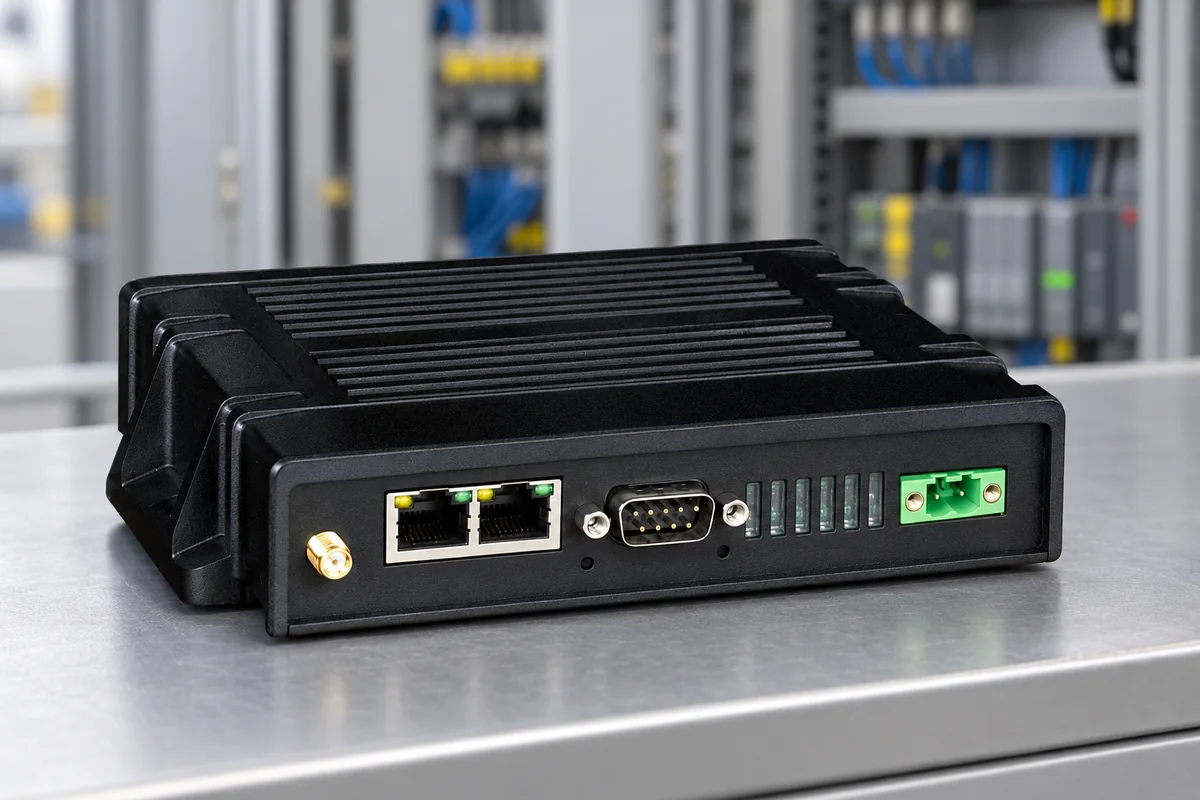
Industrial cellular routers · LTE category and bands, dual SIM failover, Ethernet and serial ports, VPN and OT protocols, DC input and power draw, temperature, IP rating, EMC and railway approvals
An industrial automation router is a DIN-rail or wall-mounted network router, built around a processor with cellular (LTE/5G) modem, Ethernet and serial interfaces, VPN and firewall software and a wide-range DC power stage in a metal fanless housing, that connects PLCs, meters and field devices to remote networks and the cloud. Ask three things first: which cellular bands, SIM redundancy and ports it needs, which VPN, security and industrial protocols it must support, and what power, temperature, protection and approvals the site requires.
Industrial cellular and wired routers for automation, utilities, transport and IoT. Office and consumer routers, Ethernet switches, serial device servers and gateways sold without routing are outside this page.
CNFX editorial research · Sources checked October 12, 2026 · 4 sources
Moxa's OnCell G4302-LTE4-EU product specification lists an LTE Cat 4 cellular router for bands B1, B3, B7, B8, B20 and B28 with UMTS/HSPA fallback, two 10/100/1000BaseT(X) RJ45 ports, digital inputs and outputs, hardware-based secure boot, deep packet inspection and industrial protocols including Modbus TCP, DNP3, IEC 60870-5-104, IEC 61850 MMS and EtherNet/IP. [1]
InHand's IR302 specification lists LTE Cat 4/Cat 1 with 3G/2G fallback, dual SIM with automatic switching on signal thresholds, one WAN/LAN and one LAN 10/100 Mbps port, an RS-232 port for transparent serial (DTU) data, 802.11b/g/n Wi-Fi, VPN types including IPsec, GRE, L2TP, OpenVPN and WireGuard, and VRRP for redundancy. Its stated Wi-Fi throughput falls from 54 Mbps typical at a 72 Mbps negotiated rate to 14 Mbps with obstacles. [2]
Editorial calculation: the IR302's typical Wi-Fi throughput is about 75% of the negotiated rate at best (54 ÷ 72) and about 19% with obstacles (14 ÷ 72); size links on measured throughput, not on the radio's negotiated rate. [2]
Give the supplier the countries and operators (cellular bands), LTE category or 5G need, SIM redundancy, number and speed of Ethernet ports, serial ports, digital I/O, Wi-Fi, VPN types and central management, firewall and security requirements, industrial protocols, supply voltage and redundancy, temperature range, ingress protection, mounting, approvals (EMC, railway, hazardous area) and quantities.
02
Check power, environment, reliability and approvals
The OnCell G4302-LTE4-EU takes 12–48 V DC on redundant dual inputs, drawing 7.6 W typical and 0.96 A at 12 V maximum; it operates from −10 to 55 °C, stores from −40 to 85 °C, at 5–95% relative humidity, in a 610 g metal housing (IP40 with the SIM cover closed) on DIN rail. Approvals include EN 55032/35 and EN 61000-6-2/-6-4 for EMC, EN 50121-4 for railway, IECEx for hazardous locations, UL/EN 62368-1 safety and EN 18031-1 cybersecurity, with shock, vibration and freefall tests to IEC 60068-2; Moxa states an MTBF of 518,722 hours and a five-year warranty. [1]
The IR302 takes 9–36 V DC with reverse-polarity protection, is listed at 2–5 W typical power and under 10 W peak, operates from −35 to 70 °C (−40 to 75 °C extended) in an IP30 fanless metal housing about 100 × 30 × 100 mm, and mounts on DIN rail or wall. [2]
Editorial calculation: 0.96 A at 12 V is about 11.5 W, half again the 7.6 W typical, so size the DC supply on maximum current; an MTBF of 518,722 hours is a statistical failure rate (about 1 failure per 59 unit-years across a population), not a promised service life. [1]
Digi International's IX20 specification shows a router built around a replaceable plug-in LTE modem: Digi says its Digi CORE modem can be upgraded or replaced without replacing the router, with LTE Cat 4 options at 150 Mbps down and 50 Mbps up maximum and an LTE Cat M1/NB1 option at 300 kbps down and 375 kbps up (M1). It has two 10/100 Mbps RJ-45 ports, one RS-232 DB9 port, two Mini-SIM slots, 256 MB RAM and 256 MB flash, and takes 9–30 V DC at 1.0 A maximum with reverse-polarity protection. Listed power is 1.5 W with light traffic, 3.5 W at peak data transmission and 1.4 W in low-power mode. The PPS housing is IP30, 107 × 162 × 35 mm and 0.65 kg; operating range is −40 to 70 °C without Wi-Fi and −20 to 70 °C with Wi-Fi, storage −40 to 85 °C, at 5–95% non-condensing humidity, with a 1-year product warranty. [4]
Editorial calculation: 1.0 A at the 9 V bottom of the IX20's input range is 9 W, about 2.6 times its 3.5 W peak-transmission figure, so the input current rating rather than the typical power sets fuse and supply sizing; the IX20's Wi-Fi models give up 20 °C at the cold end (−20 °C against −40 °C), so state whether Wi-Fi is needed before fixing the temperature class. [4]
03
Budget power when the router also feeds PoE devices
Robustel's R2120 specification lists a dual-SIM 4G LTE router with five 10/100/1000 Mbps Ethernet ports, of which ETH1–ETH4 are IEEE 802.3af/at PoE power-sourcing ports at up to 30 W each, plus one RS-485 port (300–115,200 bps, ±8 kV air and ±4 kV contact ESD), two digital inputs and two outputs with 3.75 kV DC opto-isolation, and 802.11ac Wi-Fi. It takes 44–57 V DC with reverse-polarity and surge protection and draws 4.5 W idle and 12 W maximum with a data link at 48 V, both excluding PoE; total PoE budget depends on the power supply. [3]
Robustel gives total power as system 12 W plus the sum of PoE loads, and lists EMC tests to EN 55032 Class B and EN 61000-4-2/-3/-4/-5/-6 with surge at line-to-line level 3, and mechanical tests to IEC 60068-2-6, -2-27 and -2-64. [3] Compare this 48 V PoE design with the 12–48 V DC and 9–36 V DC routers described above. [1][2]
Editorial calculation: with all four ports at 30 W the load is 12 + 4 × 30 = 132 W, more than twice the 60 W recommended supply; that 60 W supply leaves 48 W for PoE after the 12 W system maximum.
R2120 point
Published value
PoE ports
ETH1–ETH4, 802.3af/at, up to 30 W per port
Input voltage
44–57 V DC
System power at 48 V
4.5 W idle; 12 W max (excluding PoE)
Recommended supply
48 V DC, 1.25 A (60 W)
Long cable note
For 100 m runs with 30 W per port, consider a 54 V DC supply
Environment
−20 to 70 °C operating; IP30; aluminium, 539 g; 49 × 105 × 143 mm
If the router will power cameras or radios, list each PoE load and cable length, and size the 48–54 V supply from the maker's total-power rule.
04
Compare what suppliers offer
Suppliers linked to this page list industrial routers; each card links to the page reviewed.
Listings include 4G and 5G industrial routers, IoT routers with RTU functions, OpenWrt routers and cellular modems.
05
Trace the router components
This is a functional reference built from the sources cited; it is not one maker's design.
Fill the specification fields with values for your site
An industrial router quotation needs values for your site. The table explains each field, gives published values where a reviewed source states them, and says what to obtain from the supplier.
Field
What it means and published values
Ask the supplier for
Data Throughput (Mbps)
LTE Cat 4; Wi-Fi 14–54 Mbps typical in one model. [2]
Explore company information and manufacturing capabilities, then discuss the scope of your project with a relevant supplier.
Share this page
Compiled and source-reviewed by the CNFX editorial team.
Published product pages show what a company offers, not tested performance. Confirm the legal seller, factory, approvals and scope for your order. How we source and review
· Page last updated 13 October 2026
Buyer questions
What supply voltage do industrial routers take?
The reviewed models take 12–48 V DC (Moxa OnCell G4302) and 9–36 V DC (InHand IR302). [1][2]
Does an industrial router keep working if one SIM fails?
InHand's IR302 supports dual SIM with automatic switching on signal thresholds. [2]
What does a router's MTBF mean?
Moxa states 518,722 hours for the G4302; MTBF is a statistical failure rate, not a guaranteed life (editorial note). [1]
How do I size the power supply for a PoE industrial router?
Robustel gives total power for its R2120 as 12 W for the system plus the sum of PoE loads; its recommended 48 V, 60 W supply leaves 48 W for PoE devices. [3]
Can the cellular modem in an industrial router be upgraded later?
On some models, yes: Digi states that the Digi CORE plug-in LTE modem in its IX20 can be upgraded or replaced without replacing the router, with Cat 4 and Cat M1/NB1 modem options. [4]
Sources and what still needs a direct check
Sources checked 2026-10-12. Moxa, InHand, Robustel and Digi publish specifications for their own routers; values for your router must come from the supplier's data sheet and certificates.