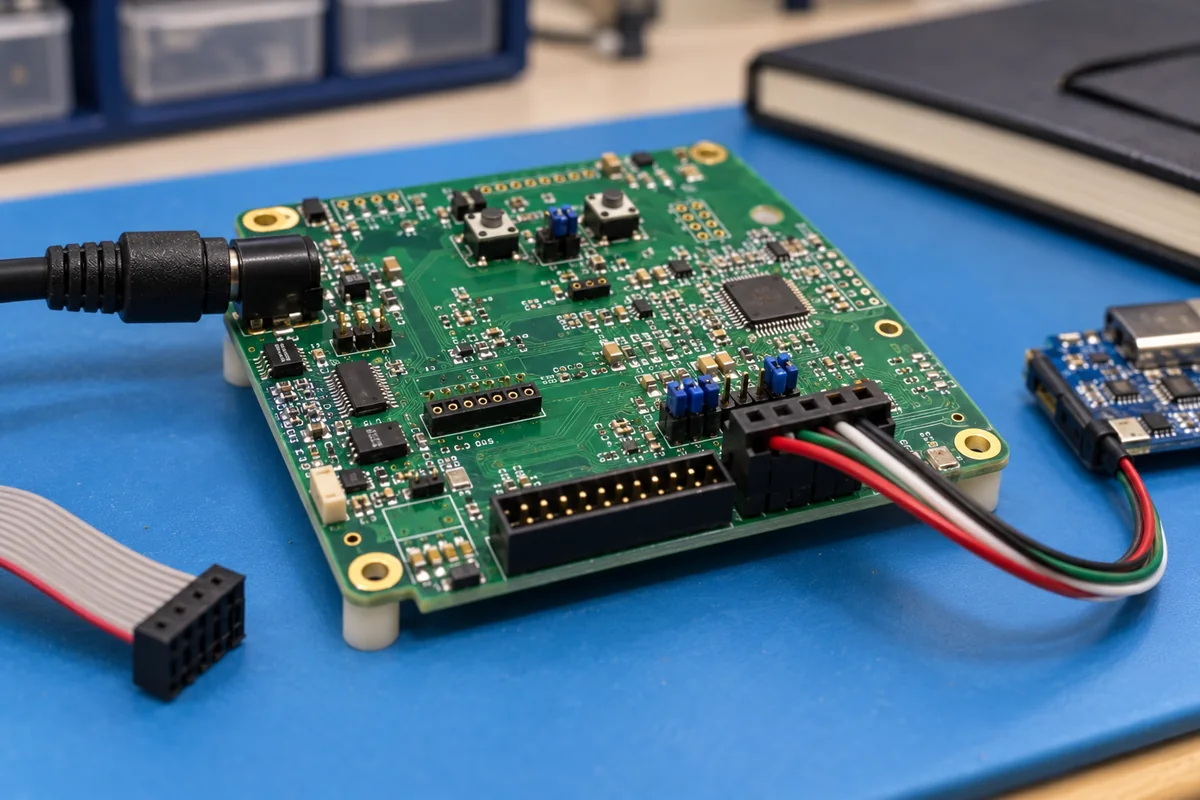
Frame-handler logic · CRC receive checking and result validity
A frame CRC checker calculates the check result for received data and exposes it to the frame handler. The interface must define which data belongs to the calculation and when the reported result is valid.
CRC checking hardware cores used within frame-handler receive paths, including the framed interface, result-valid indication and the distinction from a bare parallel-message checker. Application-specific integrated circuits (3590) covers custom chip design; Image signal processor core (3374), Debounce circuit (6480) and Multiplexer network (7488) perform different functions. Complete network MACs, software-only checksum libraries and memory-scanner peripherals are outside this page.
CNFX editorial research · Sources checked October 16, 2026 · 3 sources
A wider data bus does not select a wider CRC polynomial
Xilinx’s DS589 for Virtex-5 CRC Wizard v1.3 describes a LocalLink wrapper around the device’s integrated CRC block. It uses the CRC32 polynomial while allowing two 32-bit-input blocks to combine into a 64-bit-input block. The input-width naming describes how data enters the block; it does not change that stated polynomial to a 64-bit CRC. [1]
This is the documented Virtex-5 implementation in the dated specification. For a new core, identify the target device, tool version, polynomial, initialization and input/output transformation settings before comparing implementations.
02
Read the pass/fail indication only with its result-valid signal
UG189’s RX_CRC example passes received data between upstream and downstream LocalLink interfaces and adds CRC_PASS_FAIL_N and CRC_VALID. It states that the pass/fail signal is valid only when CRC_VALID is asserted HIGH. The interface also carries frame-start, frame-end and source/destination-ready signals. [2]
Partial final words need a version check. DS589 lists a variable REM feature. [1] UG189’s receive-interface table describes REM as the final valid-byte offset but also says its release assumes all data bytes are valid. [2] Confirm the behaviour of the delivered RTL with the provider, including non-full final words, before relying on either description.
03
A parallel checkout word is a different interface from a framed error flag
Lattice’s RD1105 reference design instead provides check_ena, a parallel data_crc_input containing message plus CRC, and a CRC-width crc_checkout word. Its documented default example uses an 8-bit message and 16-bit CRC with polynomial 0x8005; the checker timing example applies 0xAA03FC and shows checkout 0x0000. These values belong to that example and its settings. [3]
RD1105 also exposes input/output transpose and complement parameters. Match those settings and the input representation to the reference vectors. Its checkout-word interface does not itself specify the LocalLink framing and result-valid signals of the Xilinx example. [3]
Request the exact RTL or netlist version, interface timing, clock/reset requirements, algorithm settings, final-word rules and reference vectors. Include good and deliberately corrupted frames, interrupted transfers and the result-valid behaviour in the agreed verification scope.
04
Specify the algorithm together with the frame interface
Paste it into your enquiry below or into an email to a maker, then replace every bracket.
Explore company information and manufacturing capabilities, then discuss the scope of your project with a relevant supplier.
Share this page
Compiled and source-reviewed by the CNFX editorial team.
Each manufacturer above links to the page on that company's own website where the product is listed, with the date we checked it. How we source and review
· Page last updated 16 October 2026
Buyer questions
Does a 64-bit input datapath mean the core computes CRC-64?
Not in the cited DS589 example: it describes a 64-bit input arrangement while retaining the CRC32 polynomial. [1]
Can the receive pass/fail output be read on every clock?
UG189 states that CRC_PASS_FAIL_N is valid only when CRC_VALID is asserted HIGH. Follow the delivered core’s result-valid timing. [2]
Is a bare checkout-word module interchangeable with a framed receive checker?
RD1105 exposes message-plus-CRC input and a checkout word. The Xilinx RX_CRC example adds framed LocalLink interfaces and a qualified pass/fail indication; the integration interfaces differ. [3][2]
Sources and what still needs a direct check
Sources checked 2026-10-16. The dated Xilinx specification and user guide document a framed implementation and contain differing final-word statements. Lattice RD1105 supplies a separate parallel-checker example. These references describe interfaces and examples, not a claim of current tool or device availability.