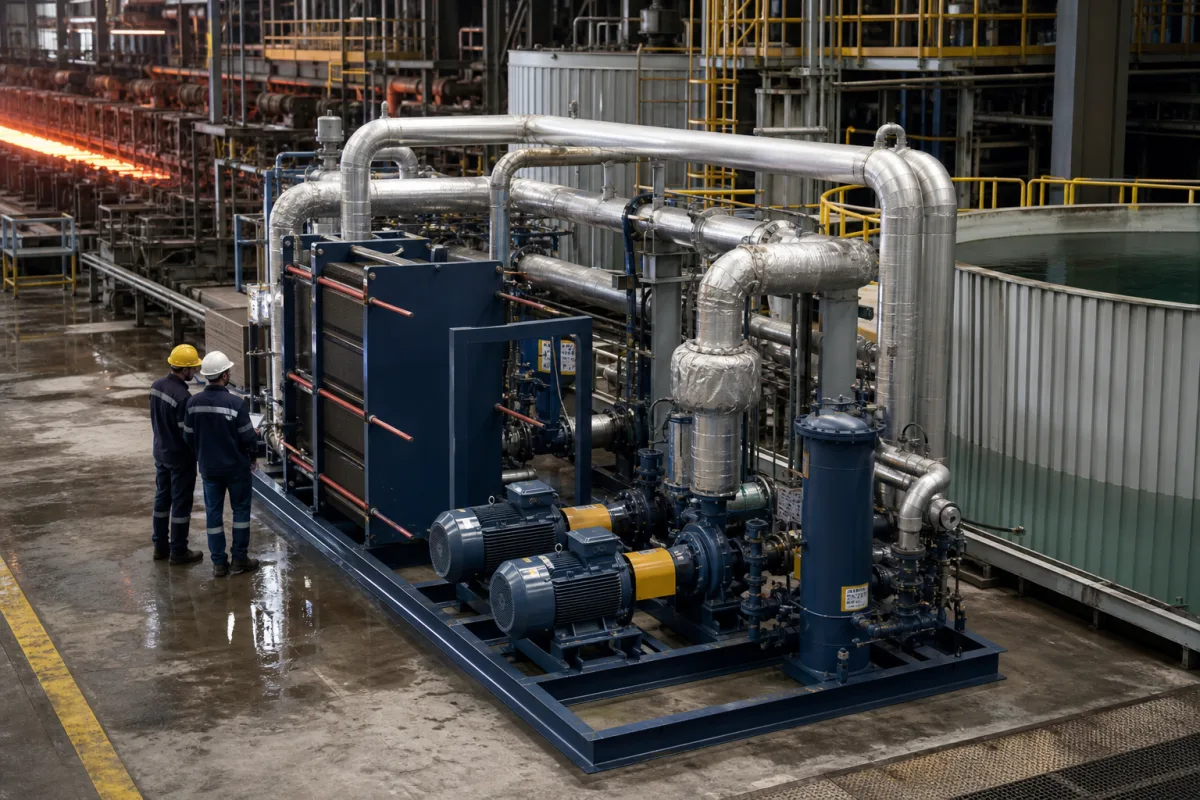
Closed-loop cooling water system with plate heat exchanger for steel plants
Plant cooling water · closed-loop circuits with plate heat exchangers and pumps, cooling towers, cycles of concentration
A closed-loop cooling water system circulates treated water through equipment such as furnace shells, moulds, rolls and drives, then gives up the heat through a plate heat exchanger to a second, open circuit such as a cooling tower circuit, without a refrigeration compressor. Ask three things first: how much heat each loop must carry and at what water temperatures, how the closed loop is separated from the open tower water, and how the tower water will be treated and blown down.
Non-refrigerated industrial cooling water systems for steel and metal plants: closed-loop circuits, pump and heat exchanger skids, plate heat exchangers, cooling tower circuits and their water treatment. Refrigerated chillers that supply water below ambient with a compressor are covered on the Process chiller page. Direct-contact spray cooling of the product and plant wastewater treatment are outside this page.
CNFX editorial research · Sources checked October 12, 2026 · 3 sources
Separate the closed loop from the open tower water
In a review of US iron and steel water use, Oak Ridge National Laboratory reports that once-through cooling has historically accounted for about 82% of total plant water use (80% for blast furnace–basic oxygen furnace plants and 93% for electric arc furnace plants), and that open-recirculating cooling towers and closed-recirculating systems are deployed to reduce water consumption. It states that melting, rolling and casting processes deploy closed-loop recirculating systems for indirect cooling of equipment, and counts heat exchangers, furnace shells and closed-loop cooling for finishing skids as non-contact water uses. [1]
The plate heat exchanger is the boundary between the two loops. Kelvion describes its gasketed plate heat exchanger range as covering connection sizes from DN25 to DN500 (1 to 20 inches), with plate materials including titanium-palladium and alloys such as C-276 and 254 SMO; its product filter lists design pressures up to 29 bar for the NT series, 31 bar for NX and 33 bar for NP, and up to 64 bar(g) on the welded side of its semi-welded HPL series. [3]
Editorial note: choose the plate material for the dirtier, more corrosive side, which is the open tower water, and ask for the approach temperature between the closed-loop outlet and the tower water inlet, since it sets how cool the closed loop can run on a hot day.
Give the supplier each consumer's heat load and required supply temperature, the closed-loop flow and return temperature, available tower water temperature and quality, pressure limits, standby pump requirement, plate material, and the space for the skid.
02
Manage the cooling tower water: cycles and blowdown
The US Department of Energy's Federal Energy Management Program explains that water leaves a cooling tower by evaporation, drift and blowdown, so make-up equals evaporation plus blowdown plus drift, and that cycles of concentration, the ratio of dissolved solids in blowdown to make-up, is a key operating parameter. [2]
FEMP states that systems operate at two to four cycles while six or more may be possible, and that increasing cycles from three to six reduces make-up water by 20% and blowdown by 50%. It recommends a conductivity controller to control blowdown automatically, set with a water treatment specialist. [2] Editorial calculation: ignoring drift, make-up ≈ evaporation × cycles ÷ (cycles − 1); at 100 m³/h evaporation that is 150 m³/h at three cycles and 120 m³/h at six, a 20% reduction, consistent with FEMP's figure.
ORNL lists drift eliminators, conductivity-controlled water supply, and variable frequency drives on tower fans and pumps among water efficiency measures reported for steel plants. [1]
03
Build the pump and exchanger skid
Editorial note: the sources reviewed describe the exchanger and the tower water in detail but not a standard skid, so define the skid contents in the enquiry: pumps and standby, exchanger, filters, expansion and make-up, instruments and controls. [3][2]
Kelvion describes gasketed exchangers as tailor-made for small to very large flows and lists gasket materials chosen for temperature, chemical resistance or food approval. [3] Editorial note: ask the supplier for pump curves at the design flow, the pressure drop across the exchanger and filters, the strainer mesh, and the corrosion inhibitor and biocide programme for both loops.
04
Chiller or non-refrigerated loop, skid contents and exchanger sizing to confirm per quote
Ask each supplier whether the quote is a refrigerated chiller or a non-refrigerated closed loop, which items are in the skid, and how the exchanger was sized.
05
Closed loop, plate exchanger, pumps, cooling tower, blowdown control and filters
Heat load, loop flows, exchanger design pressure and plate material for a steel-plant cooling loop
Heat load and supply and return temperatures come from your consumers; the published values here are exchanger limits from one Kelvion series, such as design pressure up to 29 bar. [3]
Field
What it means and published values
Ask the supplier for
Cooling Capacity (kW)
Heat removed from all consumers.
Duty per loop and total.
Flow Rate (m³/h)
Closed-loop and tower flows; exchangers span DN25–DN500 connections. [3]
Design flows.
Operating Pressure (MPa)
Exchanger design pressure, e.g. up to 29 bar (2.9 MPa) for one series. [3]
Design and test pressure.
Inlet Temperature (°C)
Water entering consumers.
Supply temperature.
Outlet Temperature (°C)
Water returning from consumers.
Return temperature.
Temperature Control Accuracy (°C)
How tightly supply is held.
Control method and band.
Power Supply (V AC)
Pumps, fans, controls.
Voltage and frequency.
Power Consumption (kW)
Pumps and tower fans; VFDs listed as a measure. [1]
Installed and running power.
Noise Level (dB(A))
Pumps and tower fans.
Measured value and distance.
IP Rating
Motors and panels.
Rating.
Material
Plates, e.g. titanium-palladium, C-276, 254 SMO. [3]
Plate, gasket, pipe materials.
Weight (kg)
Skid operating weight.
Dry and wet weight.
07
Send the heat load, water and layout data together
Paste it into your enquiry below or into an email to a maker, then replace every bracket.
Consumers: [equipment; heat load; supply temperature each]
Closed loop: [flow; supply and return temperature; water treatment]
Tower water: [temperature; quality; cycles target]
Exchanger: [approach; plate and gasket material; design pressure]
Pumps: [duty and standby; head]
Controls: [instruments; conductivity blowdown]
Layout: [skid size; connections]
12 companies list this product among what they make. Company figures are quoted from each
company's own website; every card states where the relationship came from.
TopChiller
Manufacturing site to be confirmed for the order
Lists industrial cooling systems, including chillers, cooling towers and plate and shell-and-tube heat exchangers.
Explore company information and manufacturing capabilities, then discuss the scope of your project with a relevant supplier.
Share this page
Compiled and source-reviewed by the CNFX editorial team.
Each manufacturer above links to the page on that company's own website where the product is listed, with the date we checked it. How we source and review
· Page last updated 13 October 2026
Buyer questions
How is this different from a chiller?
This page covers non-refrigerated closed loops that reject heat through a plate heat exchanger to cooling tower water; ORNL notes that melting, rolling and casting processes deploy closed-loop recirculating systems for indirect cooling. [1]
How much water does raising cycles of concentration save?
FEMP states that going from three to six cycles cuts make-up water by 20% and blowdown by 50%. [2]
What plate materials are available for the exchanger?
Kelvion lists titanium-palladium and alloys such as C-276 and 254 SMO among plate materials. [3]
Sources and what still needs a direct check
Sources checked 2026-10-12. ORNL's review is a peer-reviewed article in Water Resources and Industry; FEMP is a US Department of Energy programme; Kelvion is a heat exchanger maker describing its range. Figures are for the systems and products named.