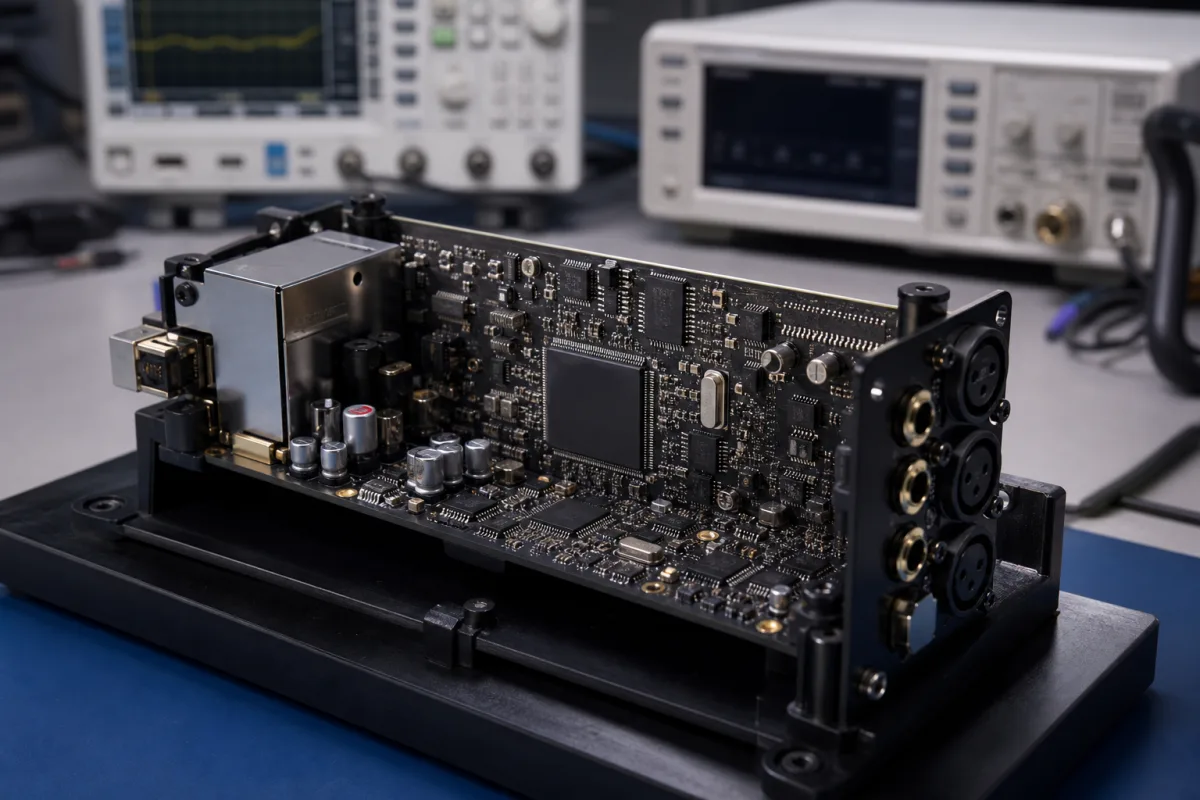
Audio DSP modules · Processing capacity per sample, data path and accumulator width, ADC and DAC range, delay memory, interfaces and programming
A digital audio signal processor module is a board built around an audio DSP chip, with analogue-to-digital and digital-to-analogue converters and digital audio interfaces, that applies equalisation, crossovers, delay, mixing and dynamics to audio signals for loudspeakers, installations and consumer products. Ask three things first: how much processing and memory it has at your sampling rate, what dynamic range its converters achieve, and how it is programmed, controlled and connected.
Audio DSP boards and modules, speaker management and matrix processors, and DSP chips with integrated converters for consumer and professional audio. Power amplifiers without DSP, pure analogue mixers and software-only processing are outside this page.
CNFX editorial research · Sources checked October 12, 2026 · 4 sources
Texas Instruments' TAS3204 datasheet describes an audio system-on-chip with a fully programmable 135 MHz digital audio processor, a 48-bit data path with a 76-bit accumulator, a single-cycle 28 × 48 multiplier and five simultaneous operations per clock cycle. Usable memory is 768 words of 48-bit data RAM, 1k words of 28-bit coefficient RAM, 2.5k words of program RAM, and 5.8k words of 24-bit delay memory, 122 ms at 48 kHz. [1]
The datasheet lists processing functions such as speaker equalisation and crossover, volume, bass and treble, mixing and splitting, delay compensation and dynamic range compression, with matrix decoding, stereo widening and virtual surround available as algorithms, and an embedded 8051 microprocessor for system control. [1]
Analog Devices' ADAU1701 SigmaDSP, a comparable single-chip audio system, lists a 28-/56-bit, 50 MIPS audio processor with a 28 × 28-bit multiplier and 56-bit accumulator for double-precision processing. Its processing blocks include equalisation, crossover, bass enhancement, multiband dynamics, delay compensation, speaker compensation and stereo image widening, configured graphically in SigmaStudio. Programs can self-boot from a serial EEPROM or be loaded by an external microcontroller, and parameters can be written back to the EEPROM at power-down. [2]
Editorial calculation: at 135 MHz and 48 kHz the core has about 135,000,000 ÷ 48,000 ≈ 2,800 clock cycles per sample; 122 ms of delay at an assumed 343 m/s speed of sound aligns loudspeakers up to about 42 m apart. Ask module suppliers how much of the processing and delay their default program already uses. [1]
Give the supplier the number of input and output channels, analogue and digital interfaces, sampling rate, processing blocks needed (EQ bands, crossovers, delay, dynamics, mixing), delay length, latency target, control (USB, Ethernet, RS-485, presets), software, power supply, connectors and housing.
02
Check converters, interfaces and programming
The TAS3204 integrates two 3:1 stereo analogue input multiplexers, four differential ADCs, for which the datasheet lists 102 dB dynamic range, and four differential DACs, listed at 105 dB, plus two synchronous serial audio inputs and two outputs (four channels each way) in 16-, 20- or 24-bit left-justified, right-justified or I2S formats. Sampling is 44.1 or 48 kHz in slave mode and 48 kHz in master mode, from a single 3.3 V supply with integrated regulators. [1]
It is programmed with TI's graphical drag-and-drop PurePath Studio environment, and code can be loaded over two I2C ports in slave or master mode. [1]
The ADAU1701 has two ADCs (100 dB SNR, −83 dB THD+N) and four DACs (104 dB SNR, −90 dB THD+N), an auxiliary ADC with a 4-input mux for analogue controls, and GPIOs. Its serial ports support I²S-compatible, left-justified, right-justified and TDM modes at sampling rates up to 192 kHz. A PLL generates the master clock from 64, 256, 384 or 512 × fS clocks, and it comes in a 48-lead LQFP. [2]
The I²S format named by both chips is defined in NXP's I²S bus specification: a continuous serial clock (SCK), word select (WS, 0 = left, 1 = right) and serial data (SD) sent in two's complement, MSB first, with WS changing one clock period before the MSB. [3]
Editorial note: a module's measured dynamic range also depends on its board layout, supply and analogue stages; ask for measured input-to-output dynamic range and THD+N of the finished module, not only the chip figures.
03
Matrices, speaker processors and DSP boards on supplier sites
Listings include digital audio matrices, speaker management processors, mini DSP boards, DSP amplifiers and networked audio interfaces.
04
Compare converter figures on the same metric and conditions
Cirrus Logic's product page for the CS47L63, a low-power audio DSP for earbud headphones and other portable audio devices, lists five converter figures for one chip: 120 dB SNR for headphone playback, 108 dB DAC dynamic range, −93 dB DAC THD+N, 99 dB SNR for a microphone input at 48 kHz and −87 dB ADC THD+N. It combines a programmable Halo Core DSP with fixed-function audio processors and sample-rate converters, takes up to four analogue or four PDM digital inputs, drives one DAC with a differential headphone output, and has two digital audio serial ports with multichannel operation at sample rates up to 192 kHz. [4]
Control is over I2C or SPI, power comes from 1.8 V and 1.2 V supplies, sleep current is 10 µA, and it comes in a 61-ball WLCSP with up to 12 GPIO pins. [4]
Editorial note: the same page gives 120 dB SNR for headphone playback and 108 dB for DAC dynamic range, a 12 dB gap (Editorial calculation: 120 − 108), so compare modules only on the same metric, weighting, sample rate and output, and ask each supplier for the measurement conditions behind every dB figure it quotes. [4]
05
Blocks inside an audio DSP module, from DSP core to clocking
1 company lists this product among what they make. Company figures are quoted from each
company's own website; every card states where the relationship came from.
Shenzhen FHB Audio Technology Co., Ltd.
Manufacturing site to be confirmed for the order
Lists digital audio matrices, speaker management processors, mini DSP boards and Dante audio products.
Explore company information and manufacturing capabilities, then discuss the scope of your project with a relevant supplier.
Share this page
Compiled and source-reviewed by the CNFX editorial team.
Each manufacturer above links to the page on that company's own website where the product is listed, with the date we checked it. How we source and review
· Page last updated 13 October 2026
Buyer questions
How much delay can an audio DSP provide?
TI's TAS3204 offers 122 ms at 48 kHz from 5.8k words of 24-bit delay memory. [1]
Why does accumulator width matter?
TI states the TAS3204's 76-bit accumulator keeps the precision needed for quality audio during arithmetic. [1]
What converter quality do integrated audio DSPs offer?
The TAS3204 datasheet lists 102 dB DNR for its ADCs and 105 dB for its DACs. [1]
How is an audio DSP chip programmed?
With a graphical tool: TI's TAS3204 uses PurePath Studio and ADI's ADAU1701 uses SigmaStudio; the ADAU1701 can self-boot its program from a serial EEPROM. [1][2]
Why do audio DSP chips quote different dB figures?
Cirrus Logic's CS47L63 page lists 120 dB SNR for headphone playback but 108 dB DAC dynamic range; ask suppliers which metric and conditions each figure uses. [4]
Sources and what still needs a direct check
Sources checked 2026-10-12. Datasheets from Texas Instruments (TAS3204) and Analog Devices (ADAU1701, read from an Internet Archive copy) describe audio DSP chips, and NXP's I²S bus specification defines the serial audio format; module performance depends on the board design, firmware and analogue stages.