Editorial Technical Reference

Automated Surface Mount Technology (SMT) Pick-and-Place Machine

This page explains how Automated Surface Mount Technology (SMT) Pick-and-Place Machine is classified within Manufacture of Consumer Electronics. Technical values and manufacturer relationships are research references; confirm the current specification and supplier evidence for each order.

Technical Definition & Core Assembly

Industrial machine for high-speed, precise placement of electronic components onto printed circuit boards.

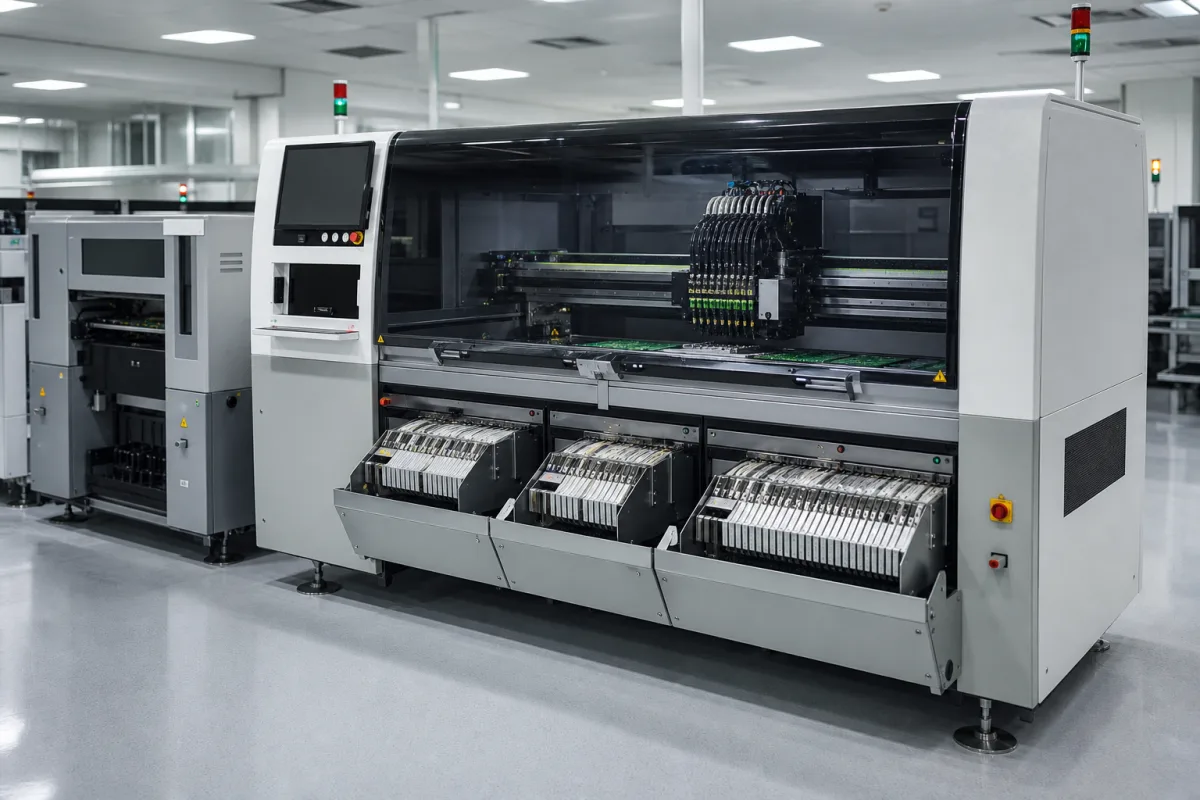
Representative product image. Confirm appearance and specifications with the manufacturer.

Product Specifications

Technical details and manufacturing context for Automated Surface Mount Technology (SMT) Pick-and-Place Machine

Definition
An Automated Surface Mount Technology (SMT) Pick-and-Place Machine is a core piece of capital equipment in consumer electronics manufacturing lines. It automates the precise placement of surface-mount devices (SMDs) like resistors, capacitors, and integrated circuits onto printed circuit boards (PCBs) prior to soldering. This machine is critical for achieving the high-volume, miniaturized assembly required for modern televisions, audio equipment, and home entertainment devices. Its speed and accuracy directly impact production throughput, yield rates, and the final quality of the assembled electronic product.

Typical specifications for such machines include a placement speed of 30,000 to 80,000 components per hour (CPH), placement accuracy of ±0.03 to ±0.05 mm at 3 sigma for chip components, and support for up to 80–160 8mm tape feeder slots. The maximum PCB size handled is 510×460 mm, and component size range spans from 01005 to 50×50 mm. The machine typically features 2–4 vision cameras for fiducial recognition, component verification, and post-placement inspection. Operating pressure should be 0.5–0.7 MPa (per ISO 8573-1), power supply is 220/380 V AC, and power consumption ranges from 2.5 to 4.5 kW. Operating temperature and humidity are 15–35°C and 30–70% RH, respectively. Ingress protection is rated IP54–IP65, machine weight is 1200–2500 kg, and footprint dimensions are approximately 1500×1800×1600 to 2000×2200×1800 mm.

These values are reference ranges for directory purposes; actual specifications must be confirmed with the legal manufacturer or supplier for the specific model and application. The machine's construction typically uses high-strength aluminum alloy for the frame, precision steel for guide rails and shafts, and engineering plastics for feeders and nozzles. Always verify model-specific parameters and standards with the manufacturer before procurement.
Working Principle
The machine uses a vision system to identify PCB fiducial marks and component feeders. A robotic placement head, equipped with nozzles, picks components from tape reels, trays, or sticks, verifies them via onboard cameras, and precisely places them onto pre-applied solder paste on the PCB according to programmed coordinates. The process involves continuous coordination between the vision system, motion control, and placement head to achieve high speed and accuracy.
Common Materials
High-Strength Aluminum Alloy (frame), Precision Steel (guide rails & shafts), Engineering Plastics (feeders & nozzles)
Technical Parameters
ParameterTypical rangeNotes & selection driver
Placement SpeedRequired30000–80000 CPHMaximum theoretical components placed per hour
Placement AccuracyRequired±0.03–±0.05 µmAccuracy at 3 sigma (99.7%) for chip components (e.g., 0201)
Number of FeedersRequired80–160 slotsMaximum number of 8mm tape feeder slots supported
PCB Size (Max)Required510×460 mmMaximum length (L) x width (W) of PCB that can be processed
Component Size RangeRequired01005–50×50 mmMinimum and maximum component dimensions (L x W) handled
Vision Cameras2–4 unitsNumber of onboard cameras (fiducial, component, post-placement)
Operating Pressure0.5–0.7 MPaBelow 0.5 MPa may cause insufficient vacuum for nozzles.
Power Supply220/380 V ACThree-phase required for high-power models.
Power Consumption2.5–4.5 kWHigher power for more feeders and cameras.
Operating Temperature15–35 °COutside range may affect accuracy and reliability.
Operating Humidity30–70 %RHHigh humidity can cause condensation and corrosion.
Ingress ProtectionIP54–IP65Higher IP for dusty or humid environments.IEC 60529
Machine Weight1200–2500 kgHeavier machines offer better stability.
Footprint (L×W×H)1500×1800×1600–2000×2200×1800 mmEnsure adequate floor space and clearance.

Ranges are indicative industry figures for RFQ preparation, not a supplier commitment. Confirm every value and standard with the legal manufacturer before ordering.

Components / BOM
  • Placement Head
    Holds nozzles, picks components from feeders, and places them on the PCB.
    Material: Aluminum alloy with ceramic nozzles
  • XY Gantry System
    Provides high-speed, precise linear motion for positioning the placement head over the PCB.
    Material: Precision steel rails with linear motors
  • Vision System
    Identifies PCB fiducials, verifies component pickup, and inspects placement accuracy.
    Material: Industrial cameras with LED lighting
  • Feeder Base
    Holds and presents tape reels, trays, or stick magazines containing components to the placement head.
    Material: Steel frame with plastic feeder units
  • Conveyor System
    Transports PCBs into, through, and out of the machine's work area.
    Material: Aluminum frame with belt or rail guides

Industry Taxonomies & Aliases

Commonly used trade names and technical identifiers for Automated Surface Mount Technology (SMT) Pick-and-Place Machine.

Industrial Ecosystem & Supply Chain Structure

Complementary Systems
Downstream Applications
Specialized Tooling

Application Fit & Sizing Matrix

Operational Limits
pressure: 0.4-0.6 MPa (pneumatic system)
board size: 50x50 mm to 510x460 mm
temperature: 15-30°C (operating environment)
component range: 0201 metric to 55x55 mm
placement speed: Up to 100,000 components/hour
placement accuracy: ±0.025 mm
Media Compatibility
✓ SMD resistors/capacitors ✓ QFP/BGA IC packages ✓ LED components
Unsuitable: High-vibration environments without isolation
Sizing Data Required
  • Maximum components per hour (CPH) requirement
  • PCB panel dimensions and thickness
  • Smallest component size to be placed

Reliability & Engineering Risk Analysis

Failure Mode & Root Cause
Nozzle Clogging
Cause: Accumulation of solder paste residue, dust, or debris on pick-and-place nozzles, often due to inadequate cleaning protocols or contaminated materials.
Misalignment or Placement Inaccuracy
Cause: Wear or misalignment of linear guides, ball screws, or vision system calibration drift, typically from mechanical fatigue, vibration, or thermal expansion.
Maintenance Indicators
  • Audible grinding or clicking noises from the pick-and-place head during operation, indicating mechanical wear or obstruction.
  • Visual misalignment of components on PCBs, such as skewed placements or repeated placement errors detected by the vision system.
Engineering Tips
  • Implement a strict preventive maintenance schedule for cleaning and inspecting nozzles, feeders, and vision systems, using manufacturer-recommended solvents and tools.
  • Regularly calibrate the machine's vision system and mechanical axes, and monitor environmental conditions (temperature, humidity) to minimize thermal and vibrational drift.

Indicative industry ranges for design and RFQ preparation. Confirm the exact figures and applicable standard with the manufacturer before specifying.

Compliance & Manufacturing Standards

Applicable Standards
CE Marking (Machinery Directive 2006/42/EC) IPC-A-610 Acceptability of Electronic Assemblies

Quoted from the published standard.

Manufacturing Precision
  • Component Placement Accuracy: +/-0.05mm
  • Repeatability: +/-0.01mm
Quality Inspection
  • Vision System Calibration Test
  • Pick-and-Place Accuracy Verification Test

Manufacturers of Automated Surface Mount Technology (SMT) Pick-and-Place Machine

1 company lists this product among what they make. Company figures are quoted from each company's own website; every card states where the relationship came from.

TYtech
Shenzhen, Guangdong, CN
Also makes: Solenoid Valve, Reflow Oven, SMT Stencil and 2 more
Listed on the company's own website · profile compiled by CNFX from public sources

Manufacturer listings support early research and capability understanding. They are not certification, ranking, or transaction guarantees.

Technical documentation
Request current drawings, revision history, and a signed specification sheet.
Manufacturing capability
Verify equipment lists, process limits, capacity, and representative production evidence.
Inspection readiness
Confirm test methods, calibrated equipment, sampling plans, and traceable reports.
Supplier transparency
Check the legal entity, factory address, ownership, certifications, and direct contacts.

CNFX does not score or rank suppliers. Buyers must verify all claims and documents with the legal manufacturer before ordering.

Frequently Asked Questions

What is the placement speed range for this type of machine?

The placement speed is typically 30,000 to 80,000 components per hour (CPH), depending on the model and component mix. This is a theoretical maximum; actual throughput may vary based on PCB complexity and feeder setup.

What accuracy can be expected?

Placement accuracy is typically ±0.03 to ±0.05 mm at 3 sigma for chip components such as 0201. This ensures precise placement for high-density boards.

What are the operating environment requirements?

The machine operates in temperatures of 15–35°C and humidity of 30–70% RH. Operating pressure should be 0.5–0.7 MPa (ISO 8573-1). Power supply is 220/380 V AC, with power consumption of 2.5–4.5 kW.

How should I verify specifications for a specific model?

Always confirm model-specific values, such as placement speed, accuracy, feeder capacity, and environmental limits, with the legal manufacturer or supplier. The values listed are reference ranges for directory purposes.

Data Basis

Editorial classification, named public sources where available, and source-reviewed manufacturer records.

Preliminary Technical Classification
This page supports structured research, RFQ preparation, and supplier evaluation. It does not replace buyer-led supplier qualification, standards review, or technical approval.
Buyer enquiry

Request manufacturing insight for Automated Surface Mount Technology (SMT) Pick-and-Place Machine

Ask for use case, specification boundaries, supplier type, and RFQ preparation information for this product.

Where it goes
Straight to the CNFX editorial desk, and to the manufacturer if this product is linked to a claimed profile. Nothing is broadcast to a supplier list.
Your details stay here
We do not sell or rent enquiry data, and we do not add you to a mailing list. Used only to answer this request.
No commission, no middleman
CNFX is a directory. We take no cut of any order and never negotiate on a supplier's behalf.
What we don't claim
A listing is not an endorsement. Qualify every supplier and verify every figure yourself before ordering.

Your business information is used only to process this request.

Thank you! Your message has been sent. We'll respond within 1–3 business days.
Sorry, we couldn't send your message. Please try again, or email us at contact@cnfx.com.

Need to Manufacture Automated Surface Mount Technology (SMT) Pick-and-Place Machine?

Compare manufacturer profiles with relevant product and process capability.

Previous Product
Automated Conformal Coating Application System
Next Product
Digital Audio Signal Processor Module
Get QuotesChat