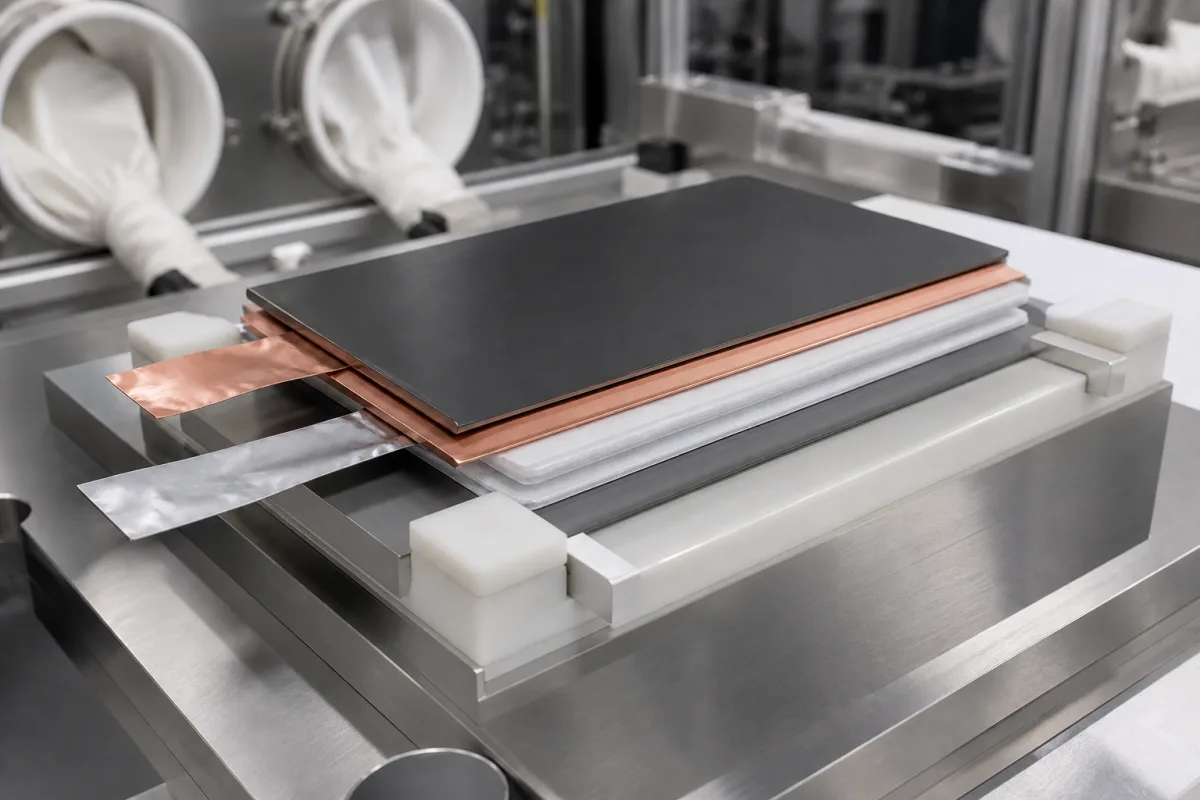
Electrode assembly (the cathode, solid electrolyte and anode stack of a sulfide solid-state cell, and where it can be built)
Building the electrode stack of a sulfide solid-state cell · composite cathode, solid electrolyte layer and anode with copper and aluminium tabs, glovebox below 1 ppm water against dry rooms near -40 °C dew point, H2S release, conductivity loss, and slurry handling
A solid-state cell replaces the liquid electrolyte and separator with a solid layer pressed between a composite cathode and an anode, each on its own current collector. With sulfide electrolytes, the layers react with moisture: they release hydrogen sulfide and lose ionic conductivity. Whether the stack must be built in a glovebox or can be built in a battery dry room, and in what form the electrolyte is handled, are the first things to specify.
Electrode stacks (composite cathode, solid electrolyte layer, anode and current collectors) of sulfide-based solid-state cells and the atmosphere and handling they need during assembly. Lithium-ion battery packs are covered on the Lithium battery pack page; electrode stacking machines for liquid-electrolyte cells on the Electrode stacking machine for lithium-ion cells page; liquid electrolyte additives on the Lithium-ion battery electrolyte additives page; electrode calendering on the Battery electrode calendering machine page.
CNFX editorial research · Sources checked October 12, 2026 · 2 sources
Thomas Yersak and Mei Cai (General Motors) with Yubin Zhang and Fang Hao (Optimal) note that "Lab-scale research typically utilizes gloveboxes with <1 ppm water, however, the large-scale manufacturing of Li-ion batteries occurs in −40°C dewpoint dry rooms with around 126 ppm water." Elsewhere in the same paper they give a -40 °C dew point as 127 ppm H2O and glovebox atmospheres as below 1 ppm (-80 °C dew point). [1]
The paper gives both 126 ppm and 127 ppm for a -40 °C dew point; the difference is small, but quote one value consistently when specifying the room. [1]
Yu-Ting Chen and co-authors at UC San Diego tested Li6PS5Cl (LPSCl) in a dry room "controlled to approximately 100 ppm" and found it "exhibit good stability in a dry room environment", with only minor conductivity loss from carbonate formation and no significant loss of performance in a half-cell; in ambient air, by contrast, hydrolysis caused irreversible sulfur loss. [2]
State the electrolyte family and composition, and ask the cell or equipment supplier which atmosphere (glovebox ppm, dry room dew point) each assembly step needs.
02
H2S release and conductivity loss: powder or slurry
Yersak and colleagues found that after 30 minutes at -40 °C dew point, (Li2S)75(P2S5)25 + 20 mol% LiI powder "generated 0.1 cc/g H 2S and its ionic conductivity decreased by over 50%", while the same material as a slurry in dodecane generated 0 cc/g H2S. They tested dry room moisture levels from -40 to -76 °C dew point and found conductivity loss "nonlinear with respect to H 2O concentration". [1]
For the dodecane slurry, the abstract says ionic conductivity "only dropped by 14%", while the body says the slurry "retained 95.3% of its pristine ionic conductivity"; these two figures do not agree, so confirm which applies before relying on either. [1]
Plan H2S monitoring and extraction at every step where sulfide electrolyte is exposed, and ask suppliers for H2S generation and conductivity retention data for the exact electrolyte, form (powder, slurry, sheet) and room condition.
03
Solid-state electrode stack details
Paste it into your enquiry below or into an email to a maker, then replace every bracket.
Explore company information and manufacturing capabilities, then discuss the scope of your project with a relevant supplier.
Share this page
Compiled and source-reviewed by the CNFX editorial team.
Each manufacturer above links to the page on that company's own website where the product is listed, with the date we checked it. How we source and review
· Page last updated 13 October 2026
Buyer questions
Can sulfide solid-state cells be built in a normal battery dry room?
UC San Diego researchers found Li6PS5Cl stable in a dry room near 100 ppm with only minor conductivity loss; other compositions behave differently. [2][1]
How much H2S can a sulfide electrolyte release?
One powder composition gave 0.1 cc/g H2S after 30 minutes at -40 °C dew point in the GM and Optimal study. [1]
Does handling as a slurry help?
In the same study a dodecane slurry generated no H2S and lost far less conductivity than the powder. [1]
What water level does a glovebox give?
Below 1 ppm water, about -80 °C dew point, according to Yersak et al. [1]
Sources and what still needs a direct check
Sources checked 2026-10-12. Frontiers in Energy Research published Yersak et al. on moisture stability of sulfide electrolytes; the NSF public access repository holds Chen et al. on dry room compatibility of Li6PS5Cl (J. Mater. Chem. A).