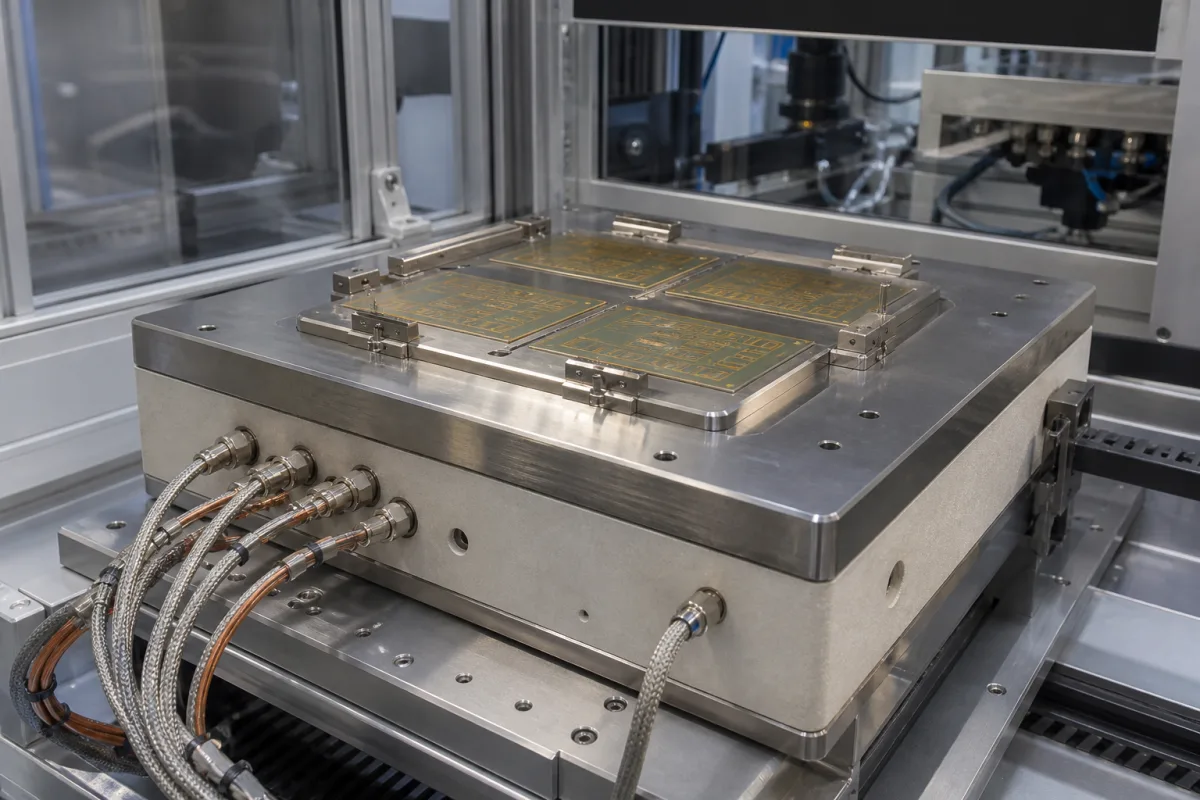
Heating stage for underfill and adhesive dispensing on PCB assemblies
Substrate heating stages in dispensing machines · contact vacuum, forced-air or IR heating of PCBs to 40–100 °C for capillary underfill
A heating stage in a dispensing machine is the heated platen, vacuum fixture or air-heated zone that brings a printed circuit board or substrate up to process temperature and holds it there while capillary underfill or adhesive is dispensed, so the fluid's viscosity drops and it wicks under the component. Ask three things first: what substrate temperature the underfill's data sheet calls for and where its cure starts, whether the board can be heated by contact on a vacuum fixture or needs forced air or IR, and how many heated zones (pre-heat, dispense, post-heat) the line needs to keep up with the dispense cycle.
Substrate heating stages, heated vacuum fixtures and heated zones built into underfill and adhesive dispensing systems for PCB and package assembly. Batch hot air ovens used for drying and final cure are covered on the Industrial hot air oven page. Microscope hot stages, melting-point stages and reflow ovens are outside this page.
CNFX editorial research · Sources checked October 12, 2026 · 3 sources
Set the stage between flow temperature and cure onset
A 2025 review of underfill reliability in Polymers describes capillary underfill being drawn under the component by capillary forces, with the assembly preheated to 70–100 °C to speed and even out the flow; for snap-cure materials, it adds, the preheat must stay below the onset of accelerated curing or the material gels before the gap is filled. Final cure then takes place in an oven at temperatures up to 160 °C. [1]
Material data sheets set narrower targets. AIM's Underfill 620, a capillary underfill for flip chip, CSP and BGA assemblies, asks for the substrate to be pre-heated to 40–50 °C, lists cure times of under 10 minutes at 100 °C, under 4 minutes at 125 °C and under 2 minutes at 150 °C, a viscosity of 30,000 cP at 25 °C, and needle height and offset from the chip edge of about 1–3 mils. [2] Editorial calculation: for this material, a stage run at 100 °C would sit at a listed cure condition, 50 °C above the top of the recommended preheat, so ask for the stage's control accuracy and uniformity at the setpoint, not only its maximum temperature.
GPD Global's capillary underfill process describes pre-heating from ambient to 80 °C, with post-heating dependent on the product. [3]
Give the supplier the underfill or adhesive and its data-sheet preheat and cure temperatures, the board or carrier size and thickness, component heights on the underside, the cycle time, the number of boards per fixture, and whether the line is inline or batch.
02
Heat by contact vacuum fixture, forced air or IR
GPD Global describes a custom contact vacuum fixture as giving the quickest and the evenest heat transfer of its pre-heating methods; forced air heats any substrate regardless of geometry or size but takes longer than contact heating; IR heating is also offered. Its systems carry 1, 2 or 3 heated substrate zones depending on configuration, heat substrates to up to 100 °C, and can monitor substrate temperature in the pre-heat zone, transferring the board to the work area once it reaches operating temperature. [3]
The same maker recommends inline systems for underfill because they can use pre- and post-heaters; the post-heater keeps the underfill flowing under larger devices before final cure. [3] Editorial note: a contact fixture has to clear the components on the underside of the board, so a double-sided board may need a pocketed fixture or air heating; send the underside drawing with the enquiry.
03
Zone layout and the numbers each source gives
Editorial note: in the process described by these sources the stage only has to reach the preheat setpoint, while final cure happens later in an oven. [1]
Explore company information and manufacturing capabilities, then discuss the scope of your project with a relevant supplier.
Share this page
Compiled and source-reviewed by the CNFX editorial team.
Each manufacturer above links to the page on that company's own website where the product is listed, with the date we checked it. How we source and review
· Page last updated 13 October 2026
Buyer questions
What temperature should a PCB be at for capillary underfill?
It depends on the material: one data sheet asks for 40–50 °C, and a 2025 review places the preheat at 70–100 °C, below the onset of accelerated cure. [2][1]
Is contact heating better than forced air for underfill?
GPD Global describes the contact vacuum fixture as the quickest and evenest method; forced air suits any substrate shape but heats more slowly. [3]
Does the heating stage cure the underfill?
No; the stage preheats for flow, and the review describes final cure in an oven at up to 160 °C. [1]
Sources and what still needs a direct check
Sources checked 2026-10-12. Process temperatures come from a peer-reviewed review in Polymers (MDPI, 2025) and AIM's Underfill 620 data sheet; heating methods and zone counts from GPD Global's capillary underfill process page.