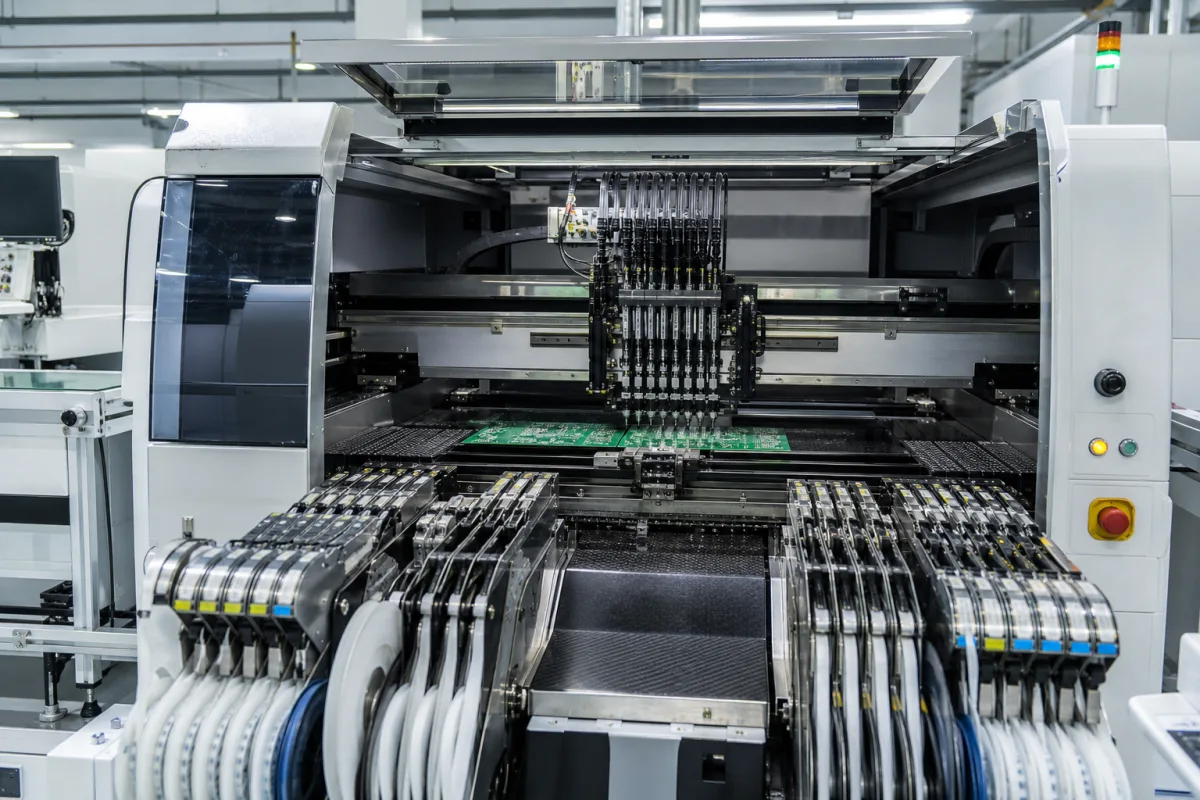
SMT pick-and-place machines · Placement rate and the conditions behind it, accuracy by part size, part range, feeder capacity, conveyor layout and in-line checks
An SMT pick-and-place machine picks surface-mount components from tape, tray or stick feeders, checks them, and places them on solder paste on a printed circuit board. Fix three things before ordering: the throughput you need, stated as components per hour under conditions close to your own boards; the accuracy and part range from your smallest chip to your largest odd-form part; and the feeder capacity, conveyor layout and in-line checks that suit your product mix.
Surface-mount placement machines (mounters) for printed circuit board assembly, single machines or modular lines. Solder paste printers, reflow ovens, inspection (SPI/AOI) machines, through-hole insertion machines and manual placement benches are outside this page; SMT stencils have their own page.
CNFX editorial research · Sources checked October 11, 2026 · 4 sources
Fuji's AIMEX III product page states that with H24S heads the machine places 03015 mm parts at ±0.025 mm accuracy, and that with two heads it reaches up to 80,000 components per hour (cph) in a productivity-priority configuration. With a DX head it covers parts from 0402 (01005") to 102 × 102 mm and glue application with one head, exchanging tools in one action as part size changes. [1]
The page describes a double conveyor that runs two models at once, making panel conveyance time effectively zero, and twin-robot configurations for a wider production scope; its example configurations pair a single robot and single conveyor for large panels with twin robots and double conveyors for simultaneous production of two models. [1]
Editorial note: a maximum cph figure is stated for a particular head, nozzle and part combination; ask the supplier to quote placement rate and accuracy for your own part list and board, at the same head configuration, and to state the accuracy basis (for example ±mm at a stated Cpk). [1]
Give the supplier your board sizes and thickness, part list with smallest and largest parts and counts per board, target boards per hour, product mix and changeovers per shift, feeder types (tape, tray, stick) and count, conveyor layout, required in-line checks, line integration (printer, SPI, reflow, AOI), floor space, power and air supply, software and data interfaces, and quantity.
02
Set feeder capacity, conveyors and in-line checks
The AIMEX III page lists up to 130 feeder slots so that all required parts can be loaded, batch changeover of feeder pallets, and nozzles that cover 0603, 1005, 1608 and 2125 metric parts in three sizes. Its Intelligent Part Sensor checks pick-up, parts left on the nozzle, tombstoned parts, part heights and upside-down leaded parts; an LCR unit checks inductors, capacitors and resistors before placement; a 3D check rejects parts with warped leads; and a laser measures panel warp so that placement is only performed on panels within tolerance. [1]
It also describes low-impact placement that uses the measured part height and panel warp to avoid pushing too far or placing above the panel, and automatic part-data creation and on-machine editing for new products. [1]
Editorial note: list which of these checks your quality plan requires as standard and which are options, because each adds sensors, cycle time or cost. [1]
03
Compare rates and accuracy on the IPC-9850 basis
IPC-9850A, Surface Mount Placement Equipment Characterization (November 2011, superseding IPC-9850 of July 2002), sets procedures for stating placement throughput and accuracy together, because the two depend on each other. Measurements are made by placing standardized components into sticky media on clear glass panels, using chip boards CB-B and CB-A and IC board IC-A, and reported on forms IPC-9850-F1 (machine performance), F2 (line summary) and F3 (measurement system capability). [2]
The standard's introduction says its test boards are less complex than real boards, so users will see different levels of derate on their own products, and recommends treating the IPC-9850 throughput rating as an initial comparison followed by evaluation on actual product. [2]
A Circuits Assembly article on the standard explains the maximum lead tip error (MLTE) and maximum ball-to-land error (MBTL) it uses, with required values for SOIC16, QFP100, QFP208 and BGA228 to give at least 50% (accuracy classes 1 and 2) or 75% (class 3) termination-to-land coverage. It states that a 100 µm, 4-sigma specification means placement within 100 µm at a Cpk of 1.33, with at most 63 ppm rejects, and that a Cpk of 2.0 corresponds to 0.002 ppm; it advises buyers to compare accuracy and defect rates at the IPC reference speed and to ask for rates on their own application. [3]
Editorial calculation: at 63 ppm per placement, a board with 500 placements has a chance of 1 − (1 − 0.000063)^500 ≈ 3.1% of carrying at least one placement outside the limit; at 80,000 cph, 500 placements take 500 / 80,000 × 3,600 = 22.5 seconds of placement time before conveyor and changeover time. [3][1]
Ask for the IPC-9850 rate and accuracy (with Cpk) for the head you are buying, the filled-in IPC-9850-F1 form, and a rate quoted on your own board.
04
Read rate and accuracy per head type, not per machine
Yamaha Motor's YRM20 specification shows how one machine's ratings change with the head fitted. The super high-speed rotary RM head (18 nozzles) handles parts from 0201 mm to 12 × 12 mm and up to 6.5 mm high at 115,000 CPH with two beams or 57,500 CPH with one; the in-line HM head (10 nozzles) handles 0201 mm to 55 × 100 mm and up to 15 mm high at 98,000 or 49,000 CPH; and the FM head for odd-shaped parts (5 nozzles) handles 03015 mm to 55 × 100 mm and up to 30 mm high at 35,000 or 17,500 CPH, all stated under optimum conditions. Accuracy in high-accuracy mode is ±0.025 mm or ±0.035 mm at Cpk ≥ 1.0 depending on the head. [4]
The same page lists up to 128 component types (32 feeders × 4, in 8 mm tape equivalents) on an exchangeable feeder carriage and up to 60 tray types with two eATS30 tray units; boards from 50 × 50 mm to 510 × 510 mm as standard and up to 810 × 510 mm as an option, with two boards up to 380 × 510 mm conveyed together on the dual stage; a 3-phase 200–416 V ±10 % supply; air at 0.45 MPa or more; external dimensions of 1,374 × 1,948 × 1,445 mm; and a main-unit weight of about 2,250 kg with two beams. [4]
Editorial calculation: Yamaha states accuracy at Cpk ≥ 1.0, a 3-sigma basis, while the Circuits Assembly article above uses a 4-sigma (Cpk 1.33) basis; for the same machine spread, ±0.025 mm at Cpk 1.0 corresponds to about ±0.025 × 4/3 ≈ ±0.033 mm at Cpk 1.33. At the RM head's 115,000 CPH, 500 placements take 500 / 115,000 × 3,600 ≈ 15.7 seconds, against 22.5 seconds at the 80,000 cph Fuji figure; both are best-case rates for their stated heads, so compare them only after converting to the same IPC-9850 basis. [4][3][1]
Placement rate, accuracy with Cpk, feeder slots and board size for a mounter order
Rate and accuracy only compare fairly when both are stated for the same head and on the same Cpk basis, which is why the first two rows point to IPC-9850. [2][3]
Field
What it means and published values
Ask the supplier for
Placement Speed
Up to 80,000 cph (two heads, productivity priority) [1]; compare on the IPC-9850 basis. [2]
Rate on your board.
Placement Accuracy
±0.025 mm for 03015 parts [1]; Cpk 1.33 at the limit allows up to 63 ppm rejects. [3]
2 companies list this product among what they make. Company figures are quoted from each
company's own website; every card states where the relationship came from.
Zhejiang NeoDen Technology Co., Ltd
Manufacturing site to be confirmed for the order
Its website lists “NeoDen9 Pick and Place Machine”.
Explore company information and manufacturing capabilities, then discuss the scope of your project with a relevant supplier.
Share this page
Compiled and source-reviewed by the CNFX editorial team.
Each manufacturer above links to the page on that company's own website where the product is listed, with the date we checked it. How we source and review
· Page last updated 13 October 2026
Buyer questions
How fast are SMT pick-and-place machines?
Fuji states up to 80,000 cph for its AIMEX III with two H24S heads in a productivity-priority setting. [1]
How accurate is component placement?
Fuji states ±0.025 mm for 03015 mm parts with H24S heads. [1]
How many feeders can a placement machine hold?
The AIMEX III page lists up to 130 feeder slots. [1]
What checks can a pick-and-place machine run before placing?
Fuji lists tombstone, part-height, upside-down, LCR, lead coplanarity and panel-warp checks. [1]
What is IPC-9850?
The IPC standard for characterizing surface mount placement equipment, which states throughput and accuracy together from placements on sticky media on glass test panels. [2]
What does a Cpk of 1.33 mean for placement accuracy?
Placement within the stated limit with at most 63 ppm rejects; a Cpk of 2.0 corresponds to 0.002 ppm. [3]
Why does one placement machine list more than one speed?
Rate depends on the head: Yamaha's YRM20 lists 115,000 CPH with its RM head, 98,000 with the HM head and 35,000 with the FM head for odd-shaped parts, each with two beams under optimum conditions. [4]
Sources and what still needs a direct check
Sources checked 2026-10-11. Fuji and Yamaha Motor publish capability and specification details for their AIMEX III and YRM20 placement machines; the IPC-9850A excerpt and a Circuits Assembly article explain how rate and accuracy are characterized.