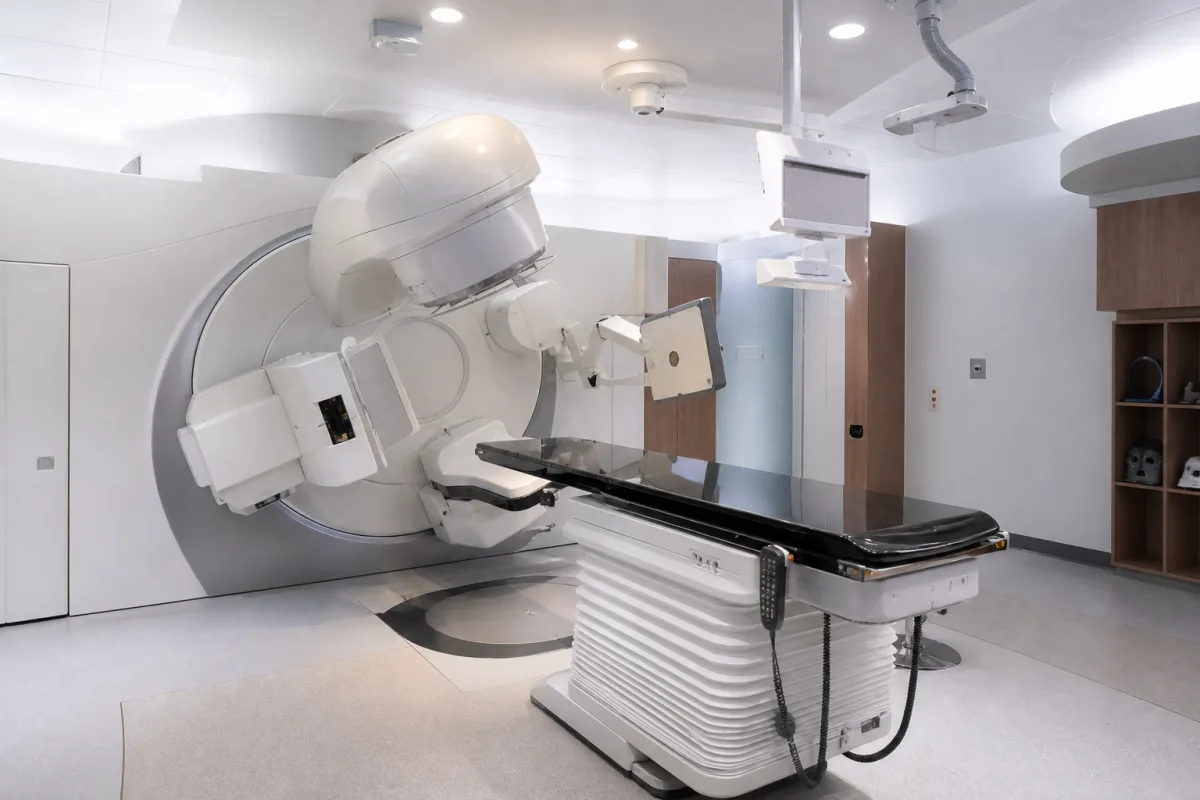
Medical linear accelerators · Photon and electron energies, S-band RF and waveguide configuration, MLC and imaging, IEC 60601-2-1 safety, FDA Class II, and the daily, monthly and annual QA action levels the physics team will apply
A medical linear accelerator (linac) is a radiotherapy machine that accelerates electrons in a microwave-powered waveguide and either uses them directly or strikes a target to produce megavoltage X-rays, shaped by jaws and a multileaf collimator and delivered from a rotating gantry to a patient on a treatment couch. Ask three things first: which photon and electron energies and treatment techniques the clinic needs, what beam shaping, imaging and dose-monitoring systems come with it, and what acceptance, commissioning and ongoing quality assurance the physics team will apply.
Medical electron linear accelerators for external-beam radiotherapy, with their treatment head, multileaf collimator, imaging and patient support. Cobalt-60 units, proton therapy systems, industrial linacs for radiography or sterilisation, and treatment planning software sold alone are outside this page.
CNFX editorial research · Sources checked October 12, 2026 · 4 sources
The IAEA handbook Radiation Oncology Physics (2005) describes medical linacs as accelerating electrons to kinetic energies of 4 to 25 MeV with microwave fields from about 10³ MHz (L band) to 10⁴ MHz (X band), “with the vast majority running at 2856 MHz (S band)”, with RF power from a magnetron or klystron. Some machines give only 4 or 6 MV X-rays, and the handbook states that “A typical modern high energy linac will provide two photon energies (6 and 18 MV) and several electron energies (e.g. 6, 9, 12, 16 and 22 MeV)”. [1]
It lists five main sections (gantry, gantry stand, modulator cabinet, patient support assembly and control console) and six beam-forming systems (injection, RF power generation, accelerating waveguide, auxiliary, beam transport, and collimation and monitoring). The accelerating waveguide is about 30 cm long at 4 MeV and about 150 cm at 25 MeV, so 4–6 MV machines can mount the gun and target in line with the isocentre while higher-energy machines need a bending beam transport system. [1]
It quotes IEC 60601-2-1 on the danger of failing to deliver the required dose or contain radiation, and says the standard addresses electrical, mechanical and radiation safety and “establishes specific requirements mainly for the manufacturers of linacs in the design and construction of linacs for use in radiotherapy”. In the US, 21 CFR 892.5050 classifies a medical charged-particle radiation therapy system as a Class II device. [1][2]
A 2026 study by Edmondson and colleagues (J Appl Clin Med Phys 27(9):e70802) compared two current machine designs using trajectory logs from fourteen clinical linacs between February 2025 and February 2026. A C-arm linac offered nominal maximum dose rates of 1,400 MU/min for 6 MV flattening-filter-free (FFF) beams and 2,400 MU/min for 10 MV FFF, with a 2.5 mm leaf MLC on its high-definition variant. An O-ring linac had a single fixed 6 MV FFF beam at 800 MU/min, a dual-layer stacked and staggered MLC, and higher maximum gantry and leaf speeds. For non-SBRT plans the O-ring machine saved over 50 seconds of on-table time per plan; for high-dose SBRT plans it ran at its maximum dose rate for about 96% of beam-on time, and the C-arm machine with higher FFF dose rates gave shorter beam-on times. [3]
Editorial note: choose between a multi-energy C-arm and a single-energy O-ring design by your case mix; ask each supplier for maximum dose rate per energy, gantry and leaf speeds, and beam-on times for your conventional and SBRT plans. [3]
Give the supplier the photon and electron energies, treatment techniques (3D conformal, IMRT, VMAT, stereotactic), MLC leaf width and number, imaging (portal, kV cone-beam), couch type, dose-rate needs, room layout and shielding drawings, power and cooling supply, network and record-and-verify integration, regulatory approvals required in the country, acceptance test procedure, training, service contract and spare parts.
02
Plan acceptance, commissioning and QA
The handbook's Table 12.3, a sample quality control programme for a dual-mode linac based on AAPM TG-40, sets daily action levels of 3% for X-ray and electron output constancy and 2 mm for lasers and the distance indicator; monthly levels of 2% for output, backup monitor and X-ray dosimetry constancy, 2% X-ray and 3% electron flatness, 3% symmetry, 2 mm or 1% for light/radiation field coincidence and 1° for gantry and collimator angle indicators; and annual levels including 2% output calibration constancy, 1% monitor chamber linearity and 2 mm diameter for the collimator, gantry and table rotation isocentres. [1]
It notes that AAPM TG-40 lists these as tolerances but means them as action levels, and that IPEM 81 uses a wider daily output tolerance with a tighter weekly check and adds checks for dynamic wedges and multileaf collimators. [1]
Editorial calculation: a 3% daily output action level on a 2 Gy fraction corresponds to 0.06 Gy, and the 2% monthly level to 0.04 Gy; confirm with your physicist which protocol and action levels the acceptance tests and service contract will use. [1]
03
Size the electrical supply and running energy
The Department of Radiotherapy at University Hospital Giessen-Marburg connected an energy meter to its Elekta VersaHD linac and treated plans for 30 patients (prostate, breast and spine). It measured about 50 kWh over a 12-hour working day and 5 kWh per 24 h on non-working days in sleep mode, giving 52.5 kWh per treatment day including 2.5 kWh for the remaining 12 h of sleep. The meter showed about 0.2 kWh in sleep mode, 3–4 kWh once the machine was switched on without beam, short-lived peaks up to 20 kWh with beam on, and nearly 5 kWh per hour on average in clinical use. The paper states the meter readings for sleep, switched-on and beam-on states in kWh; as instantaneous levels they read as power draws (kW), so confirm the unit with the authors or the manufacturer before using them for sizing. The authors cite published means of 65–112 kWh per working day depending on manufacturer, model and mode. [4]
Editorial calculation: at 52.5 kWh per treatment day, 250 treatment days a year come to about 13,100 kWh, plus 115 non-working days at 5 kWh (about 575 kWh), so about 13,700 kWh a year for one machine of this model; the 250-day year is an assumption. Ask the supplier for the electrical supply rating, measured consumption in sleep, standby and beam-on states, and the chiller load, and compare them with the 65–112 kWh per working day range the authors cite. [4]
For a linac the seller also has to stand behind the regulatory approval and the service work: FDA classifies these systems as Class II under 21 CFR 892.5050, so ask for the clearance or local approval covering the model offered and who will run acceptance tests and QA support. [2]
05
Electron gun, RF source, accelerating waveguide, bending magnet, MLC and dose chambers
The IAEA handbook groups these parts into six beam-forming systems, from injection and RF power generation to collimation and monitoring; the MLC row is where the two current designs in the 2026 study differ. [1][3]
Energies, dose rate, isocentre accuracy, utilities and room conditions for a linac quotation
Ask for the dose-rate row per energy: the 2026 log-file study compared 800 MU/min on a single-energy O-ring machine with 1,400 and 2,400 MU/min at 6 and 10 MV FFF on a C-arm. [3]
Field
What it means and published values
Ask the supplier for
Photon Energy Range (MV)
4 or 6 MV on single-energy machines; 6 and 18 MV for “a typical modern high energy linac” in the IAEA handbook. [1]
2 companies list this product among what they make. Company figures are quoted from each
company's own website; every card states where the relationship came from.
Shanghai United Imaging Medical Technology Co., Ltd.
Manufacturing site to be confirmed for the order
Its website lists “uRT-linac 506c (Integrated CT-linac)”.
Explore company information and manufacturing capabilities, then discuss the scope of your project with a relevant supplier.
Share this page
Compiled and source-reviewed by the CNFX editorial team.
Each manufacturer above links to the page on that company's own website where the product is listed, with the date we checked it. How we source and review
· Page last updated 13 October 2026
Buyer questions
What energies do medical linacs provide?
The IAEA handbook describes 4–25 MeV electron acceleration and states that “A typical modern high energy linac will provide two photon energies (6 and 18 MV) and several electron energies”. [1]
What daily QA action level applies to linac output?
A sample programme based on AAPM TG-40 sets 3% daily and 2% monthly for X-ray and electron output constancy. [1]
How are medical linacs classified by the US FDA?
As Class II medical charged-particle radiation therapy systems under 21 CFR 892.5050. [2]
Does a higher maximum dose rate shorten treatment?
For high-dose SBRT plans, a 2026 log-file study found the 800 MU/min single-energy machine at its maximum dose rate for about 96% of beam-on time, and the 1,400–2,400 MU/min machine faster. [3]
How much electricity does a medical linac use?
University Hospital Giessen-Marburg measured about 52.5 kWh per treatment day on an Elekta VersaHD, 5 kWh per day in sleep mode, and 53–195 kWh per breast or prostate treatment course depending on fractionation. [4]
Sources and what still needs a direct check
Sources checked 2026-10-12. The IAEA handbook (2005) is a teaching text that summarises linac design, the IEC safety standard and QA protocols; 21 CFR 892.5050 is the US classification; the Edmondson log-file study and the University Hospital Giessen-Marburg energy-meter study report measurements on clinical machines. Specifications and acceptance criteria for your machine must come from the manufacturer, the applicable standards and your medical physicist.